After the Eaton Fire upended her life, the longtime Occidental professor reflects on finding a new home, returning to her research, and reconnecting with her community through art
Eighteen months after losing her longtime Altadena home to the Eaton Fire, “Things are a lot better in some ways,” Amy Lyford says. “Sometimes I still can’t believe all the things that happened.”
After bouncing around multiple locations in the weeks and months after the fire (“Life After Fire,” Spring 2025 issue), Lyford, who retired from teaching in July as a professor of art and art history and Arthur G. Coons Professor in the History of Ideas, ended up renting a place in Silver Lake until October 2025. With insurance money, she was able to buy a new house in Echo Park, a 1921 structure that has been renovated several times.
Just before the move, she had to put down her rescue Doberman, Angus—and her remaining dog, Kaya, a Rhodesian Ridgeback, has seemed “depressed” for the last year and a half, she says. “There’s been a lot of change for her and for me, but I’m kind of getting used to it,” Lyford says. “Everything’s different. The saddest thing is I don’t go up to Altadena that much. And I’ve lost track of a lot of people.”
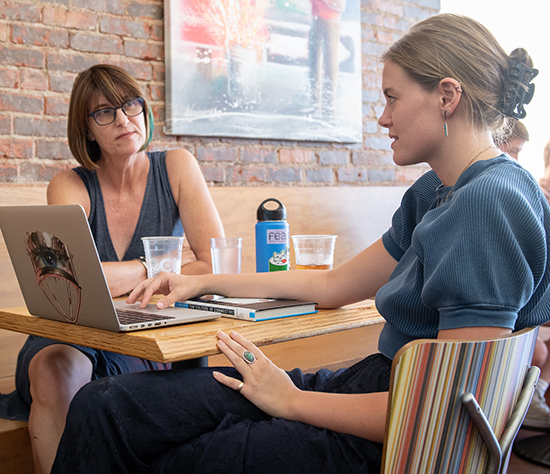
Since moving to Echo Park, she misses the serendipitous neighborhood encounters that once defined daily life in Altadena. “Now it has to be planned. It’s less spontaneous. There’s your circle of friends. But there’s also a community of people whose names you may not know right away, but you know their faces and you travel in the same circles and you have interactions—and that’s missing.”
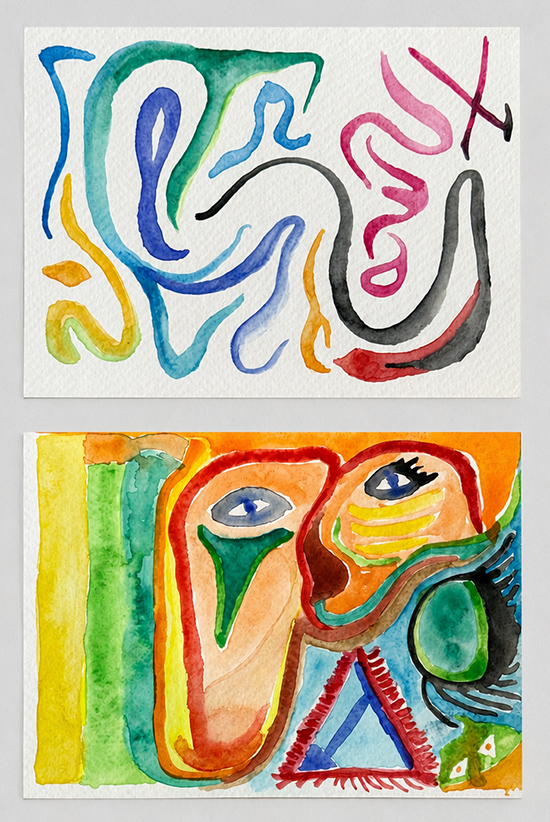
At her new home, she’s building a yard that evokes the feel of its predecessor. “Now there’s some patio space and stairs that go down to the lower part of the yard. I want it to be native and drought-tolerant and have some citrus trees, similar to what I had at my other house. It’s in no way like the other place, but I’m trying to create a beautiful environment.” She’s also found herself painting watercolor postcards and mailing them to friends around the country, another way of reconnecting after the fire.
For Lyford, another source of renewed energy has been the art that has emerged from the tragedy. On May 2 at Des Artistes gallery in Culver City, Lyford moderated an artist panel—including Oxy resident assistant professor and sculptor Camilla Taylor—for the exhibit Post-Fire 1, which featured recent works by 22 Altadena-area artists created after the Eaton Fire.
Over Memorial Day weekend, Lyford attended Field Set, a sound installation and series of sculptural interventions using recordings and materials from the site of Kelly Akashi’s former Altadena home and studio. The exhibit included a life-size rubbing of Akashi’s chimney, Lyford says, “which she thinks of as a sculpture.”
Given everything that’s happened in the last year and a half, is this a good time to be leaving Oxy? “Yes. The main reason I decided to do early retirement is that after my husband died suddenly [in 2017], I really felt like, ‘The future’s now.’ There’s no wait for me ever again. The fire reinscribed this on me. It’s like, I have to do what I’m going to do now and take advantage of it. I want to focus on my research and my writing.”
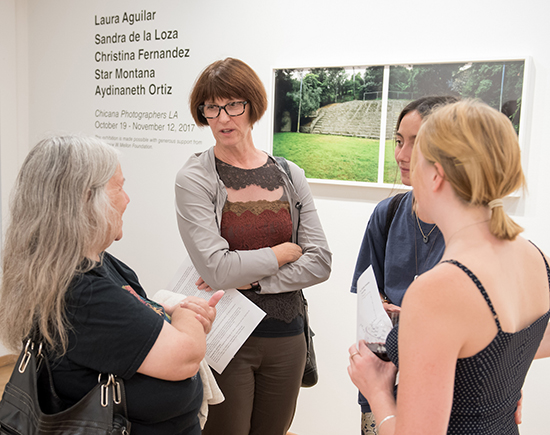
Her next book is about Surrealist photographer Dora Maar (1907-1997), whose innovative work has often been overshadowed by her association with Pablo Picasso. In a successful grant proposal to the National Endowment for the Humanities, Lyford wrote: “Maar’s expressive, unflinching approach enabled her to invent a powerful visual critique of how bodies and social spaces might express alternative gender, class, and identity positions in the 1930s.” Lyford will be reading from the manuscript at the Conference of the International Society for the Study of Surrealism at the University of Glasgow in August.
She also contributed an essay to the exhibition catalog for the High Museum of Art’s exhibit Isamu Noguchi: “I am not a designer,” which opened in April in Atlanta—the artist’s first design retrospective in nearly 25 years. Lyford published Isamu Noguchi’s Modernism: Negotiating Race, Labor, and Nation, 1930-1950 (University of California Press) in 2013.
During her last semester, Lyford taught a class on Surrealism and Women, a 200-level art history course, as well as a first-year seminar titled Photography, Film, and Surrealism—“two courses that were right up my alley,” she says. “I’m happy I got to teach these courses in my final semester. I will definitely miss some of my students.”
Looking ahead, she’s collaborating with Oxy Arts director Meldia Yesayan on an exhibition exploring the friendship between painter Arshile Gorky and sculptor Isamu Noguchi, two artists who worked outside the cultural mainstream. “Their work almost seemed like it was speaking a language that was just between them,” Lyford says. “I’ve never curated an exhibition before, so that’s exciting, and I love collaborating with Meldia.”
She also presented a talk on Gorky and Noguchi at Hauser & Wirth in West Hollywood in April in conjunction with the exhibit Arshile Gorky: Horizon West. After the talk, she says, “Some people came up to me crying because I was talking about how these two artists had to deal with racism, xenophobia, and discrimination.” (Gorky died by suicide in 1948.)
After 27 years in an Oxy classroom, she says, “The detaching process is a very interesting one—not that it’s difficult. I really want to do other things. I want to make my own art. I’m going to start practicing piano again—I haven’t done it since I started teaching at Oxy. I love going to hear live music, so I can go as much as I can and obviously travel for research or fun. I’ve had to grapple with the idea that my time is completely my own.”
One uncertainty still hanging over much of the Altadena community is the resolution of a class-action lawsuit against Southern California Edison, which more than 10,000 plaintiffs have blamed for the 2025 wildfire. Pending a settlement, any plans for her property in Altadena are on hold. Lyford imagines creating a small community-oriented space on the land—a place where people could gather amid gardens and shared greenery.
After the fire, former Occidental colleague Laura Nasrallah (now a professor of religious studies at Yale) sent Lyford postcards and handwritten notes nearly every week for eight months. “It meant a lot to me,” she says. “That’s what got me thinking about the idea of using postcards to reconnect with friends and family across the country.
“While I was grading—maybe this is the perfect image of transition—I was reading student papers and giving comments, and between papers I’d swivel around, paint a quick watercolor postcard, then go back and read the next paper. Making the postcards helped me come back to the papers feeling refreshed.”
“As my chapter at Oxy came to a close, Professor Lyford was right by my side.”
Mckenzie Locke ’23: During Opening Convocation in August 2019, I stumbled into Thorne Hall, confused and slightly overwhelmed by the unexpected size and grandeur of the ceremony. One memory stands out: seeing an art history professor with a fabulous streak of blue in her hair being recognized for her dedication to her teaching and to Oxy. It was Professor Amy Lyford, who was presented with the Janosik-Sterling Award for Service to the College. I didn’t yet know Professor Lyford, but she seemed very cool. I also didn’t know that she would become a foundational presence and a throughline in my time at Oxy.
Early in my first year, I jumped at the opportunity to take Professor Lyford’s CSP course about revolutionary art and muralism in Mexico and the United States. As our relationship grew and I took more classes with her, I was honored when she asked me to assist her with her book, Exquisite Dreams: The Art and Life of Dorothea Tanning. And as my chapter at Oxy came to a close, Professor Lyford was right by my side when I presented my senior comps essay, providing invaluable support until the very end.
I completed my comps under the guidance of Professor Lyford alongside fellow art history major Alex Kawawaki ’23. I will never forget having weekly meetings with the two of them and feeling so grateful to be working on what is often the most stressful project of a student’s time at Oxy with such an incredibly supportive and collaborative team. (I do hope there have been many more art history majors since our class of two.)
In Professor Lyford’s classes, she frequently pushed for her students to have the best possible academic experiences—a meaningful guest speaker, an unexpected field trip, a unifying class project—and she often came up with last-minute ideas for other “happenings” based on suggestions from her students. She even tried to find a way for me to travel to Japan to conduct firsthand research for my comps on site. Beyond her academic generosity, she remained a trusted adviser who always had my back. Her passion for feminist, surrealist, modernist, and dematerialized art—coupled with her honesty, optimism, encouragement, and sincerity—made a lasting impact on me and many others, I’m sure. Thank you always, Professor Lyford.
Mckenzie Locke ’23 is an interior design project manager living in Los Angeles.
“The questions she encouraged students to ask—and the ways of seeing that she cultivated—demonstrate liberal arts at its finest.”
Madeline Wander ’08: When I arrived at Oxy as a student in 2004, I was incredibly fortunate to be placed in Amy Lyford’s first-year seminar “Architecture, Urbanism, and the Politics of Space in Los Angeles.” Even though more than 20 years have passed since I took that class, I know the title by heart as I continue to traverse and take in Los Angeles. This course, or more specifically, Professor Lyford, expanded the very way I think—and launched what became my lifelong passion for urban planning and social justice.
My story is not unique. Professor Lyford’s students walk away from her courses, and their interactions with her, having been challenged and inspired to think critically and capaciously about what they observe in the world. The questions she encouraged students to ask—and the ways of seeing that she cultivated—demonstrate liberal arts at its finest. As Amy turns her attention to new endeavors, may we honor her legacy at Oxy by continuing to ask difficult questions, challenge conventional thinking, and engage the world with the same curiosity, rigor, and creativity that defined her teaching.
Madeline Wander ’08 is an assistant professor of urban and environmental policy at Occidental.
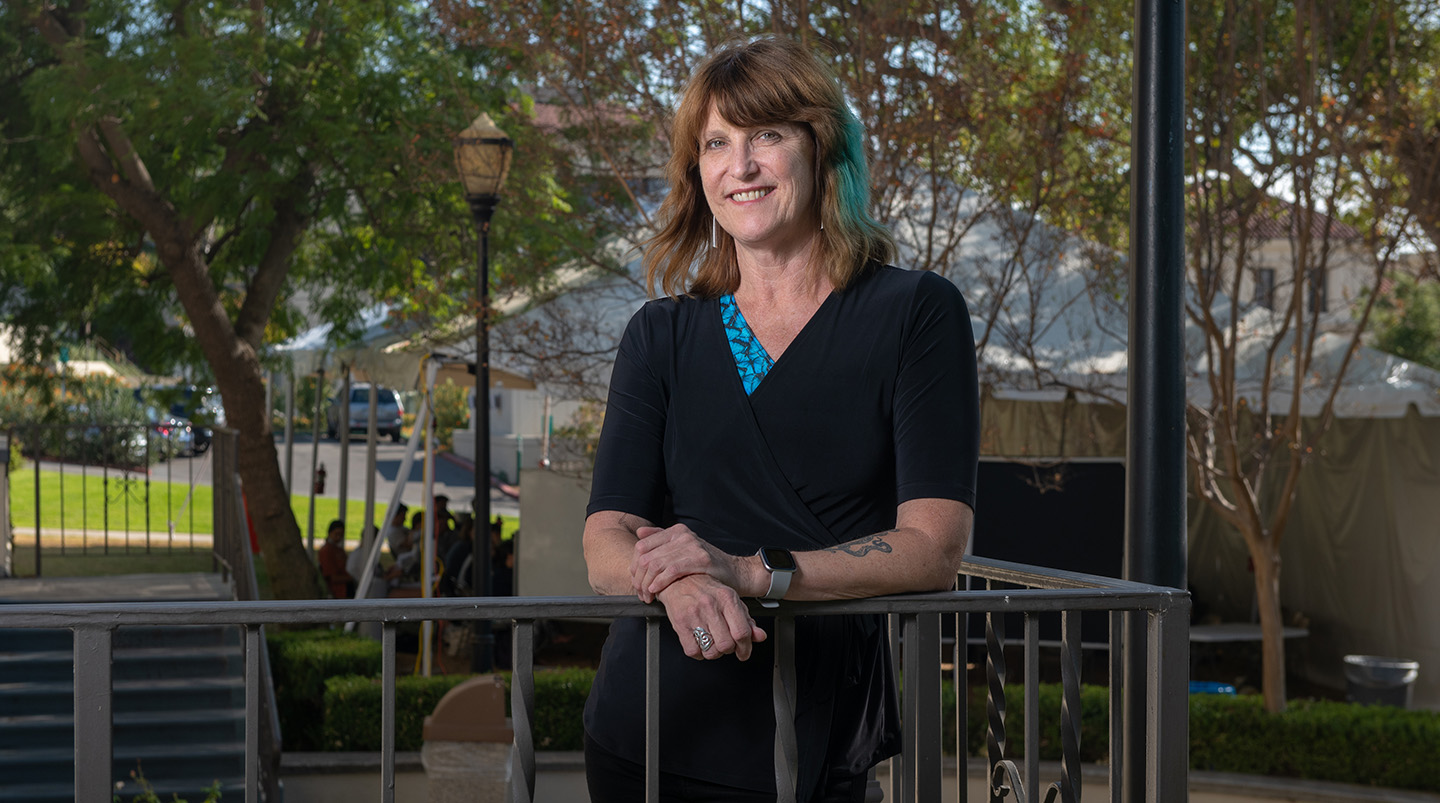
Top photo: Lyford, photographed outside Weingart Hall in October 2021.