After 35 years at Oxy, the politics professor looks back on a career shaped by remarkable mentors, devoted students, and a deep belief in a liberal arts education
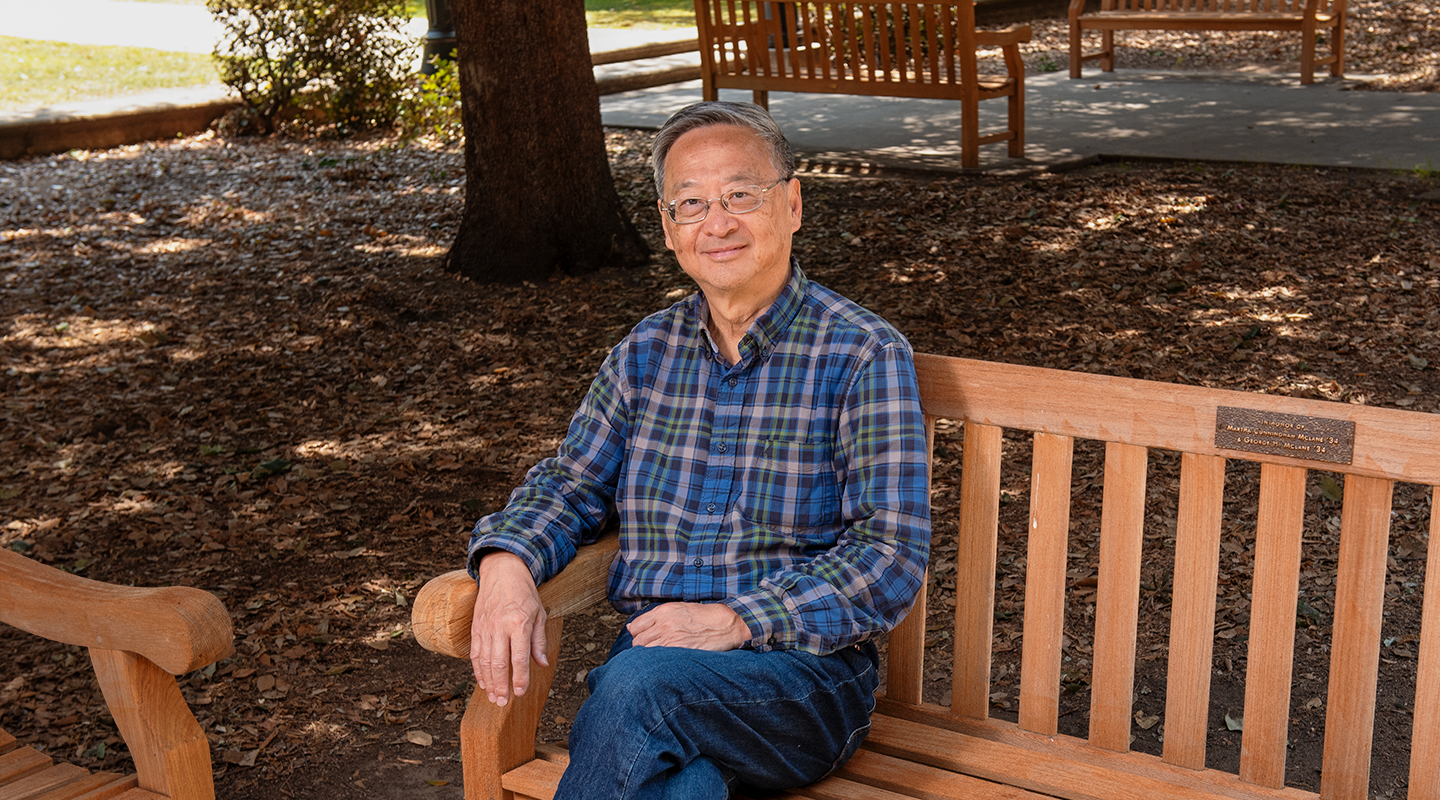
Several years ago, in the middle of the semester, Tsung Chi’s students in his Chinese Politics course gave him a round of applause. “That’s my favorite class to teach,” he says—one that compares the democracies of Taiwan, South Korea, and Japan with China’s one-party state. “For the last 35 years, I’ve taught that class almost every year,” he says.
The spontaneous applause at the end of his lecture took him by surprise. “It was an amazing moment,” Chi says, one that he recalls experiencing only six or seven times in his career. “I hope that’s not self-promoting,” he adds with a smile.
Does he remember what he was talking about?
“No, not at all.”
In his second year of study at National Chengchi University (NCCU) in his native Taiwan, Chi changed his major from applied mathematics to political science. He made lifelong friends in college, many of whom went on to graduate school in the United States. All but Chi eventually returned to Taiwan.
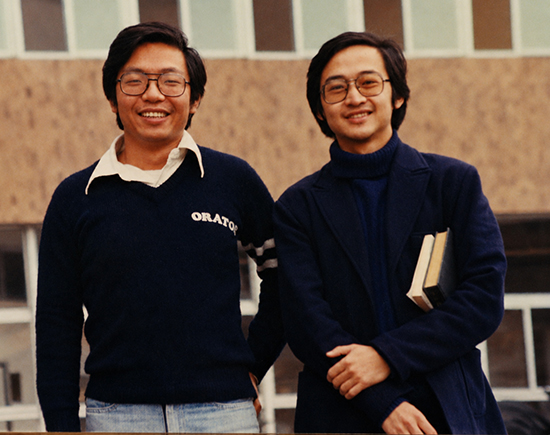
Toward the end of his Ph.D. coursework at Michigan State University in 1991, Chi received three job offers, including a tenure-track position in Occidental’s Politics Department. As a graduate student, he says, “I heard about Occidental from one of my former professors, but I had zero knowledge about liberal arts education.” He chose Oxy over schools in Ohio and Tennessee because “the weather here is unbeatable,” he says. “From the very beginning, I knew I would retire here. It’s a great campus in a great location. And Oxy is family.”
One of the most common definitions of politics is “the authoritative allocation of resources.” That shaped Chi's doctoral dissertation, which compared how China and Taiwan allocate scarce political and educational resources—a question that would remain central to his scholarship for decades.
At Occidental, Chi found mentors in three “giants” of the Politics Department: Roger Boesche, Larry Caldwell, and Jane Jaquette. “I’m grateful for all three of them, especially Larry,” he says.
After receiving tenure in 1998, following Oxy tradition, Chi became chair of the department the next year—and Caldwell gave him a piece of advice that has stayed with him ever since: “You have to leave a mark during your chairship.”
“Every day I thought about that,” Chi says. In the decades that followed, he served three terms as Politics chair and twice as chair of East Asian Studies, as well as master of a residential college in Taiwan. “I’ll always remember Larry’s words: You have to leave a mark when you take some administrative responsibility.”
Of Boesche, Chi says, “Roger was a serious scholar and professor. I learned a lot from him just sitting in his classroom when we were team-teaching.” Occidental typically places an emphasis on interaction between professor and student, but “Roger was unique. He talked continuously during his teaching, like an iconic scholarly figure. His students were mesmerized, and so was I.”
As for Jaquette, he says, “We were very close, and Jane helped me correct my correspondence. English is not my first language, you know, and I was very eager to publish at the time. I learned about writing from her in very specific details.”
By Chi’s estimate, diplomacy and world affairs and East Asian studies majors accounted for maybe half of his students. “I got students from all walks of life—from politics to the sciences to the arts,” he says.
Another “special group,” Chi says, were the students who came to Occidental from China. At the height of the influx of Chinese students nearly a decade ago, perhaps 10-15 percent of the students in his Chinese Politics class were from China. He offered them a window into their homeland and a different perspective on what was happening there. “They were very serious students.”
Chi leaves the Politics Department at a moment of transition. After a period of significant turnover, the department has begun to stabilize, with three new faculty members recruited in the last four years to build a foundation for the future.
“Thank God we have Regina Freer, who’s the cornerstone of the department,” Chi says. “I really admire her leadership.” He’s optimistic about the department’s younger faculty, calling Assistant Professor Isaac Hale ’11, who returned to his alma mater in 2022, “our next-generation leader. It’s a young, growing department.”
Chi’s immediate plans for retirement include traveling and writing. One destination is particularly meaningful: “I want to go back to Agriculture Hall at Michigan State, to the classroom where I began my teaching career 39 years ago—from Agriculture Hall to Johnson Hall at Oxy.”
He also hopes to write something nonacademic for publication: a book-length alternate history of China. He envisions China Without Communism as a thought experiment rooted in his training as both a political scientist and a sinologist, as well as his family history. Chi’s parents fled to Taiwan just before the Communist Revolution in 1949, meaning that without communism, “chances are they would not have met in Taiwan and raised a family there.”
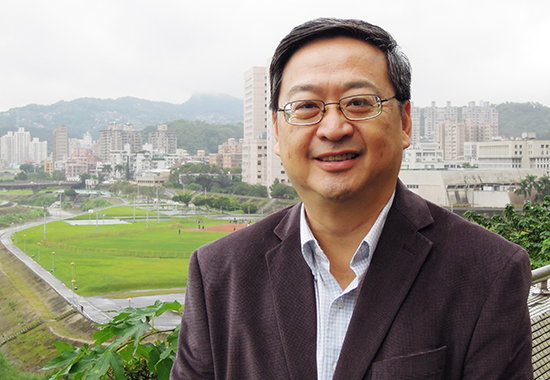
The book would detail a world without the division between China and Taiwan, without the Korean and Vietnam wars, and without the current tensions between the United States and China. “I will begin with a very small piece—a long essay to test the waters before expanding to a book,” he says. “I want to publish it both in Chinese and in English. One of the reasons I want to write the book is to show how I feel about communism.”
Chi’s commitment to liberal arts education extends well beyond the classroom. Looking back at the last 35 years, one of the highlights of his career was the time he spent away from Oxy to establish a residential college at National Chengchi University (NCCU) in Taipei. The Residential College of International Development was an experiment in bringing the liberal arts model to a public research university. Students lived on campus and took general education “core” classes designed to expose them to a wide breadth of ideas and perspectives.
“I left Taiwan in 2014 to return to Occidental, and the experiment was discontinued one year later,” he says. “Oxy was so generous to let me go for four years.” Since then, NCCU has tried similar approaches under a different name, but the program Chi helped establish “just vanished.”
The experience did not diminish his faith in the model he had learned at Occidental. “I had zero knowledge about liberal arts education before coming to Oxy in 1991,” he says. “Now I’m a deep believer. Occidental is the gold standard of liberal arts education and community-based learning. And L.A. is the best location for it.”
“He made an increasingly complicated world feel a little less distant and a great deal more understandable.”
James Steinberger ’25: My friendship with Professor Chi began in the fall of my sophomore year at Occidental, when I took his Contemporary Chinese Politics course. I entered the class leaning toward a politics major, but Russia’s invasion of Ukraine earlier that year had left me searching for a deeper understanding of international affairs. I wasn’t sure I had found the global perspective I was looking for in the politics major. That changed when I took Professor Chi’s class.
Immediately, I was struck by his unique ability to teach the complex and fascinating political landscape of China while drawing connections to the political forces at work in our own society. He showed me that, however different countries may appear, politics is ultimately about how people organize power—their incentives, institutions, and relationships—and that these underlying dynamics are remarkably universal. He made an increasingly complicated world feel a little less distant and a great deal more understandable. I left that class not just with a strong foundation in Chinese politics, but with a deeper appreciation for what it means to be a thoughtful citizen of a global community. That perspective gave me the confidence to spend a semester abroad in Spain, and it continues to shape my desire to engage with the world around me.
When I declared politics as my major and chose Professor Chi as my adviser, his decades of experience at Occidental meant he always seemed to have the perfect course recommendations for me. More importantly, that experience gave him the ability to guide students through the many decisions that define their college journey. When we first discussed my interest in law school, he offered both pragmatic guidance and idealistic encouragement, candidly explaining the challenges of pursuing a legal career while encouraging me to think deeply about the kind of impact I hoped to make through that work. Professor Chi always challenged his students to question not only what happens but why, regardless of whether we were analyzing the decisions of world leaders or reflecting on the choices we make for ourselves. And no matter the paths we ultimately chose, no one celebrated our accomplishments more enthusiastically than he did.
While I am saddened by the void that Professor Chi’s retirement creates at Oxy, I am encouraged that his legacy will live on through the countless students he has inspired to think critically, engage with the world, and become better people. I hope we all continue to carry forward the lessons he taught us and make him proud.
Professor Chi, congratulations on a phenomenal career. I feel immensely fortunate to be able to call you a friend. I’d be hard-pressed to find someone more deserving of a wonderful retirement.
James Steinberger ’25 is a J.D. candidate at UC Berkeley School of Law.
“He’d simply widen the frame until I understood more upon walking out than I had walking in.”
Ty Lyman ’27: I enrolled at Occidental in the fall of 2025 as a 32-year-old transfer student from Pasadena City College, “non-traditional” in nearly every sense of the term. I felt a bit out of place as I crossed the Quad that morning, a foreign entity attempting to navigate to my very first class at Oxy: Contemporary Chinese Politics with Professor Tsung Chi.
China’s history, its hegemonic rise and fall and resurrection, its peculiar political transformation—all these had pulled at my curiosity for years, and this course was my first real chance to wade in. Professor Chi greeted me that morning with a smile unmarked by cynicism, a kind demeanor that made this stranger’s classroom feel like home. He was a man delighted by ideas, tender toward his students and family, and quietly sentimental (a yellow legal pad on his desk still held the scrawled notes from his very first semester of teaching).
His lectures were precise, built with care, but always with room for questions and discussion. His meticulously crafted charts were particularly impressive. To untangle the complex differences and similarities between democracy, totalitarianism, and authoritarianism would usually require an entire textbook chapter, but Professor Chi somehow managed to synthesize it into one slide. Still, he made room for every hand, every tangent, every argument. Office hours with him had no clock. He’d sit with a question, turning it over, for as long as it needed.
My favorite memories live in his office in the corner of the Politics Department, half the books already boxed for retirement, where we argued, gently and frequently, about political theory, history, Jiang Qing, the strange machinery of revolution, and where the world’s contemporary geopolitical rearrangement was taking us. I was wrong more than I’d like to admit, but he never let it sting. He’d simply widen the frame until I understood more upon walking out than I had walking in.
He conveyed his intellect without ego; he was quick with a laugh, quicker with encouragement when it was earned. He carried me through my first year, and it was an honor to sit in his last two classes before he closed out 35 extraordinary years at Oxy. I hope these words return a fraction of what he gave. Congratulations on a remarkable career, Professor Chi. It was an honor to have you as a mentor and teacher.
Ty Lyman ’27 is a politics major from Los Angeles.
“I’ll make sure to do you proud.”
Elliott Jen ’28: Despite initially dreading the 8:30 a.m. time slot of Professor Chi’s East Asian Politics course, I was immediately fascinated and engaged by his inspirational personality and fierce dedication to deepening our understanding of comparative politics. One might expect a retiring professional to ease off the gas somewhat after 35 highly successful years, but he would likely take offense at such a notion. It can be said with certainty that no matter the time or place, Professor Chi is unabashedly himself: a champion for problem-solving and a believer in the future through honest education. I fondly recall his unfiltered yet optimistic teaching style accompanied by light humor (ask him about the long-necked dinosaur drawing), and what seemed like a chore to wake up early for class quickly turned into the best part of my day.
Beyond the classroom, an important connection I share with Professor Chi is our Taiwanese heritage. On the first day of class, when Professor Chi took attendance and called my last name with its authentic Mandarin pronunciation, I was shocked. Although that moment may seem minuscule, it sparked an appreciation and curiosity about my heritage that continues to this day. I admired his ability to remain unbiased yet proud when discussing Taiwan’s political affairs, which further inspired me to continue researching and staying up to date on all things Taiwan.
Even in retirement, Professor Chi will doubtless remain the most influential figure Oxy has ever provided me. His class and advising have rerouted my career pursuits in positive ways and instilled in me a philosophy that emphasizes seeking to understand while remaining humble through it all. Thank you for everything, Professor, and enjoy your retirement. I’ll make sure to do you proud.
Elliott Jen ’28 is a politics major from Sammamish, Washington.