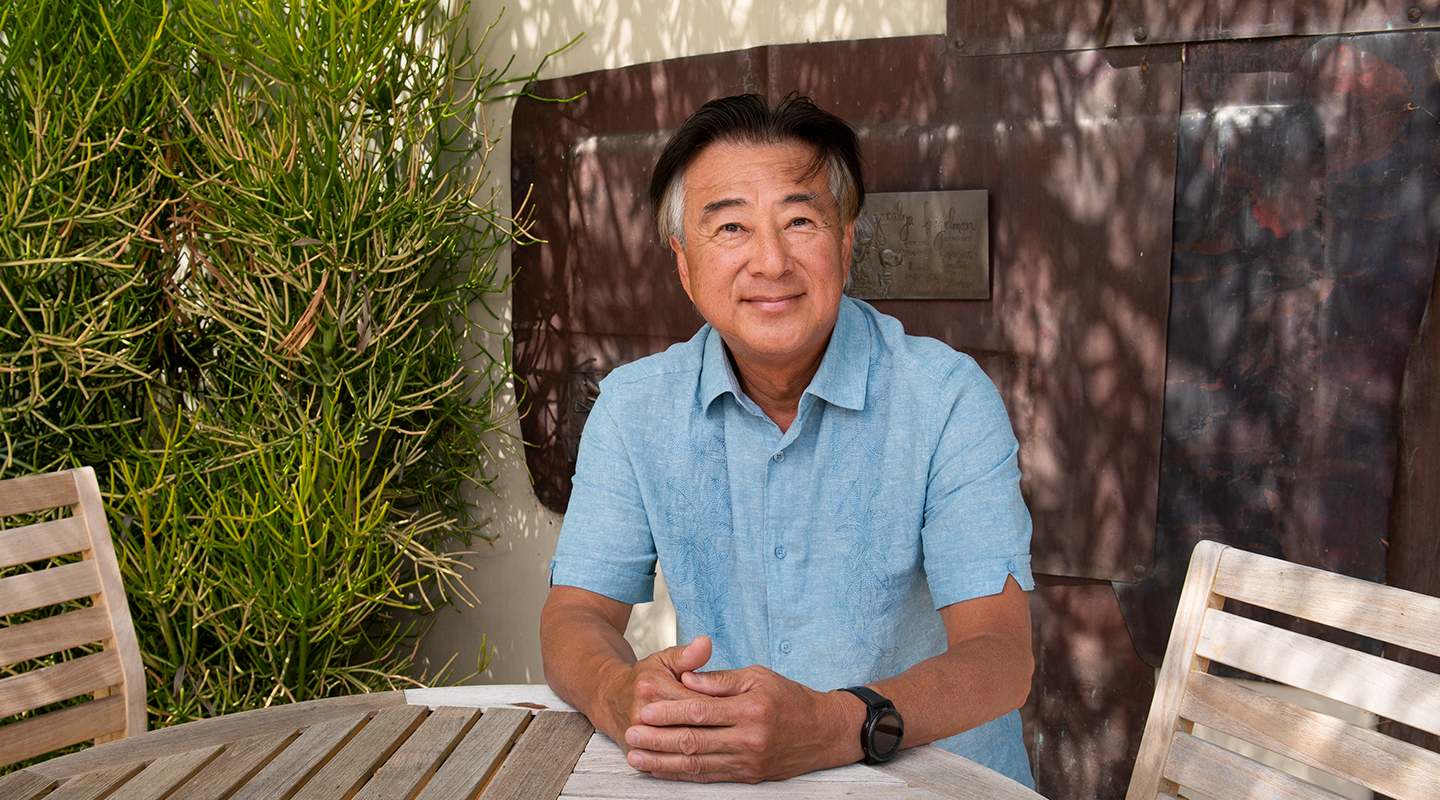
For 28 years, Occidental’s renowned urban and community sociologist has connected the College with its surrounding neighborhoods through research, teaching, and thoughtful partnerships
When Jan Lin first saw a faculty opening in the Sociology Department at Occidental, he had never heard of the College. Yet the position offered exactly what he had been looking for. After teaching at Amherst College and the University of Houston, he wanted to return to a major city without giving up the close relationships with students that define a liberal arts education.
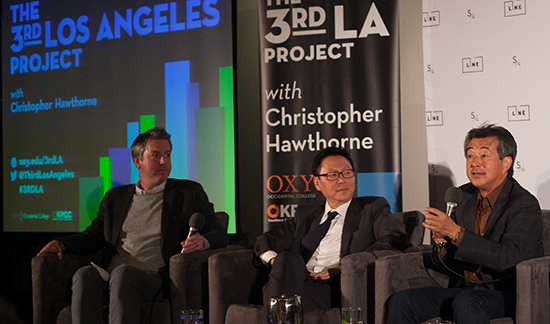
“Coming to Occidental allowed me to combine my past experiences and interests,” Lin says. “I could work at a small college, teach small classes, mentor students closely on their independent research, and still be in a big city.”
For an urban and community sociologist, Los Angeles was more than just a desirable place to live. Its neighborhoods and community organizations offered opportunities for collaborative scholarship that would become a hallmark of Lin’s career, helping him secure government grants while connecting Occidental more deeply with the surrounding community.
Lin has long championed public sociology—the idea that scholarship should engage with the broader community. But earning the trust of Occidental’s neighbors in Northeast Los Angeles took some work.
“In the early days, my community partners would often say, ‘We think the College is an ivory tower—what are you going to do about it?’” he recalls. “That’s why I came to Los Angeles to work at this college.”
His approach to urban sociology draws on anthropology’s ethnographic tradition, emphasizing collaboration with communities rather than treating cities as “laboratories” for research. That approach, Lin says, begins by recognizing the biases researchers inevitably bring to their work.
“It’s about getting them to speak authentically,” he says. “Too easily, there is this kind of implicit bias in the way that we view ethnic, immigrant, deviant, underprivileged, disempowered groups. To get beyond implicit bias means to really understand the voice of the person that you were saying was voiceless.”
Lin’s family immigrated to the United States from Taiwan in 1966, a year after the Hart-Celler Act abolished the old national-origins quota system. “My dad was a research economist,” he says. “I was 4½ when we moved here and I was privileged enough to grow up in the suburbs of Washington, D.C.”
He received a B.A. in anthropology from Williams College, an M.S. in sociology from the London School of Economics and a Ph.D. in sociology from the New School for Social Research. His first book, Reconstructing Chinatown: Ethnic Enclave, Global Change, drew on his dissertation research and won the American Sociological Association’s 1999 Robert Park Award for best book in Community and Urban Sociology.
A decade later, he published The Power of Urban Ethnic Places (Routledge, 2010), an exploration of historic preservation and cultural identity in urban ethnic neighborhoods. Lin examines how grassroots activists, historians, and community organizations fought to preserve ethnic neighborhoods that had long been dismissed as urban blight.
“It’s all about that heritage activity that went on in the 1980s, 1990s, and 2000s: Chinatown history projects, Black history projects, Latino history projects,” he says. “Instead of tearing down these places after they were designated slums, activists said, ‘Try to preserve what you can of the architecture and help build a coherent community around it.’”
Lin is well known for his research on gentrification in Northeast Los Angeles, particularly the complicated role that artists play in neighborhood revitalization. “The arts are an incredible tool for revitalizing communities,” he says. “But after the rents go up and property values increase, the artists are often pushed out.”
Taking Back the Boulevard: Art, Activism, and Gentrification in Los Angeles (NYU Press, 2019) explores the cultural and political dynamics of neighborhoods including Eagle Rock and Highland Park. Lin sees that work—and the community partnerships that informed it—as part of a broader shift at Occidental. When he arrived in 1998, he says, relatively little faculty research was rooted in the surrounding neighborhoods. Today, community-engaged scholarship has become a much more visible part of the College’s identity.
Urban sociology drew Lin to Occidental, but it was the College’s collaborative culture that convinced him he had found the right home. The campus gave him an ideal vantage point for his research, he says, and “I enjoyed having these interdisciplinary, interdepartmental relationships that a small college permits.”
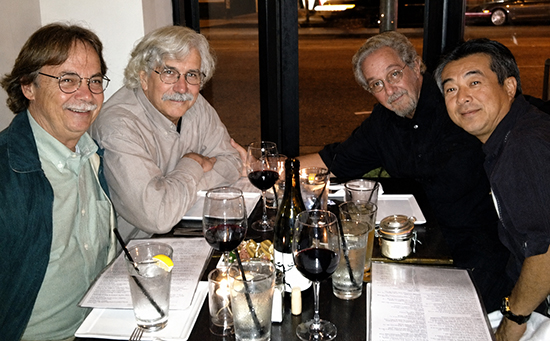
Lin points to his 28-year partnership with sociology colleague Dolores Trevizo as one of the defining relationships of his career. He also collaborated extensively across campus, co-teaching with Raul Villa (English and comparative literary studies), Regina Freer (politics), and Jeremiah Axelrod (history) through the former Institute for the Study of Los Angeles (ISLA). Together, Lin and Axelrod developed courses exploring the history and culture of Northeast Los Angeles and interviewed local business owners, artists, and community leaders for Northeast L.A. Stories, an oral history project published through ISLA.
Soon after arriving at Oxy, Lin secured a three-year, $400,000 grant from the U.S. Department of Housing and Urban Development to serve as principal investigator for the Northeast Los Angeles Community Outreach Partnership Center. Working with Occidental’s Urban and Environmental Policy Institute—including professors Bob Gottlieb, Andrea Brown, and Mark Vallianatos—the Center supported faculty and student projects ranging from community data mapping and business development to environmental and nutrition surveys, regional archival histories, tenant organizing, arts and gardening programs, and youth and adult leadership development.
Gottlieb was an important mentor to Lin. His community-based research created opportunities for students to work alongside faculty during the academic year and over the summer—a model of interdisciplinary, community-engaged scholarship that would shape Lin’s own work.
Lin also found ways to share his classes’ research on gentrification with the broader public. Through a partnership with public television station KCET, Lin and his students published articles documenting the rapid changes reshaping Northeast Los Angeles. When demonstrations against displacement erupted along York Boulevard and North Figueroa Street in 2014, Highland Park emerged as a flashpoint in the citywide debate over gentrification.
Community-based research became a cornerstone of Lin’s teaching, whether through the Center for Community-Based Learning, Education in Action, or senior comps. As the department’s main instructor for Qualitative Research Methods, he taught students to conduct interviews, participant observation, and fieldwork. He recalls the work of Jean Won ’01, who graduated at the top of her class at Eagle Rock High School before conducting archival research as a sociology major at Oxy and presenting her findings to community members.
Beyond teaching and research, Lin devoted countless hours to faculty service, particularly on Occidental’s affirmative action committee, where he pored over applications and helped shape the College’s efforts to recruit a diverse faculty. “I have enjoyed doing that interdepartmental work in my teaching,” he says. “To do it in my service work was also very fulfilling.”
As he transitions into retirement, Lin is putting the finishing touches on his latest book, co-authored with a colleague at the State University of New York. Immigrant Growth Machines: Urban Growth Politics in Koreatown and Monterey Park compares the evolution of the Chinese “ethnoburb” in the San Gabriel Valley with the transformation of Los Angeles’ Koreatown, drawing on Lin’s National Science Foundation-funded research on immigrant-driven urban development. The book will be published in 2027.
Thirty-five years in higher education—28 of them at Occidental—“feels like a full career,” Lin says. Although he expects to remain academically engaged, with plans to consult on a UCLA project examining cultural placemaking and ethnic communities, retirement will give him more time to care for his partner, Nina, who has endured a recent series of health challenges. While the couple still enjoys traveling together, “Nina prefers cruise travel, which we did many times over the years,” he says. “Now we can do Carmel and places closer to home.”
Lin recently bought a 1997 Volkswagen Eurovan camper that he plans to take on camping trips. “It’s not like those vintage Vanagons,” he notes with a laugh. “This one comes a little more equipped, with a fridge and a pop-top. I just really love traveling, and it’s big enough to camp.”
For nearly 15 years until his passing, Lin’s border collie, Guardian, was a fixture around Swan Hall, including departmental open houses and senior receptions. With Guardian leading the way, “I probably sniffed out every little corner of lower campus,” Lin says with a smile. “Guardian loved the students, and the students loved him.”
Lin now has a 7-month-old border collie puppy, a brown merle named Scottie, to accompany him on camping trips in the Eurovan. “When Scottie gets trained enough, I will come back occasionally to show him the campus and for him to love on the students and the students to love on him,” Lin says. “Part of my happiness and sense of fulfillment about this campus isn’t just the research and teaching and service—it was enjoying the campus as a green and beautiful place.”
“Jan Lin was my single greatest cheerleader and encourager over the past two decades.”
Jean Won ’01: I met Professor Jan Lin the first year he taught at Oxy. I was a sophomore who had just decided I wanted to major in sociology, and Professor Lin was an expert in urban sociology. I took every class that he taught, worked on research with him, and he was my academic adviser. Professor Lin was around for some of my most memorable moments in college, from eating his homemade dumplings with my classmates at his house during a senior seminar, to class field trips studying urban enclaves. Professor Lin was a major part of my Oxy experience.
I would be forever grateful for all of this alone and for the ways that Professor Lin encouraged me to pursue my academic interests, but Jan Lin did more than that. Professor Lin was my single greatest cheerleader and encourager over the past two decades. He has written me countless recommendation letters whenever I was applying for numerous programs and experiences. When I decided to become a lawyer, Jan even connected me with a lawyer mentor, who helped me navigate life as a lawyer and judge.
I recently went to Jan’s birthday/retirement party, surrounded by his wonderful friends and family, and I realized how priceless his mentorship to me has been over all these years of knowing him. Jan has always made me feel like I was good enough to succeed at anything, and I knew that I’d always have his support in whatever I did. Jan did more than just teach me sociology in college. He has been an unconditional support in life. Of all the mentors I have encountered over the years, he stands above them all. Jan, I wish you a wonderful retirement. Thank you for making my world a better place.
Won is an administrative law judge for the State of California.