

Photo by Brandon Patoc
Alumni
American Studies
Joy Shigaki turned her lifelong commitment to social justice and community building into a career dedicated to creating inclusive public spaces—and Seattle’s Waterfront Park is her most ambitious project yet.
As the eyes of the soccer community turned to North America for the 2026 FIFA World Cup, Seattle took center stage as one of 11 U.S. host cities. Just a mile away, Waterfront Park hosted free watch parties for 10 matches, drawing a single-day record of 84,767 visitors on June 19—a festive mix of soccer fans and Juneteenth celebrants.
That diversity gets to the heart of Waterfront Park, which has been described as Seattle’s “front porch” since its opening last September.
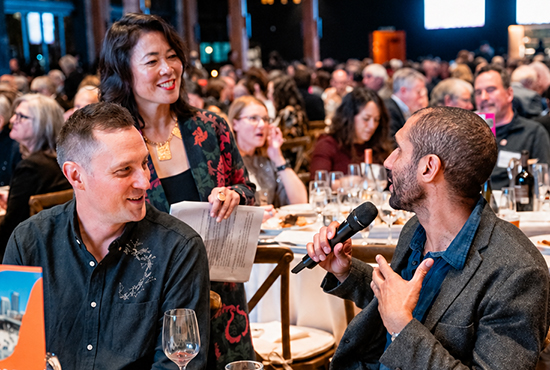
For Joy Shigaki, however, building a beautiful urban park was only the beginning. For the past four years, Shigaki served as president and CEO of the nonprofit Friends of Waterfront Park. With the support of her board, she guided Friends through the completion of a $172 million campaign for the $806 million project while shaping the young organization around partnership, community building, cultural programming, and connection to place.
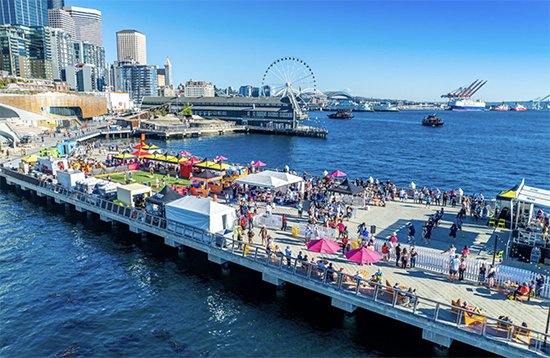
“‘If you build it, they will come’ is a false mantra,” Shigaki says. “The question is, who are you building it for? As cities across the country are investing in new urban parks, how do we create an inclusive, welcoming, and safe public space for locals—especially communities of color and other marginalized groups that don’t always feel that sense of belonging? This is what makes the work of Friends important and relevant.”
Shigaki didn’t set out to create inclusive public spaces. After graduating from Occidental with a degree in American studies, “I wanted to be a social worker to empower young people, and be of service to my community,” she recalls. “Things evolve and opportunities came into my path. I’m very much a big-city person, and one thing that has always been at the center of everything I’ve done is working for social and racial justice and investing in solutions to big-city issues.”
At Oxy, her senior comps examined the Japanese American experience during World War II. Shigaki’s research deepened her understanding of her own family’s and community’s history: Relatives had been forced from their homes and livelihoods in Seattle and spent more than three years and five months at Idaho’s Minidoka War Relocation Center.
“It was so formative to my worldview given the grave injustice, but also the resilience of my ancestors,” says Shigaki, a fourth-generation Japanese American (Yonsei) and Seattleite. “Occidental gave me the space to keep exploring my history and sharing my experience with other students. This included being shaped by other social movements locally and internationally and seeing the connections in our collective struggles for liberation and justice.”
My calling in the world has been about living my values and bringing my unique approach to leadership to a range of generational projects.
Before she returned to Seattle, Shigaki was director of campaign and fundraising initiatives at Golden Gate National Parks Conservancy, raising $103 million for the Presidio Tunnel Tops campaign. Earlier, she spent a decade in senior fundraising leadership roles with the Mayor’s Fund to Advance New York City and Coro New York Leadership Center. She also led the campaign to establish the Wing Luke Museum’s first permanent home.
Waterfront Park is one of the most consequential public spaces in the Emerald City since the construction of Seattle Center for the 1962 World’s Fair. For more than six decades, sweeping views of the Cascade and Olympic mountain ranges, as well as Elliott Bay and Puget Sound, were blocked behind the Alaskan Way Viaduct, a double-decker elevated highway, which literally and figuratively cut off Seattle from its waterfront.
After more than 15 years of public discussion, planning, and design, construction began in 2018. Then the COVID-19 pandemic disrupted the project’s momentum. When Shigaki was named president and CEO of Friends of Waterfront Park in September 2022, a new narrative was needed.
“We had to become storytellers, to capture people’s imagination and help them see themselves in this new space,” she says. That meant showing up at community meetings, business forums, and cultural events. It meant cultivating relationships with local organizations, artists, donors, and residents. And it meant inviting them to help shape the park. The message got through: The park’s opening drew 50,000 people.
“My calling in the world has been about living my values and bringing my unique approach to leadership to a range of generational projects,” she says. “My hope is that I’ve left the places I’ve lived—and the communities within them—better and more deeply connected.”