

Photo by Dennis Drenner
Alumni
Diplomacy & World Affairs
From Tel Aviv and Beirut to Minneapolis and Washington, NPR reporter Kat Lonsdorf follows the news wherever it leads, covering some of the defining stories of our time.
On a recent overseas assignment for NPR, correspondent Kat Lonsdorf and her field team traveled to central Beirut amid a ceasefire in Lebanon. The pause in fighting followed the war’s deadliest day, when Israeli airstrikes on what the Israeli military identified as Hezbollah targets killed more than 350 people across Lebanon in 10 minutes. Lonsdorf spent two days with the family of 26-year-old Zahraa Abboud, who went missing when the apartment building where she had been staying was destroyed in the airstrikes.
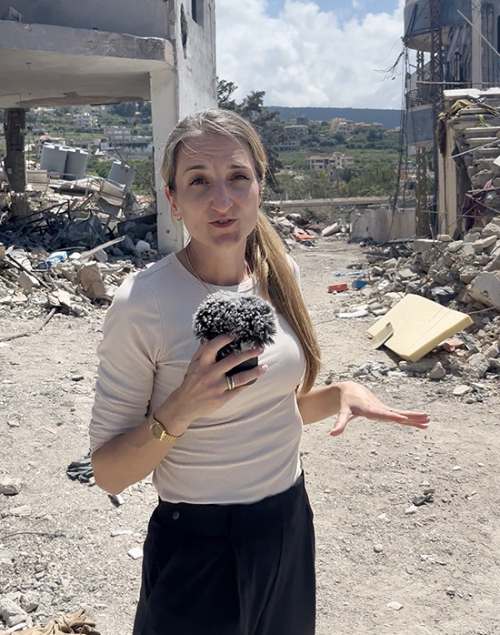
“When we first visit the site five days later, a giant mound of rubble spills onto the sidewalks. It’s littered with broken glass and personal items,” Lonsdorf reported. “There’s stuffed animals, toothbrushes, shoes, backpacks. There’s a couch, a fridge. You can just see little glimpses of all the people’s lives who lived in this building.”
Experiences like this have shaped Lonsdorf’s approach to reporting. “I’m usually sent somewhere where news is happening, and when someone talks to me about one of the worst days of their lives, it’s a huge responsibility to boil it all down to two or three minutes and tell it to our audience,” she says from NPR headquarters in Washington, D.C. “It’s their emotions and their thoughts, and I’m always trying to make sure I do that as best I can.”
Growing up in a tiny town outside Madison, Wisconsin, Lonsdorf applied to Occidental sight unseen. “I was a study-abroad student in Japan in high school, so it’s not like I had never left Wisconsin. But being out of my comfort zone of high school friends and my little town was a lot.
“A lot of the building blocks of my career started at Occidental, even if it was a winding path,” Lonsdorf adds. She majored in diplomacy and world affairs and took journalism courses with Adjunct Assistant Professor Bob Sipchen. “There was no journalism major, but in some ways that was great, because I always tell aspiring journalists that they should focus on something other than journalism.”
Lonsdorf was a freshman in high school when 9/11 happened, sparking an interest in the Middle East “because it was always in the news,” she says. Having learned Japanese in high school, Lonsdorf turned to Arabic in college, taking multiple classes at Occidental and studying at the University of Jordan during a year of study abroad. While most of her time was devoted to intensive Arabic instruction, she explored a region that would eventually become central to her reporting, traveling throughout Jordan, Syria, Egypt, and Qatar. When Lonsdorf returned to campus for her senior year, she secured a yearlong internship with ABC News in L.A., working with producer Julia Seifer ’85.
But graduating into the Great Recession in 2009 made a journalism career seem increasingly out of reach for Lonsdorf. For nearly eight years, she worked in the restaurant industry in downtown Los Angeles, first as a server and later as a bartender.
Lonsdorf now credits those years with sharpening one of her most important reporting skills. “I think that my time working in the service industry has made me a much better reporter,” she says. “I can talk to anybody.”
In the fall of 2015, Lonsdorf enrolled in Northwestern University’s Medill School of Journalism. She received a scholarship, completed the yearlong master’s program, and landed a postgraduate internship at NPR headquarters in Washington, D.C.
After her internship, Lonsdorf spent several months temping before joining All Things Considered as an entry-level producer, where she worked with veteran journalists Ari Shapiro and Mary Louise Kelly. Traveling with them, she watched experienced correspondents ask probing questions and navigate difficult stories with empathy and precision.
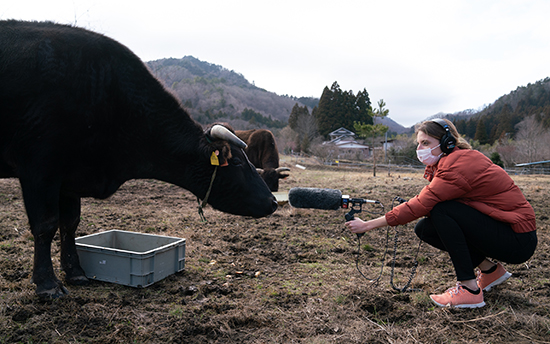
In February 2020, Lonsdorf traveled to Japan as the recipient of NPR’s Above the Fray fellowship, awarded annually to one early-career journalist. She chose to report from Japan’s Fukushima nuclear exclusion zone, examining the area’s long-term recovery after the 2011 earthquake, tsunami, and accompanying nuclear disaster.
“That was a big moment for me,” Lonsdorf says. While reporting from Japan, she covered the country’s early response to the COVID-19 pandemic. After returning to Washington, she says, “I think the newsroom maybe saw me a little bit differently.”
From there, Lonsdorf started getting more opportunities to report internationally. She went to Israel as a producer in 2021 during the Israel-Palestine crisis. When Russia invaded Ukraine the following year, “That was an all-hands-on-deck moment,” Lonsdorf says, “so I was cycling in and out of Ukraine during the first year of the war a lot. I was mostly producing, but then eventually one of those cycles, my bosses said, ‘Do you want to go as a correspondent for a month?’”
In 2024, Lonsdorf moved to Tel Aviv for a year to become a full-time correspondent for NPR to help cover the region. Since returning from the Middle East, Lonsdorf is based in Washington, D.C. She primarily covers a broad mix of domestic stories, including the aftermath of the ICE shootings in Minneapolis earlier this year, with the occasional assignment abroad as news dictates.
Following the flash floods in Central Texas in July 2025 that took 119 lives in Kerr County, Lonsdorf was reporting from Ingram, Texas. While walking around the remains of a trailer park next to the Guadalupe River, Lonsdorf met Sherry Sweeney, who had driven more than five hours overnight to help people find their lost pets. Together, they came upon 71-year-old Cindy McCarthey, a recent widow who was picking through the wreckage of her house looking for her lost cat, Rambo.
“We were there for the moment that we found her lost cat, who was hiding in some nearby wreckage,” Lonsdorf says. “We got the moment on tape that they were reunited, which was really sweet. It’s these little glimmers of happiness in these otherwise dark times that are nice.”