
Main photo by Marc Campos
Student
Computer Science
Mathematics
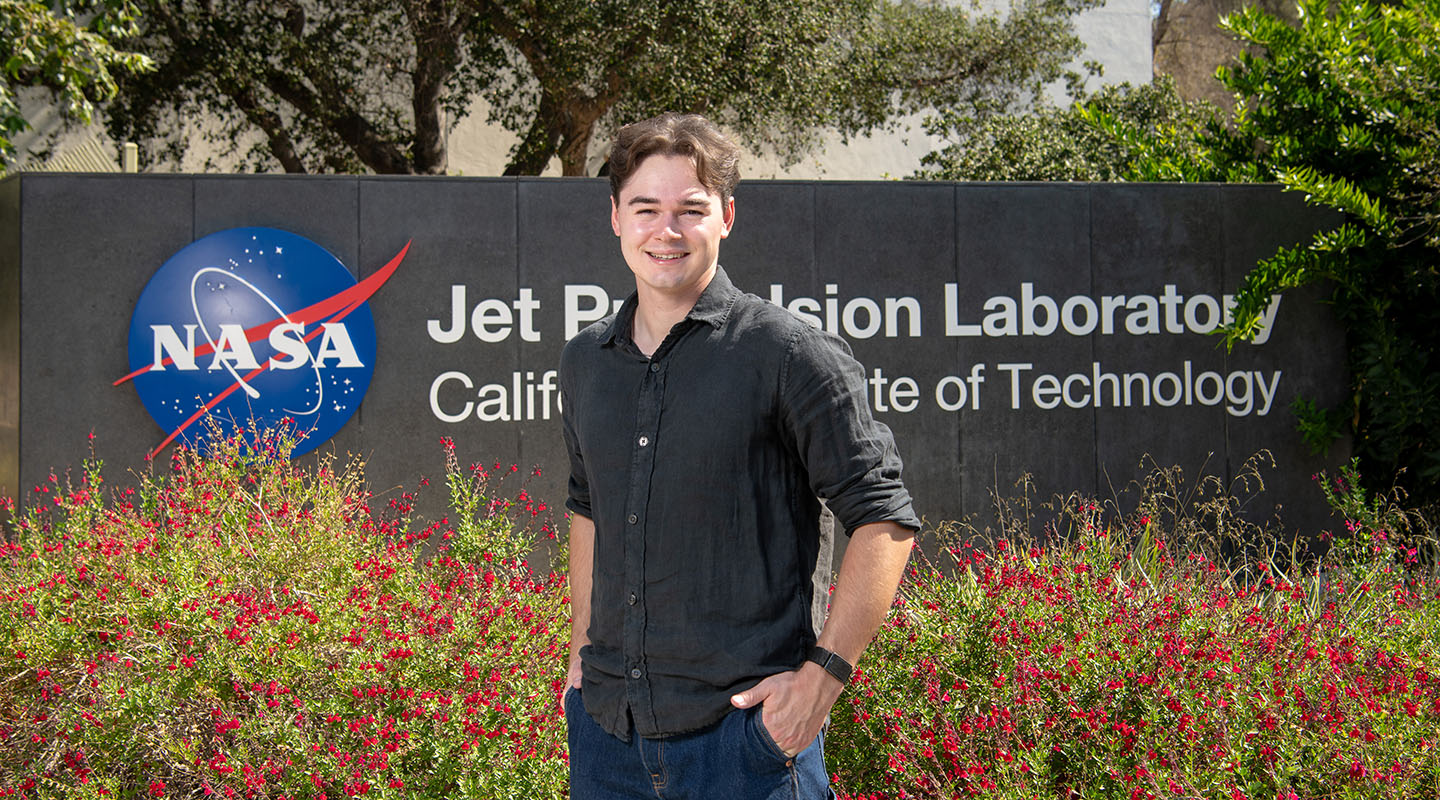
Andy Franck ’27 pursued an Occidental College liberal arts education and close faculty mentorship, opening the door to cutting-edge AI research at NASA’s Jet Propulsion Laboratory well before graduation.
This summer, Andy Franck has spent hours studying satellite images of Earth, searching for something the human eye can’t easily see.
Having earned a coveted internship at NASA’s Jet Propulsion Laboratory (JPL), the rising senior is helping researchers teach computers to detect invisible plumes of methane, nitrogen dioxide, and ammonia using deep learning. Working with data collected by the EMIT instrument aboard the International Space Station, his research could improve how scientists monitor such greenhouse gas emissions around the world.
“If you had told me three years ago that I would be working at NASA,” the Portland native says, “I would’ve said, ‘Are you serious? That’s crazy.’”
But for Andy, a double major in mathematics and computer science with a minor in physics, the path to JPL began long ago. It started in his childhood home, with his math-loving father. “I’d walk past the kitchen table where my Dad was sitting and he’d say, ‘Here, let me show you something cool,’” Andy recalls. “Every day we’d do math together.”
His fascination with the subject eventually expanded into computer science and a love of coding. Prior to Oxy, Andy took a course at Portland State University with Prof. John Lipor called Math Foundations of Machine Learning. Machine learning, Andy soon realized, offered a way to combine theory with impact and solve real-world problems.
Originally recruited to Oxy to play baseball, Andy was also drawn to the College’s small classes. “I wanted a place where I could really have a personal connection with my professors,” he says. “That’s one of the biggest advantages of Oxy. Many of the upper-division classes are super small. I have plenty of friends at other schools who don’t have that connection.”
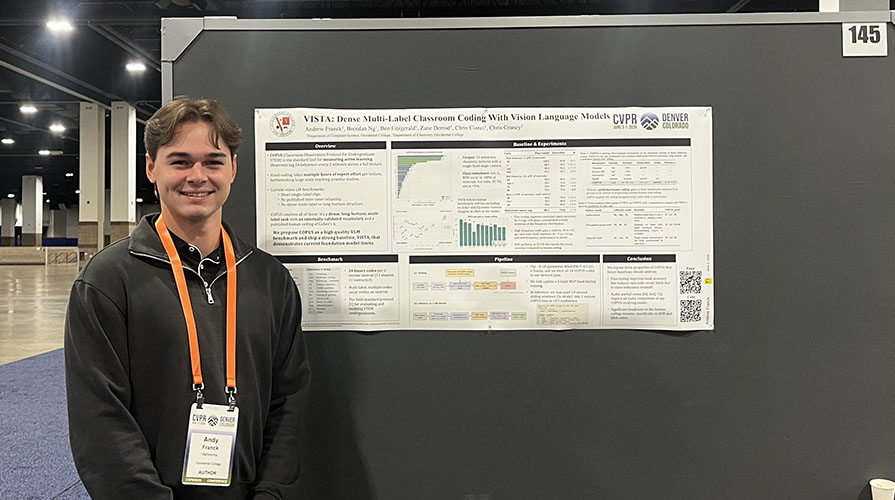
Resident Associate Professor of Mathematics Jeffrey Miller challenged students to pursue their own research questions, while computer science professors Justin Li and Chris Cianci mentored Andy on projects that led to two first-author papers and presentations at major conferences.
Later this summer, Andy will travel to Bremen, Germany, to present research from his senior comps project (completed as a junior) at the International Joint Conferences on Artificial Intelligence. Andy developed a machine learning model that accelerates simulations of neuron behavior, laying the groundwork for future research into real-time simulation and noninvasive anesthesia.
I probably wouldn’t be at JPL if I wasn’t going to college in Los Angeles.
At JPL, unlike many internships, Andy’s role isn’t centered on shadowing researchers. Instead, he arrived with his own research questions. When searching for internships, he says that it was important for him to “find a group that closely aligned with my research interests.”
This summer’s project develops models for new pollutant gases and explores whether these models can identify multiple types of emissions simultaneously.
“People think machine learning is just building models,” Andy says. “But a lot of doing high-quality research is really about the data.” That means spending hours analyzing satellite images, evaluating results, refining algorithms, and working alongside scientists whose expertise continually pushes him to learn.
Studying in Los Angeles has been instrumental in making opportunities like JPL possible. “I probably wouldn’t be at JPL if I wasn’t going to college in Los Angeles,” he admits. Living minutes from one of the world’s leading research institutions allowed him to interview in person and commute from Eagle Rock throughout the summer, connecting his classroom learning with Southern California’s innovation ecosystem.
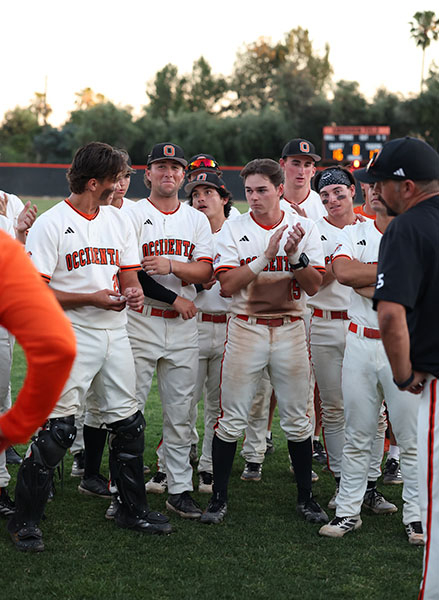
Even with a schedule that includes collaborative research and a demanding double major, Andy remains deeply involved with Oxy baseball as a catcher for the Tigers. He says the friendships he’s built with fellow players are one of the defining aspects of his college experience. “I have 45 teammates and I can say I’m close friends with all of them,” he says. “These are going to be lifelong friends.”
My parents always instilled the idea of doing work that’s really fulfilling. Focusing on problems where you can really have an effect on a wide variety of people is what’s important to me.
As artificial intelligence continues to reshape nearly every industry, Andy hopes his work remains grounded in something larger than the technology itself. Much of his research so far has centered on environmental science and healthcare, fields he believes can improve people’s lives. Whether monitoring greenhouse gas emissions or advancing medical applications of machine learning, he’s motivated by its potential to address meaningful challenges.
“My parents always instilled the idea of doing work that’s really fulfilling,” he says. “Focusing on problems where you can really have an effect on a wide variety of people is what’s important to me.”
After graduating, Andy plans to pursue a Ph.D. in machine learning before continuing into industry research. If this summer at JPL is any indication, he’ll continue looking for ways to teach machines to see what humans can’t, and to use that technology in service of challenges that affect people around the world.