
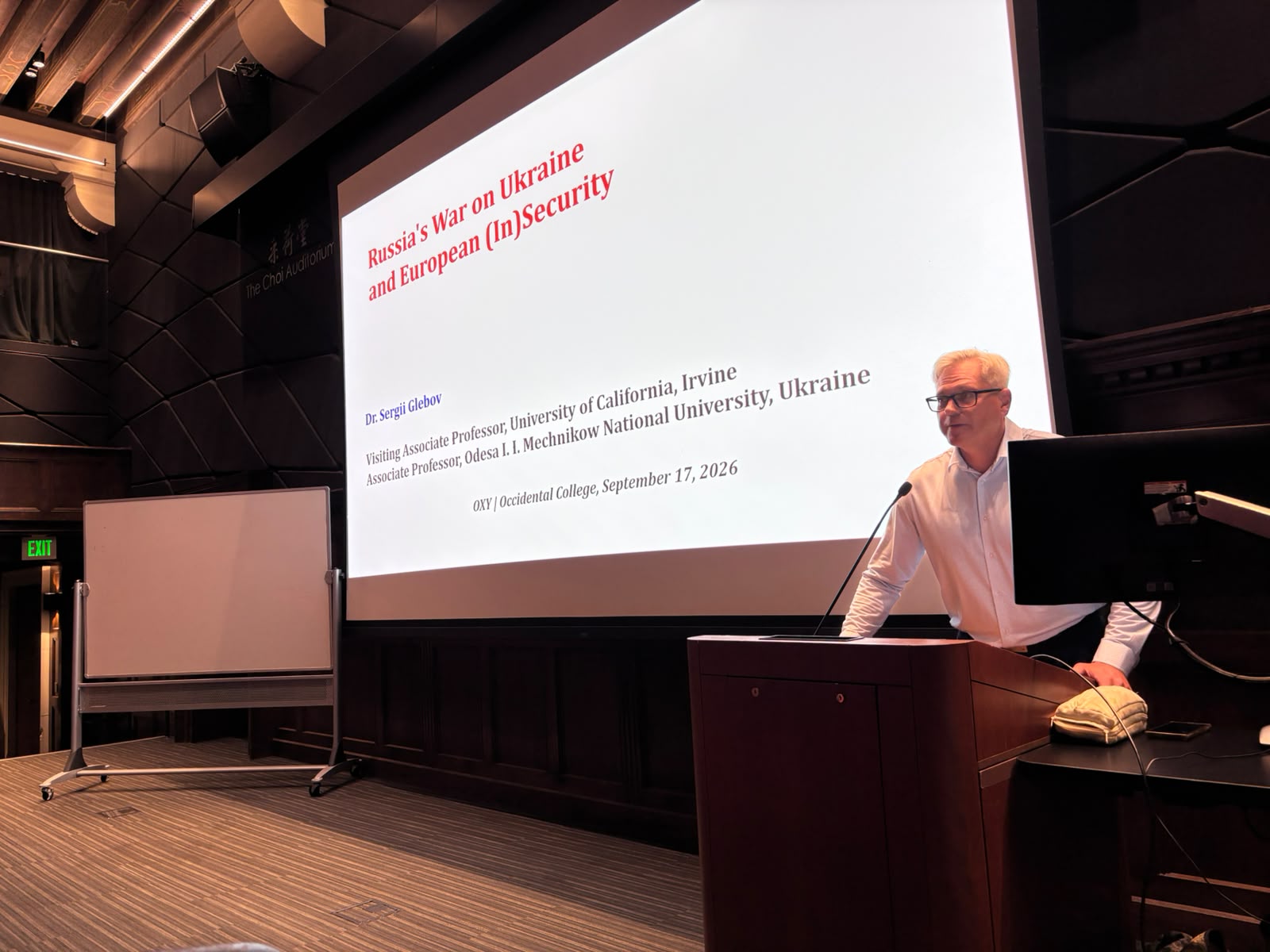
On September 17, 2026, the John Parke Young Initiative welcomed Dr. Sergii Glebov to Choi Auditorium to discuss the Russia-Ukraine war and its implications for European security. Glebov is an Associate Professor at I.I. Mechnikov Odesa National University in Odesa, Ukraine, and a Visiting Professor at UC Irvine through their Scholars at Risk network.
Glebov opened his talk with statements by Poland’s Foreign Minister Radosław Sikorski, reacting to the September 14 Russian drone strike on a Ukrainian train near the Ukraine–Poland border. Sikorski claimed that Russia’s war was not knocking on Europe’s door, but “already in the house.”
The central question Glebov posed for European security was: “Can Europe deter, defend, and remain resilient without reproducing vulnerabilities that made war possible?”
Building on Sikorski’s warning, Glebov argued that the war is both kinetic and hybrid: beyond the fighting in Ukraine, Russia uses attacks on allies, disinformation, and narrative-shaping to “weaken the will to resist.”
Glebov supported his argument by pointing to Russia’s official Foreign Policy Concepts and public rhetoric shifts to illustrate how Russia has slowly become more hostile to the fragility of democratic Western states over time. From viewing itself as having shared norms and culture with Europe, to positioning the Euro-Atlantic region as a direct threat infringing on Russian sovereignty, Glebov argued that this transformation laid the groundwork for war. To describe Russia's long-term strategy against the West, he introduced the term First World Hybrid War (HWW-I).
For Glebov, then, the invasion is not “merely” an attack on Ukraine. Glebov argued that the full-scale invasion exposed a deeper crisis of the post-Cold War security order and Europe's vulnerability to hybrid warfare. As Russia's attacks on the EU escalate—as seen in attacks on Dutch and Polish railways and violations of NATO airspace—Ukraine, in his view, becomes Europe’s strategic frontier rather than an object of European policy.
Glebov closed with forward-looking solutions for the future of European security: a Ukrainian victory, the democratization of Russia’s political system, and a stronger NATO.
When asked about what Russia stands to gain from this war, Glebov asserted that the Kremlin seeks to recreate the Soviet Union, and in some ways, the Russian Empire. Turning to Russian society, he observed that “the most serious and dramatic disappointment of any Russian who supports Putin is when they find out, in theory and practice, that no one wanted to invade Russia. There was no threat at all.”
Throughout the afternoon, Glebov framed the conflict as an existential struggle between democracy and authoritarianism, challenging Occidental students to reckon with the fragility of democratic institutions worldwide.
Next month, the Young Initiative will host Daniel Treisman, co-author of Spin Dictators: The Changing Face of Tyranny in the 21st Century, to continue our public discussions on the global political economy.