
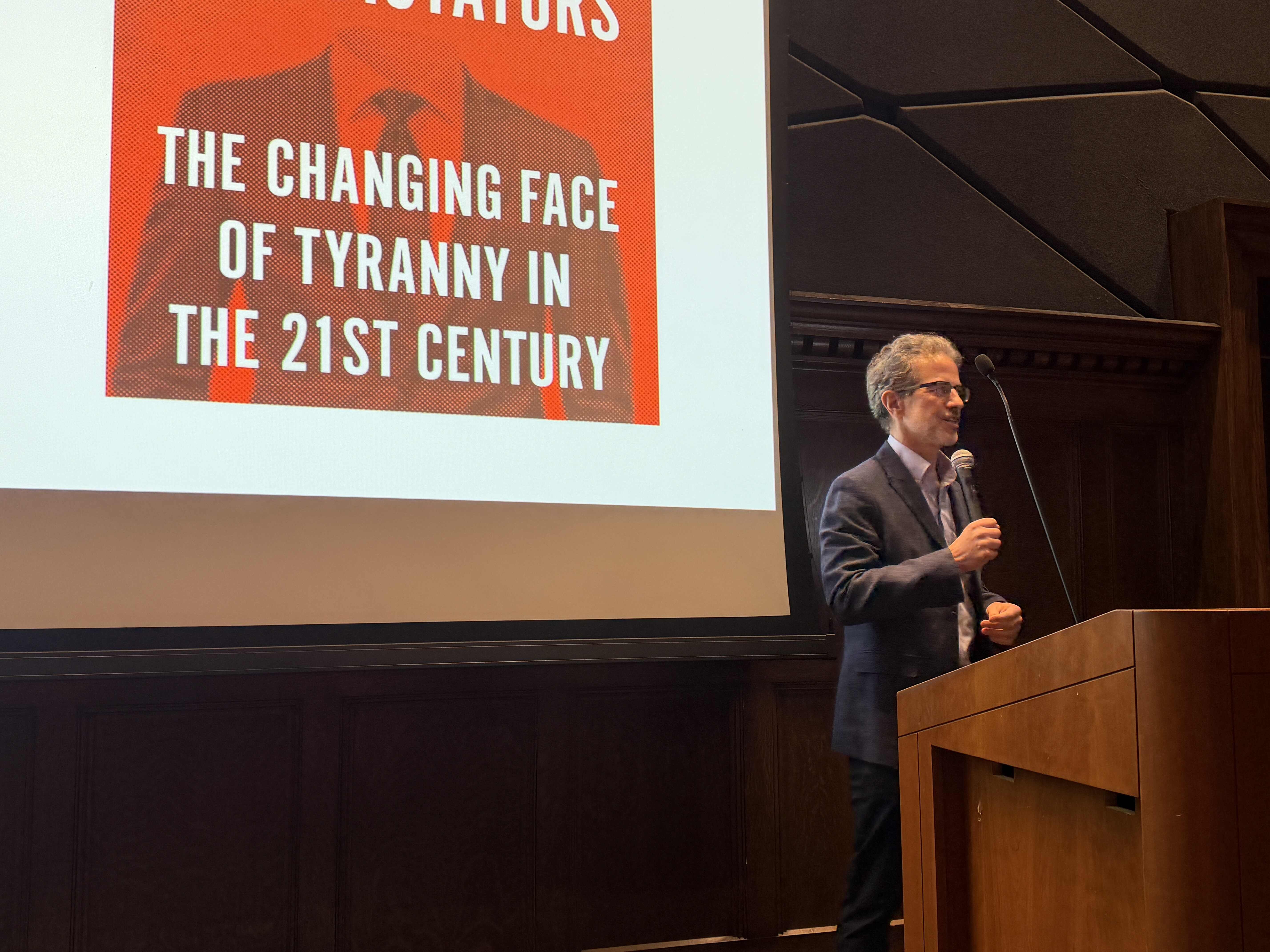
On October 29, 2026, the John Parke Young Initiative hosted UCLA political scientist Dr. Daniel Treisman to discuss Spin Dictators: The Changing Face of Tyranny in the 21st Century. Treisman explained how modern authoritarians trade fear for deception, and reflected on what has changed since the book was published.
What happens when a dictatorship looks like a democracy? This is the question that Treisman sets out to answer in Spin Dictators. On October 29, 2026, the John Parke Young Initiative on the Global Political Economy hosted Dr. Daniel Treisman, professor of political science at UCLA, in Choi Auditorium to discuss the 2022 book he co-authored with economist Sergei Guriev. The dictators of the 20th century, Treisman explained, were driven by ideology and publicizing violence to deter dissent, enforcing comprehensive censorship from book burnings to official bans. As one of his examples, Rafael Trujillo had the corpse of an executed rebel paraded through a province, seated in a chair. But most contemporary dictatorships nowadays don’t operate on this system, but rather a new system where dictators spin truth and control information, creating the illusion of popular sovereignty. They concentrate power just as thoroughly, but they hold elections, claim popular support, conceal their violence, and work to look competent rather than terrifying.
Treisman and Guriev found that spin dictators detain opponents for short spells rather than sending them to labor camps for years, harass opposition candidates rather than banning them, and devote far less of their speeches to violence and far more to economic performance, much like democratic candidates from the United States. Behind the change, Treisman argued, are modernization and globalization. Educated publics, open borders and global media make fear too costly, and thriving economies struggle under censorship. Dictators can stall the pressure toward democracy by co-opting democratic institutions, but when spin fails, they revert to fear. Between 2000 and 2010, Treisman said, Vladimir Putin pretended not to be a dictator at all, allowing opposition parties and hosting elections. But when the going got tough and his power was questioned, Putin reverted to the classic tool of fear to maintain control. Like adding a new threshold to the political spectrum, spin dictatorships can also arise out of a more open democracy, Treisman said, pointing to India under Narendra Modi, where the government has begun to interfere with elections. Spin dictators can lose, too. Treisman pointed to Serbia, where Aleksandar Vučić conceded defeat to a student-led movement just four days before the talk.
Which brought Treisman to the question he put to himself: where did the book get it wrong? Competence, the central claim spin dictators make to their publics, has been devalued, and to many voters expertise now comes across as elitist. Globalization has been increasingly discredited as an idea, even though the world remains deeply global, and global media has moved from outlets like CNN toward platforms like TikTok. Most striking, Treisman said, is the recognition that publics will often reward illiberalism rather than punish it. Then there is technology. Deepfakes and artificial intelligence are new tools for spin whose implications are not yet clear to anyone, and Treisman framed these revisions as part of the authors' ongoing effort to adapt their argument to a changing world.
The Q&A picked up the same threads. Asked about AI, Treisman suggested it favors spin dictators over fear dictators, since governments can plant information for models to train on, and conversations with chatbots may become another tool of surveillance. Asked how Lee Kuan Yew's Singapore fits the framework, he described it as the place where many spin techniques were first discovered, a one-party state that presents itself as a government of good managers rather than one ruling through fear. And asked whether people care who is in charge when the economy is growing, he noted that economic performance works as a heuristic for competence, but that educated, innovative societies are harder to rule with fear. China, where a great deal of innovation coexists with a great deal of fear, remains the puzzle, and one Treisman acknowledged he could not fully explain.
The Young Initiative, alongside the entire Occidental community, was grateful to welcome Dr. Treisman and his research to Oxy.