From Occidental magazine, Winter 2002: As shock and disbelief gave way to courage and resilience, the Oxy community came together in the face of tragedy of the 9/11 attacks
Watching the harrowing images of jetliners exploding into the World Trade Center, Anthony Williams ’02 shook his head and struggled to fathom the unfathomable. “If I saw this in a movie, I wouldn’t be able to take it as fact,” said the kinesiology major from Chicago, “It doesn’t look real. I just don’t know what to do with myself.”
“I’m just now starting to believe it,” said Mark Cummings ’02, whose aunt felt the explosion in her brownstone 10 blocks from the Twin Towers. The economics major from Los Angeles learned of the tragedies in a wake-up call from his father, who was holding a family portrait taken on the World Trade Center observation deck when Mark was 3.
Julia Sitko ’02, a history major from Denver, could think only of reaching classmate and U.N. program participant Minara Mardakhayeva ’02, a diplomacy and world affairs major from Santa Monica Sitko left a frantic message on Mardakhayeva’s cellphone, then another, then a third urgent plea beseeching her friend to call. On the fourth try, Mardakhayeva picked up. Sitting in the Tiger Cooler, a relieved Sitko set her phone on speaker as a handful of students gathered to hear Mardakhayeva’s voice: “It looks like a war out here,” she told her friends back in Eagle Rock.”
For the current generation of Occidental students, most of them too young to have previously experienced their nation in crisis, Sept. 11, 2001, marked the birth of a frightening new era fraught with vulnerability. Williams, Cummings, and Sitko were among the dozens of students who sat in a semicircle around a Tiger Cooler television in the hours after the attacks. The news was grim, the recurrent video footage graphic. Some students cried, while others wondered aloud what could prompt such horror. As was the case with many Oxy students far from home, Sept. 1l started with early morning wake-up calls from friends and relatives. The question was always the same:
“Are you OK?”
In a campuswide community meeting two days later, President Ted Mitchell called on students and employees alike to show “the kind of strong, analytic courage and thoughtful citizenship that is needed most at times of crisis.” “There is little good that we can point to in this tragedy,” he continued, “but I hope that as we think of our own lives, we can find in this week’s events a renewed sense of purpose in our work here and be reassured of the value of that work in building the understanding of ourselves and others that is the foundation for harmonious coexistence, whether in our small community or in the world at large.”
The Oxy community wasted no time heeding Mitchell’s call. On the night of Sept. 13, more than 150 students, employees, and area residents participated in a candlelight vigil that offered prayers for those killed or injured in the attacks, including Capt. Charles F. Burlingame III, the older brother of Brad Burlingame ’74. Charles was in the cockpit of American Airlines Flight 77, the hijacked airliner that crashed into the Pentagon. Vigil participants gave an hour of personal testimonials in front of the Tiger Cooler, then walked to Gilman Memorial Fountain to continue their reflections.
“Seeing everybody here together makes me feel like I’m part of a really special community,” said Nathaniel Deknatel ’02, a history major from Brook-line, Mass. Also speaking was Mohamed “Rali” Badissy ’02, a diplomacy and world affairs major from Seattle. Badissy, who is of Moroccan descent, reminded classmates that most Arab-Americans don’t condone terrorism. “I feel like everybody else—I’m grieving for what’s happened,” Badissy said. “But I’m worried about the power that fear and anger have to make people do unreasonable things, and I realize this is just the beginning.” (He subsequently aired his views in two appearances on the late-night ABC talk show Politically Incorrect, appearing alongside Ali Hasan ’04 of Pueblo, Colo., who has family living in Pakistan.) Following the vigil, Mitchell and Associated Students of Occidental College president Vlad Milev ’03 took part in a “Tiger Talk” on campus radio station KOXY.
On Sept. 14, a multifaith prayer program was held on campus in conjunction with the National Day of Mourning proclaimed by President Bush. Prayers from Buddhist, Muslim, Jewish, Christian, and other traditions were offered. More students than usual visited Herrick Memorial Chapel in the week following the attacks, and 100 students signed up for a new campus club called Students United for Peace, according to Interfaith coordinator Anne Cohen.
Immediately after the attacks, the College posted an online resource page in which nearly 100 alumni in the New York and Washington, D.C., areas listed their names to inform classmates that they were safe. (While a number of graduates in or around the Pentagon and the Twin Towers miraculously escaped injury or death in the Sept. 11 attacks, sculptor Michael Richards—a good friend of Kira Lynn Harris ’85—was one of the more than 4,000 people to die in the attacks that day. Richards worked in a studio on the 92nd floor of the north tower.)
On campus, teach-ins drew hundreds of people to hear analyses by politics professor Derek Shearer, U.S. ambassador to Finland from 1994-97; Larry Caldwell, Cecil H. and Louise Gamble Professor in Political Science; Jane Jaquette, Bertha Harton Orr Professor in the Liberal Arts; and Movindri Reddy, assistant professor of diplomacy and world affairs. In a speech on campus Sept. 27, U.S. Congressman Xavier Becerra urged Americans to seek justice, not revenge: “We have to realize that there will be consequences to everything we do internationally.”
Further Reading
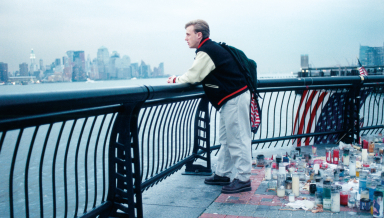 New York Stories
From Winter 2002: The horror, the heroes, and the hole in the sky: Seven Oxy alumni share their tales of the city on 9/11
As a nation readied itself for war in the weeks that followed, a student-organized “peace-in” Sept. 26 gave students the chance to discuss responses to the terrorist attacks “in the name of nonviolence.” And while many professors found students rattled and unable to focus on their studies immediately following the attacks, classroom life has returned to relative normalcy. “I’ve brought it up in the context of class material and students don’t seem to get animated or distressed,” observes psychology professor Nancy Dess. “I guess the happiest view of it is they’ve taken it in stride and gotten past the acute distress.”
To English and comparative literary studies professor Eric Newhall ’67, the campus climate on Sept. 11 was uncannily reminiscent of Nov. 22, 1963—the day President Kennedy was assassinated. “It’s a sense of déjà vu,” said Newhall, who was an Oxy freshman at the time. “For this generation, there’s a sort of innocence that’s been penetrated.”
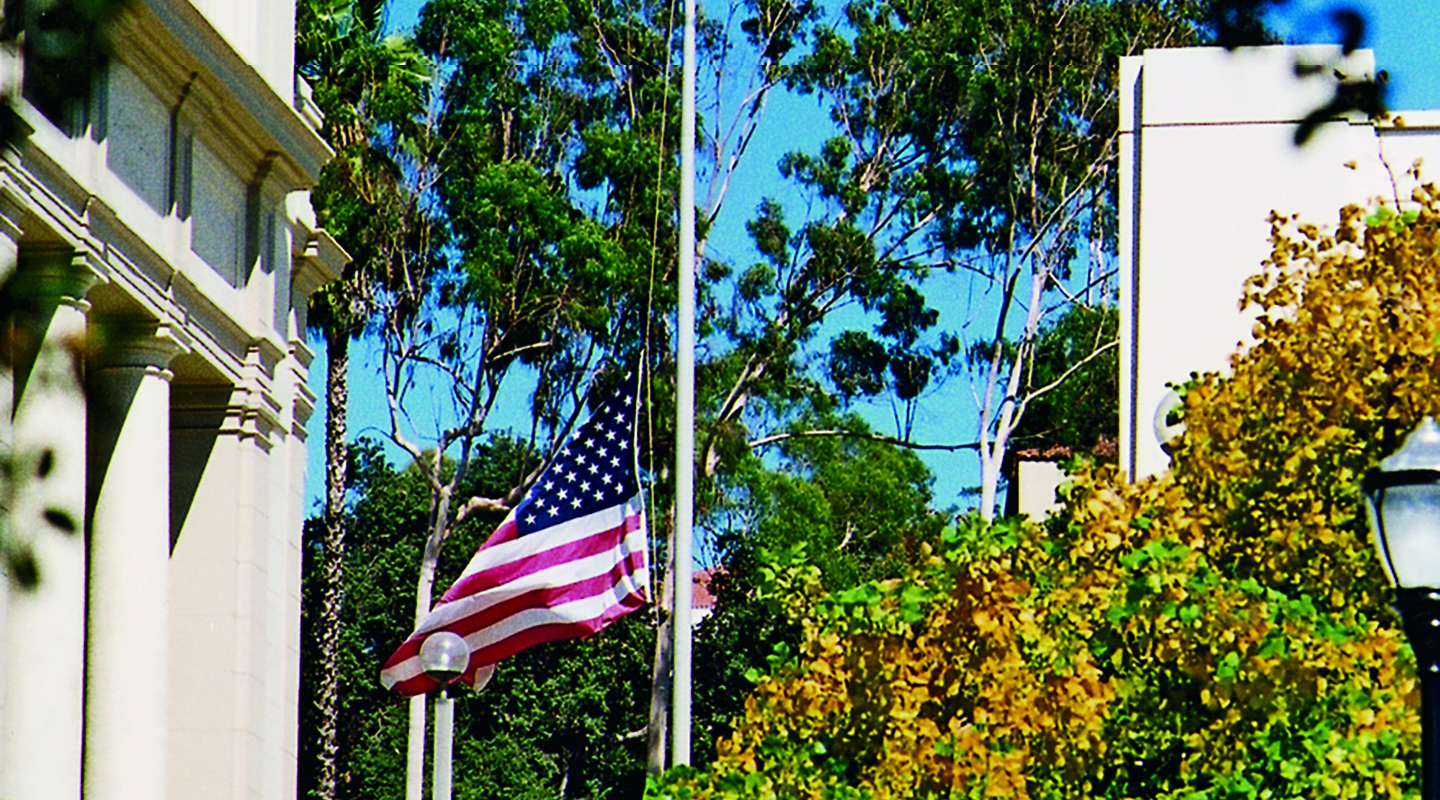
Top photo: By order of President George W. Bush, the American flag flew at half-staff nationwide in the aftermath of 9/11 until Sept. 22, 2001.
Tags