Occidental Chemistry Professor Receives National ACS Award
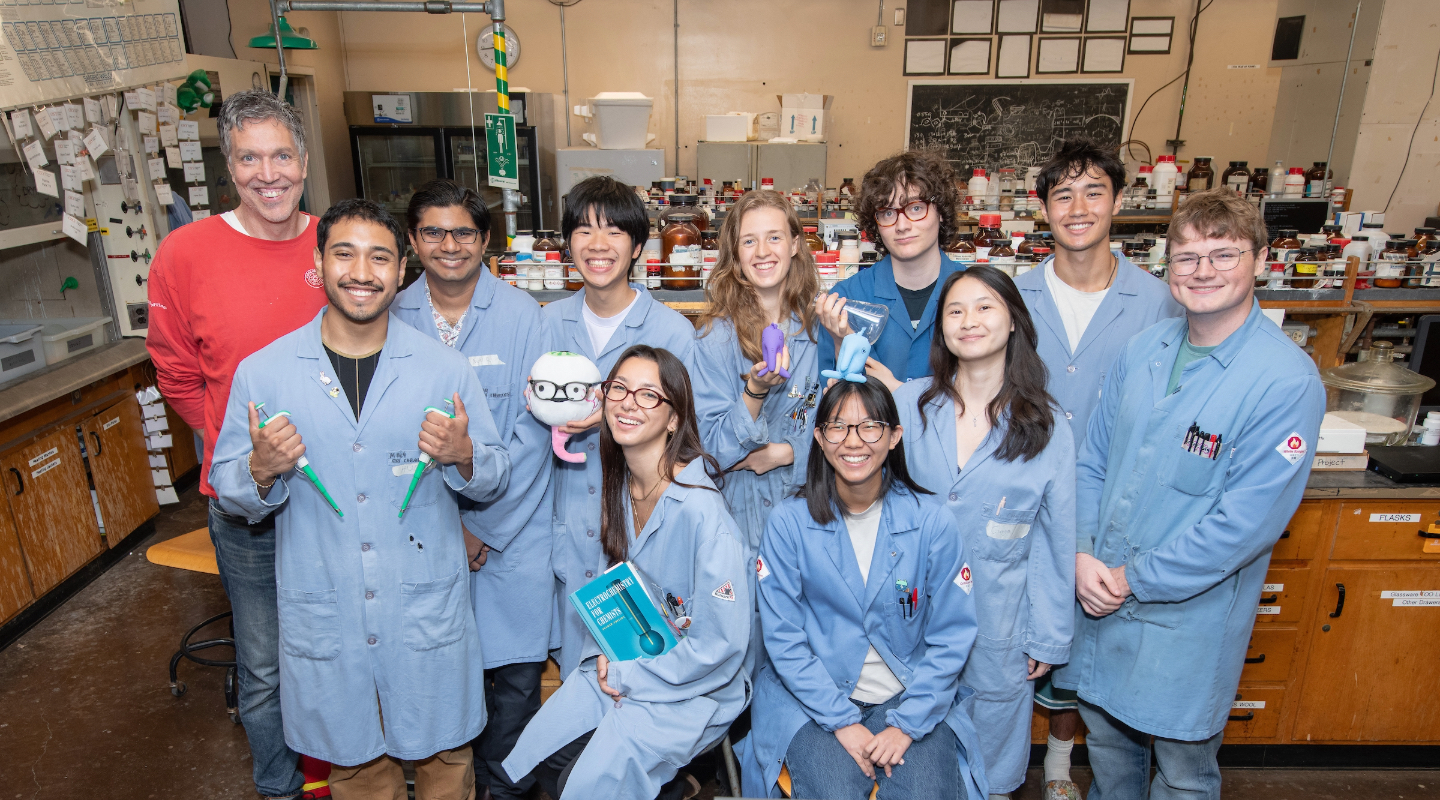
Occidental College Fletcher Jones Foundation Professor of Chemistry Michael G. Hill is the 2027 recipient of the prestigious American Chemical Society (ACS) Award for Research at an Undergraduate Institution.
When Fletcher Jones Foundation Professor of Chemistry Michael G. Hill P ’28 talks about the many students he has worked with on research projects since joining Occidental as a faculty member in 1994, he exudes both joy and pride.
“We have published over 100 papers, and a bunch of students have gone on to great work,” says Hill, sitting in his office, across the hallway from his laboratory in the Norris Hall of Chemistry, which will undergo renovations anticipated to begin in 2027. “My students have always been gracious and supportive of each other, and that’s what makes it fun to come here,” he adds. “That’s what I'm proud of.”
For more than 30 years, Hill has taught general chemistry, inorganic chemistry, and organometallic chemistry at Occidental. His research focuses on electron transfer reaction, which is responsible for photosynthesis and combustion.
As the recipient of the prestigious 2027 American Chemical Society (ACS) Award for Research at an Undergraduate Institution, sponsored by the Research Corporation for Science Advancement, he not only feels thrilled for his department, but also for the College.
Hill is just the second Occidental professor to be awarded the national honor, after Fletcher Jones Professor of Chemistry Emerita Phoeba Dea received it in 2005.
This award signifies that it's possible to do relevant, interesting, and new research work with undergraduates.
“The fact that Oxy’s been represented twice puts us in very rare company,” says Hill. “There's only been a handful of liberal arts schools to have someone win this award, and a smaller set to have multiple people win it. This award signifies that it's possible to do relevant, interesting, and new research work with undergraduates. Research is research.”
Hill and other recipients of 2027 ACS national awards, acknowledging outstanding achievements in chemistry, will be honored at an awards ceremony on March 23, 2027, in conjunction with the ACS Spring 2027 meeting in New Orleans. In 2025, Hill received the Award for Distinguished Creative Activity and Research Mentoring from Occidental’s Undergraduate Research Center.
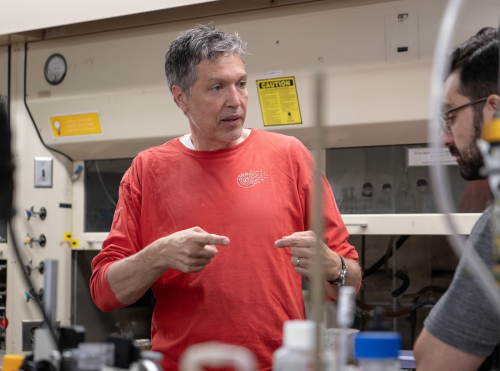
In his laboratory, students explore electrochemistry and photochemistry of transition-metal complexes, small-molecule activation, and bioinorganic catalysis. His team’s work includes the electromechanical reshaping of nose cartilage and of corneal eye tissue as an alternative to LASIK surgery. Hill and his students did their first experiment for this corneal research in 2020.
“Normally the cornea is relatively stiff, and holds a shape and forms a lens,” he says. “We take a platinum contact lens that has the ideal shape for your eye and mount it in a 3D printed device we designed. We put this contact lens on your eye and apply short voltage pulses that induce a chemical reaction to temporarily make the cornea softer. The cornea conforms to the shape of the platinum lens. Once the reaction is over, it stiffens into this new shape.”
For Hill—who started at Occidental after finishing his Ph.D. in inorganic chemistry at the University of Minnesota and then conducting postdoctoral work at Caltech—research includes working collectively, not being afraid to be wrong, and asking important questions.
His students have gone on to careers in science or medicine, as well as other fields. Azam Ahmed ’99 is a neurosurgeon in Madison, Wisconsin. Haley Hill ’04 works as an executive at the Gates Foundation in Seattle. Anna Stokolosa ’18 is a resident in anesthesiology at Cedars-Sinai Medical Center in Los Angeles. Jack Thomas-Colwell ’23 is a Ph.D. chemistry student at Harvard University. H. Tetsuo Uyeda ’96, a scientific investigator at Promega Biosciences, was a student of Hill’s, along with his son Kai Uyeda ’25, a Ph.D. chemical engineering student at UC Santa Barbara.
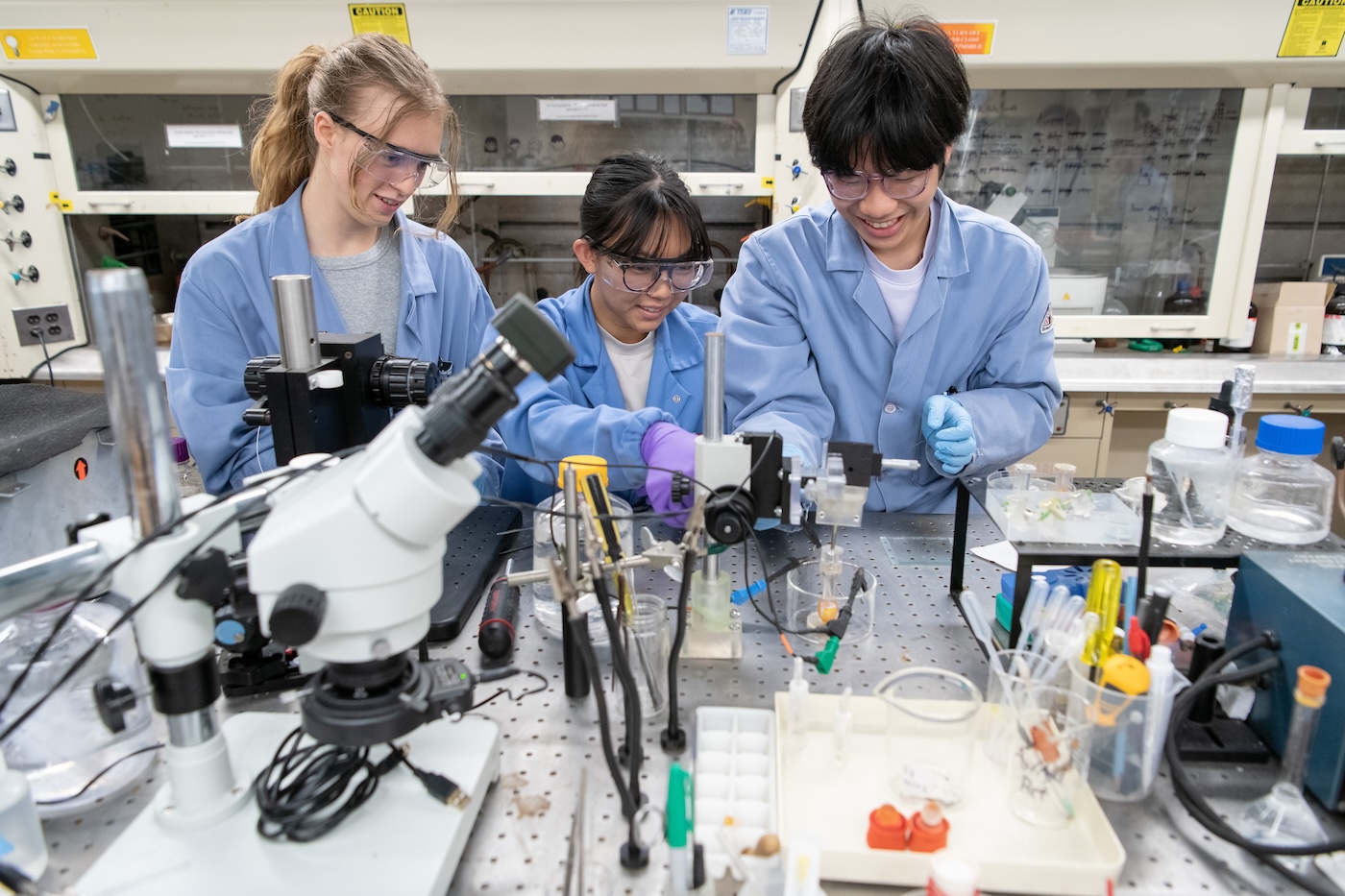
Most of his students started doing research their first year at Occidental, Hill says.
“Basic research is so important, and understanding how science works at a fundamental level,” he says. “As chemists, we study the architecture of molecules. What holds them together? What defines their properties? That fundamental knowledge has made possible all these technologies. Getting involved in research develops a very deeply thinking and curious individual.”
Hill also credits his Occidental Department of Chemistry faculty colleagues—including Professor Chris Craney, late Associate Professor Aram Nerissian, and John Stauffer Professor of Chemistry Andrew K. Udit—as incredible scientists who are instrumental in uplifting undergraduate research.
“In science, the principle of cooperativity—that the sum is greater than the whole—is behind so much of how biological systems work,” Hills says. “That cooperativity and commitment to giving students a good research experience has been a feature of our department.”
Top image—Back row, from left: Occidental Fletcher Jones Foundation Professor of Chemistry Michael G. Hill, with Hugo Alvarez '27, Neel Rangan '29, Damien Chow '28, Skylar Cottell '28, Jackson Birchler '29, Ayden Rieke-Wey '28, and Parker Glynn '27. Front row, from left: Ava Navales '28, Michelle (Mimi) Chen '26, and Cinya Xu '29.
Tags