
Photo by Marc Campos
Faculty
Economics
Alaa Abdelfattah studies the distributional effects of public policy and national economic shocks on local labor markets. She is particularly interested in spatial inequality and the factors that contribute to wage and firm dispersion across space and over time.
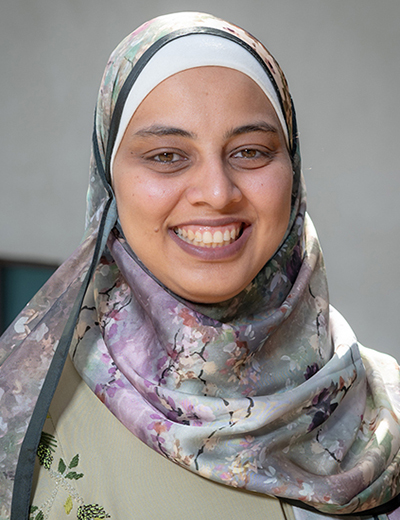
Her recent work studies the effect of large firms’ subsidies on workers’ wages and employment options. In another project, she evaluates the effect of COVID on employer’s skill demand across different markets that were unequally affected by COVID due to their industrial composition. Abdelfattah has a Ph.D. in economics from UC Davis.
What attracted you to Occidental?
I love how diverse and collegial the economics department is at Oxy. I went to Middlebury College in Vermont for undergrad and really enjoyed the experience, so I wanted to work at a place where I can connect with my students in a small classroom environment but step out into a large city at the end of the day.
How did you take an interest in economics, and in your specialty in particular?
I grew up in Cairo, Egypt and lived through the Arab Spring around the time I was heading to college, so I planned to major in economics and politics to be an agent of change for my country. When I got to college I was really sold on economics’ emphasis on causality and the notion that we need to identify the real causes of inequality to address them instead of the band-aid solutions we often apply. So, I abandoned politics, majored in economics and minored in English and American literature and the rest is history.
Why urban economics and wage inequality? Well, anecdotally, in our social circle following the 2011 “revolution” it seemed that a lot of men lost their jobs and women were carrying the torch. This had me thinking that national shocks—whether it be a political upheaval, a pandemic or a financial crisis—could affect different groups differently and, depending on a locality’s demographic composition, different places differently. So, when I got to grad school, I decided to test the theory.
Can you talk about a favorite class you have taught (or are currently teaching) and what students can expect to take away from it?
I am currently teaching two classes, Economics 101 and Urban Economics. Both are fun to teach for different reasons. Economics 101 is often students’ first taste of economics and it’s a privilege to witness students connecting what we are learning in class to their everyday lives whether it is college grants or highway tolls. Urban Economics is fun to teach at Oxy because we get to learn about cities in an interactive way. One task I assign my students is to walk around a neighborhood of their choice in Los Angeles and take note of food, healthcare, and school access options to test the consumer city theory we are learning in class. Another cool aspect of Urban Economics in L.A. is that it easily lends itself to having a diverse group of invited speakers from the Metro or housing authorities to speak to us about how urban economics theory is applied in the field.
Outside of work, what do you enjoy doing in Los Angeles?
I really like walking. For a city, L.A. is incredibly green and the hilly view from around campus is amazing at any time of the day, but especially around sunset, so I like to just walk around and try different restaurants—mostly desserts—I have a sweet tooth.
Anything else you would like to add?
I have had the privilege of living in a few major cities around the world from Cairo to Hong Kong to Boston to Abu Dhabi to Los Angeles. So when I am teaching Urban Economics or the Economics of Inequality, or even Economics 101, I think of it as an exercise in learning about our shared humanity and how the issues we are talking about are not U.S.-specific, they are global issues that manifest differently over time and across space and thus need our collective effort to solve them. I try and remind myself and my students of that by having a canvas in my office that reads: “Ideas that change the world.” That’s what education can do. It can expose us to ideas that change our world by allowing us to see the world differently. It can equip us with the knowledge and tools we need to be generators of ideas that help change the world.