
Photo by Marc Campos
Faculty
Computer Science
Meiqing Zhang’s research draws on computational methods, including machine learning and natural language processing, to study media and politics.
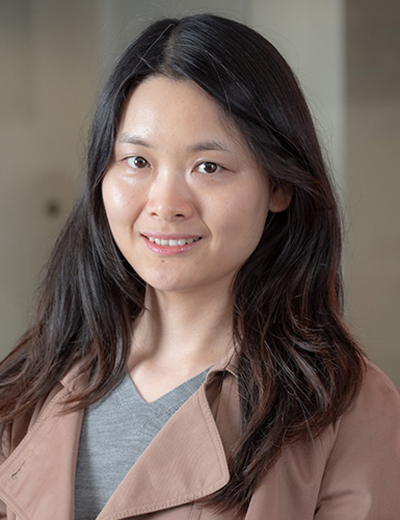
She comes to Oxy from Wesleyan University, where she was a postdoctoral research fellow in computational social science. She has a B.A. from Harbin Engineering University; a master’s from the University of Chicago; and a master’s in computer science and Ph.D. in communication from USC, specializing in political and computational communication. She has taught natural language processing, social data science and machine learning methods in audiovisual analysis.
What attracted you to Occidental?
I have always been drawn to a liberal arts education model, particularly its emphasis on intellectual inquiry and support for connecting scientific and humanistic perspectives. Occidental is distinctive as a small liberal arts college located in a metropolitan area. I also appreciate the Mediterranean architecture of the campus.
How did you take an interest in computer science, and in your specialty in particular?
The logic and problem-solving involved in computer science can be very fun, rewarding, and even aesthetically pleasing. Initially coming from a social science background, I found the challenge and promise of combining computational approaches with social inquiry quite fascinating.
Can you talk about a favorite class you have taught (or are currently teaching) and what students can expect to take away from it?
Last semester I taught natural language processing, a field that has been rapidly evolving. We covered the contemporary state-of-art approaches to NLP, as well as the evolution of techniques leading up to large language models. Students learned NLP with deep learning and the architecture underpinning LLMs, which can be applied to a variety of natural language tasks.
Outside of work, what do you enjoy doing in Los Angeles?
I tend to be spontaneous outside of work. Los Angeles has much to offer through its food, cultural, arts, and sports scenes.