
Photos by Marc Campos
Student
Economics
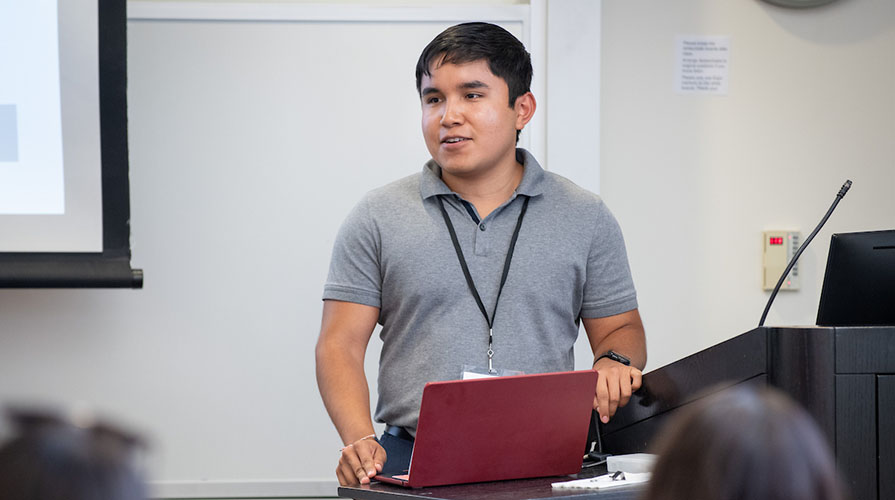
As co-president of the Law Society, Raymond Arias ’26 has spent his college years reimagining what a pre-law club can look like at a small liberal arts college, ensuring it is not only a space for professional development, but also one rooted in connection, access, and shared growth.
At Occidental College, the Law Society now encompasses three main branches—mock trial, moot court, and law review—while also welcoming a broader network of general members who participate in events, workshops, and networking opportunities. For Arias, that openness is intentional. “Being part of Law Society is what you make of it,” he emphasizes, recognizing that students arrive with different levels of interest, experience, and time. Not every member is committed to law school, and that has contributed to a more inclusive environment where students can explore legal studies without pressure.
That sense of belonging is especially evident within the mock trial team, where students with varying degrees of experience have found both a competitive outlet and a close-knit community. In recent years, the team has been competing alongside larger state universities—and holding its own. This spring marked a milestone: the team placed seventh out of 28 at the American Mock Trial Association’s Regional Tournament and advanced to the Open Round Championship Series (ORCS) for the first time in the mock trial team’s three-year history.
I’ve always thrived in community, but also in trying to build it.
For Arias, these accomplishments are part of a larger vision that began when he arrived on campus. Coming out of the pandemic, he and others on the Law Society’s initial executive board recognized that many student organizations had lost momentum due to remote learning. Law Society was one of them. Drawing on his own background in student leadership (he served as a statewide student council president in Oregon and advocated for eliminating extracurricular fees in his school district) Arias stepped up to the challenge of rebuilding.
“I’ve always thrived in community, but also in trying to build it,” he says. At Occidental, that has meant not only reviving existing programs like mock trial, but also expanding opportunities for students with different interests. Under his leadership, moot court gained traction, with student teams simulating an appellate court proceeding after researching and analyzing hypothetical legal cases. Arias also founded the College’s law review program, an ambitious initiative rarely seen at small liberal arts institutions.
Law review, in particular, reflects Arias’s commitment to creating accessible pathways into the legal field. While mock trial and moot court focus on oral advocacy, law review gives students the chance to develop research, writing, and critical thinking skills. Arias designed the program with a strong emphasis on peer learning, establishing an editorial structure and a cohort model that allows students to collaborate closely and receive consistent feedback. As a student representative for Oxy’s Board of Trustees, he’s been able to talk to board members who are attorneys to brainstorm about what else would be useful to implement within the group and get advice.
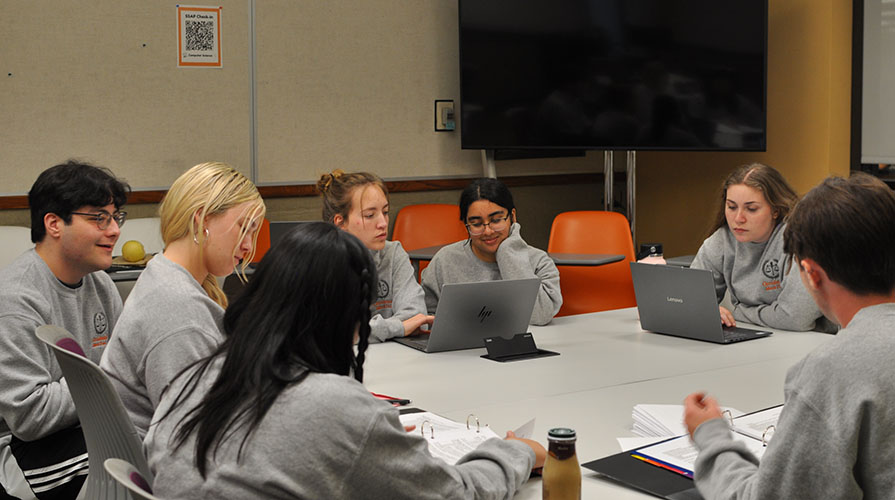
Beyond structured programming, the Law Society connects students with real-world opportunities. Events with alumni, guest speakers, and organizations have opened doors to internships and mentorship. Students have met with guests like Luis Cespedes ’81, California Governor Gavin Newsom’s Judicial Appointments Secretary, and Youth Justice Alliance held an event where student interns were recruited for the L.A. County Public Defender’s office. Workshops, including research sessions led by campus librarians, equip students with practical skills they can carry forward, whether or not they pursue law school.
What motivates Arias to dedicate so much time to the organization is simple: he wants students to feel that their involvement matters. “I’ve always been really intentional about wanting people to get the most out of an activity they’re putting time and effort into,” he says. That philosophy is shaped in part by his own experiences as a first-generation college student, where mentorship from teachers and professors played a crucial role in his journey.
At Occidental, he has found that same encouragement from faculty and has worked to pass it on by building a club that not only prepares students for future careers, but also supports them in the present. Whether through late-night practices, collaborative editing sessions, or conversations at events, Arias has focused on creating a space where students can learn from one another and feel invested in something larger than themselves.
As he prepares to graduate, Arias hopes the foundation he’s built will continue to grow. He credits his mentors and professors for always keeping him going. More than any single accomplishment, his goal has been to create something lasting: a community that future students can join, shape, and carry forward.