
Photo by Marc Campos
Faculty
Black Studies
Tiffany Wheatland-Disu’s research and scholarship bridge the histories of decolonization, Black radicalism, and Black political thought.
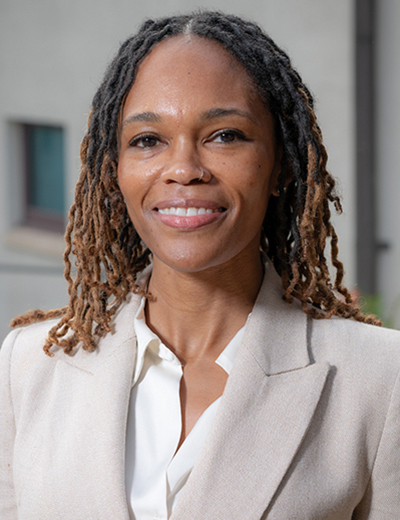
She is the Mellon Postdoctoral Fellow in the History and Culture of the 20th and 21st Century African Diaspora. In 2025, Wheatland-Disu earned her Ph.D. with distinction in History from Howard University where she was awarded several fellowships including the prestigious, Sasakawa Young Leaders Foundation Fellowship. Her dissertation, A History of the All-African People’s Revolutionary Party (A-APRP), 1968-1998: A Pivotal Moment in Black Internationalism, investigates the transnational dimensions of political thought and praxis inspired by Kwame Nkrumah’s 1958 All-African People’s Conference in Accra, Ghana. Previously, she served for more than a decade as a lecturer of Africana studies at John Jay College of Criminal Justice, CUNY in New York City. Beyond the classroom, she has worked extensively in the nonprofit sector, advocating for social justice for underserved immigrant communities of African descent.
What attracted you to Occidental?
I came for a campus visit and was deeply impressed by the intellectual curiosity of Oxy students and the warmth of the faculty and staff. In addition to the dynamism and methodological diversity reflected in the research and scholarship of Black Studies faculty, I was especially drawn to the department’s newness and the prospect of contributing to the shaping of Black Studies at Oxy.
How did you take an interest in economics, and in your specialty in particular?
Pursuing my master’s degree in international affairs at The New School was an intellectually transformative experience which inspired a particular interest in development economics. I received rigorous training under renowned economists including Sakiko Fukuda-Parr, former Director of the United Nations Development Program’s Human Development Reports; Barry Herman, former Senior Advisor on Financing for Development, United Nations Department of Economic and Social Affairs; and Max Fraaud Wolff, economic analyst and writer. This training, interdisciplinary in nature, was integral to refining my conceptions of economic growth, development and human well-being beyond conventional metrics and paradigms—lessons which I seek to impart to my own students.
Much of history is shaped by the choices we make in times of scarcity and abundance alike. The study of economics is therefore fundamental to understanding the complex histories of past and present societies. Nowhere is this better demonstrated than in the field of African history.
Can you talk about the course you taught last semester: Fueling the Green Energy Revolution: The New Scramble for Africa (BLST 212)? What was the impetus for the course, and what do you hope students took away from it?
While living and working in New York City and Washington, DC, I cultivated lasting relationships with individuals and community-based organizations engaged in advocacy on issues ranging from U.S. immigration reform to U.S. foreign policy towards Africa. Inspired by my dear friend, Maurice Carney and his work with Friends of the Congo, I developed a course that engages students in critical analysis of the pivotal role of Africa—the Democratic Republic of the Congo in particular—in fueling the global Green Energy transition.
Today, the DRC possesses an estimated $24 trillion dollars in natural resource wealth, yet the vast majority of Congolese citizens remain impoverished—the outcome of a green energy transition that has intensified the “new scramble" for Africa’s vast mineral wealth. In this class, students are encouraged to consider the centrality of the Congo’s resources to our daily lives, critically interrogate dominant narratives of sustainability, and reimagine more just models of development for all.
Outside of work, what do you enjoy doing in Los Angeles?
Since relocating to California in the fall of 2025, I’ve enjoyed visiting new bookshops, attending documentary film screenings and spending time outdoors soaking up that SoCal sun. Afrobeats and Jazz form the soundtrack to my life and I welcome suggestions for new artists/songs.