

Photos by Marc Campos
Student
Media Arts & Culture
Media Arts & Culture (MAC) major Qingxi Yang ’28 bridges classroom learning with community engagement, collaboration, and public art in Los Angeles through Occidental College’s Education in Action program.
On a sunlit Sunday afternoon on York Boulevard in Highland Park, Qingxi Yang moved through a crowd of artists, neighbors, and passersby, camera in hand, documenting a public art event she had spent months helping to create. After so much planning and coordination, she was relishing the experience of seeing it all come together.
“It was kind of surreal to see, especially after so many email chains and going over each artist's submission so many times and tweaking all the fine details,” she says. “Then it was, ‘oh, this is that piece, this is that artist that I’ve been talking to over email and now I get to go and meet them and see their work’.”
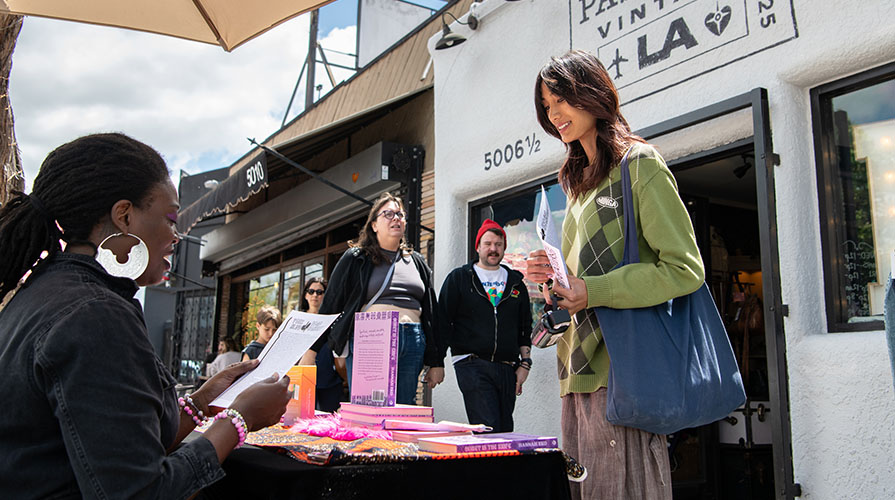
A sophomore, Qingxi is a MAC major (production track) with minors in art history and cognitive science. As a participant in Education in Action (EIA), an innovative program of Oxy’s Center for Community Based Learning, she has had the opportunity to serve as an EIA facilitator. This role allowed Qingxi to shape Oxy courses that extend beyond the classroom, connecting theory and creative practice in real-world settings. Facilitators expand their role as students as they build leadership skills and develop their understanding of social justice and responsibility.
Qingxi’s first experience with EIA came through a MAC course called Remix Media and Culture Jamming. Working as a facilitator alongside Prof. Allison DeFren and the activist duo The Yes Men, she got to explore how art and media can challenge dominant narratives (culture jamming refers to activist tactics to critique, subvert, and otherwise “jam” the workings of consumer and corporate culture). She engaged directly in collaborative, project-based work as the class created its own culture jamming campaign.
“It’s a much more involved and meaningful way to engage with a course to be able to move beyond the classroom and actually collaborate and build relationships with people as part of that education in action,” she says.
This semester, Qingxi again served as a facilitator in a curatorial art history course called Creating a Road Concert: A Public Art Collaborative in Los Angeles with Prof. Stephen van Dyck. Focused on developing and executing a large-scale public art event, course activities ranged from studying socially engaged art practices to actively producing them. The class researched the context of the Highland Park community, collaborated with local partners, and curated work that would respond to the surrounding environment.
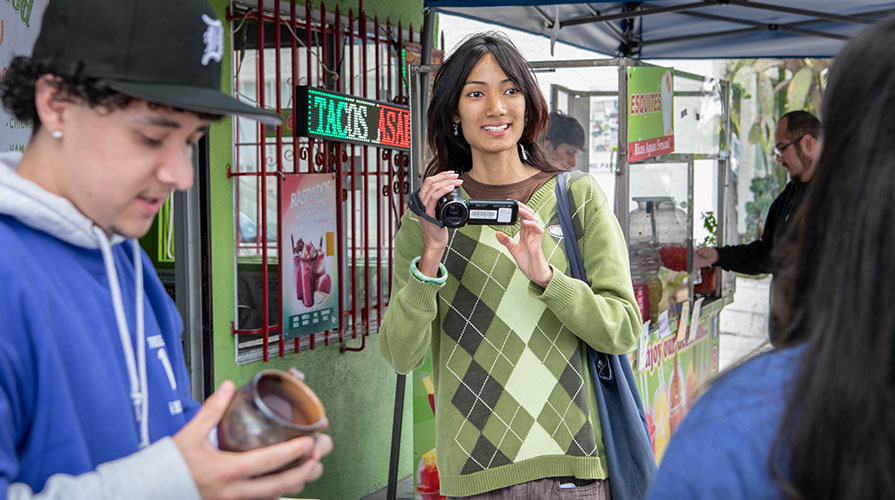
As a facilitator, Qingxi helped coordinate communication between students, faculty, artists, and small businesses, while also contributing as a student in the six-person class. “[Being a facilitator] is distinct from TA-ing because there’s a lot of emphasis on reciprocity and removing the more traditional hierarchy of the classroom,” she explains. Rather than approaching community work as a one-way exchange, the course emphasized shared learning and cultivating long-term relationships.
That approach shaped every stage of the York Boulevard event, which featured more than 40 artists installing and performing works along the street. Qingxi and her peers reviewed submissions, built an interactive map, conducted outreach to local businesses, and worked to ensure the event reflected the social and cultural context of the neighborhood.
“What I love about public art is that it’s accessible for anyone to create their own unique meaning,” Qingxi says. “It’s also about elevating marginalized voices, raising awareness on social issues, and broadening access to the arts.”
The process of developing the event reinforced the importance of thoughtful, community-responsive work that is grounded in research, ongoing dialogue, and an understanding of broader social issues. “It definitely showed me how important it is to create spaces that emphasize reciprocity and transformative collaboration rather than fixed hierarchies and established outcomes,” she says.
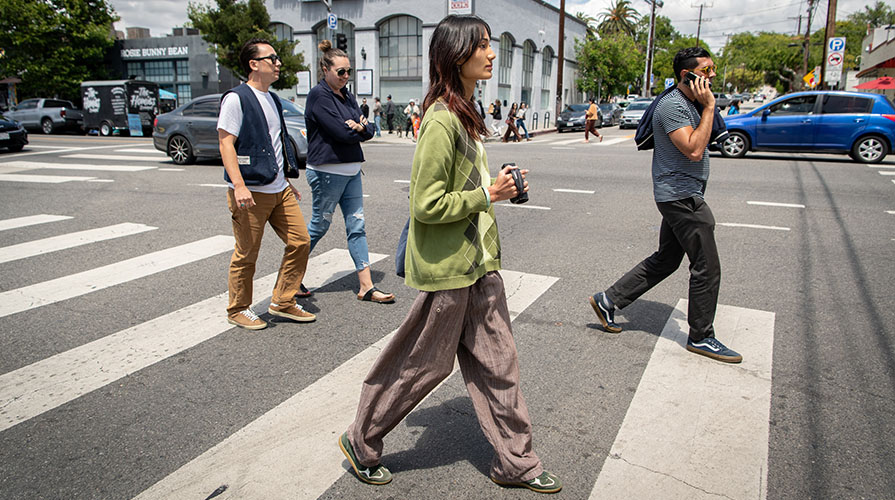
Through EIA, Qingxi has explored how creative practice can intersect with advocacy, access, and community-building. Her experiences across courses, campus organizations, and arts spaces have strengthened her interest in public arts programming, curation, and expanding access to the arts.
“I think it’s really rewarding to be able to build community while also thinking about creating events and programming that are responsive to the community we’re a part of,” she says.
Looking ahead, Qingxi hopes to continue this work of bringing together artists, communities, and ideas in ways that foster connection and shared meaning. If her experience with EIA has taught her anything, it’s the value of approaching that work collaboratively, combining action with reflection.