
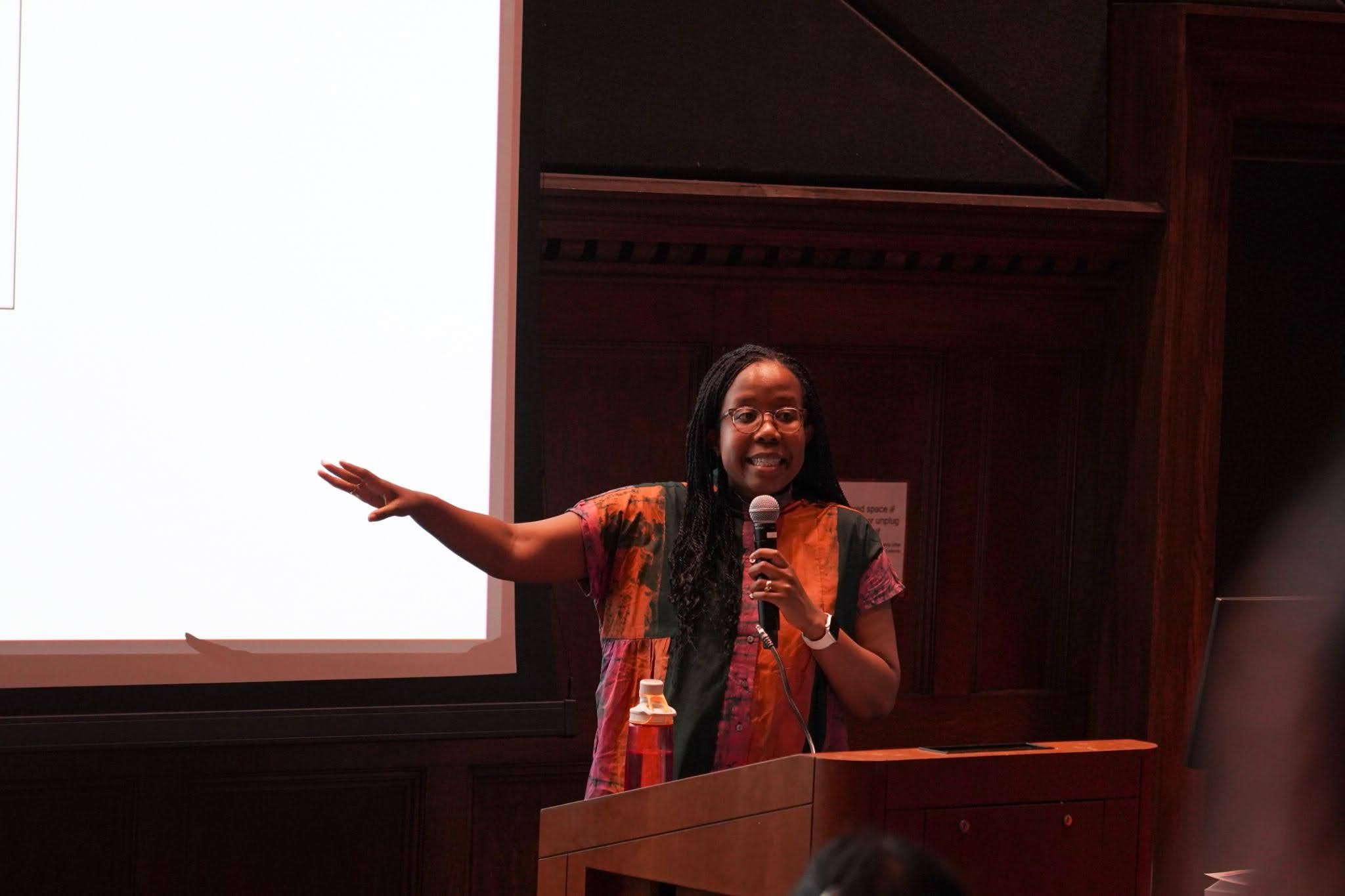
Dr. Kelebogile Zvobgo spoke to an audience on April 7, 2026—eight years after her first visit to Occidental College, at the invitation of Professor Anthony Chase—to discuss her recently published book Governing Truth: NGOs and the Politics of Transitional Justice. Zvobgo opened with a note of both advice and warning for students: the research questions you pursue as an undergraduate can follow you for years. In Zvobgo’s case, a study abroad experience in France during 2012–2013 sparked a scholarly trajectory that culminated in her 2026 publication.
At the heart of Zvobgo’s research is an inquiry about who governs transitional justice. Conventionally, scholars and policymakers have treated governments as the primary architects of post-conflict accountability and guarantees of non-repetition. But Zvobgo challenges that assumption. Governments, she argues, are often not the most motivated actors in these processes; instead, the driving force comes from below and beyond the state: affected communities and civil society organizations.
This reframing shifts transitional justice from a primarily domestic process to a fundamentally transnational one. Drawing on the intellectual foundations of constructivist scholars, Zvobgo situates transitional justice within a global network of advocacy. Domestic civil society groups apply pressure from below, while international NGOs exert influence from above; together, they form what Zvobgo termed a global transitional justice network. Zvobgo introduced the burden-sharing model, which extends the classic understanding of transnational advocacy networks by emphasizing the full lifecycle of policy from mobilization to design to implementation and beyond. It also foregrounds the practical realities of scarce resources; by “burden sharing,” actors maximize impact without duplicating efforts—a dynamic visible across her case studies of Guatemala, Timor-Leste, and South Africa.
In addition to theoretical advancement, Zvobgo spoke to the importance of research design and empirical ambition. Governing Truth introduces the Varieties of Truth Commissions dataset and uses statistical analysis with interviews and focus groups conducted in over a dozen countries to offer robust support for her argument. The book’s contributions aren’t confined to strictly post-conflict settings abroad, as Zvobgo urged the audience to consider the possibility and proliferation of transitional justice initiatives within the United States. Zvobgo noted how California’s Truth and Healing Council on abuses against Indigenous communities, as well as federal proposals like the proposed Truth, Racial Healing, and Transformation framework, signal an important recognition that historical injustices remain unresolved.
The discussion took on an added urgency during the Q&A session, where audience members asked about contemporary crises and the role of civil society in moments when formal political leadership falls short. Zvobgo’s response returned to a core theme of documentation. In contexts where justice may be delayed or obstructed, the work of recording abuses—preserving testimonies, archiving evidence, etc—becomes essential groundwork for future accountability. Transitional justice, in this sense, is not only retrospective but also proactive. The impact of today’s activism may not be realized immediately; as Zvobgo noted, the pursuit of truth and justice often spans generations, sustained by the belief that conditions can improve.
These research implications raise a crucial point: transitional justice isn’t only for “other countries.” Zvobgo noted that part of her project is to “put established democracies in their place,” as even states that pride themselves on robust democratic governance can exhibit weak accountability mechanisms, particularly when confronting systemic or ongoing rights violations. For students of global political economy, Zvobgo’s intervention carries broader significance, challenging state-centric frameworks and highlighting the catalytic capacity of non-state actors operating across borders. In doing so, Zvobgo invited a reconsideration of how power, legitimacy, and accountability are organized in the international system.