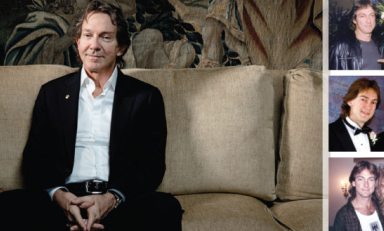
Larry Layne ’71 came to love rugby as a student-athlete—and an estate gift will provide a swift kick to its future at Oxy
Of the countless social gatherings he organized over his lifetime, Larry Layne ’71 may be best remembered for his legendary opening day outings to Dodger Stadium—a ritual that was born during his time at Oxy sitting in the cheap seats at Chavez Ravine with his rugby buddies. In decades to follow, the guest list grew to encompass hundreds of acquaintances from every facet of his life: athletes, artists, politicians, and more. That tradition became so ingrained that the Los Angeles Times reported on the 1999 gathering when Larry had to miss his own party because he had flown to England to help his fiancée, Sheelagh Boyd, with her move to the United States.
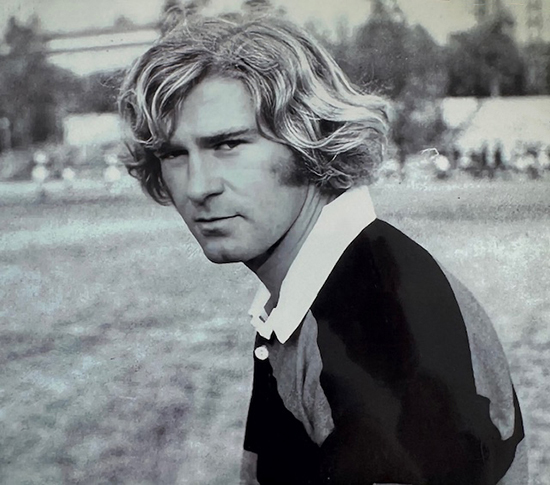
The couple met a few years earlier, when Sheelagh—who at the time was a surgical pathologist living in Nottingham—was visiting the United States with a couple of friends. To give her traveling companions some time alone, she signed up for a 229-mile bike trip from Eureka down to San Francisco.
When the cyclists gathered for a casual meet-and-greet the night before setting off together, “Larry turned up with a tray of the most incredible appetizers that I have ever seen,” Sheelagh recalls. “Nobody ever does anything like that. How he got them from L.A. up to Eureka, I do not know. I remember thinking, ‘Gosh, this is an unusual guy.’”
On the first day of cycling, she says, “The signpost had been knocked down so I was not sure which way to go. But Larry, who absolutely loved paper maps all his life, was standing at the junction with a map in his hands and saved the day. I didn’t even realize that it was the same person with the appetizers, but he was basically cutting the next five miles off the route. There’s no way he was going to do three sides to a square if he could go right across it. He knew the shortcuts. And that’s how I met Larry.”
Sheelagh soon became familiar with Larry’s love of all sports, rugby foremost among them. As it happened, “I was always a rugby fan”—it’s a big sport in her native Ireland—“and my father would have played a lot of rugby in his day,” she says.
“Larry loved bringing people together,” says John Engle ’72. “Of course, the number of people he most liked to bring together was 15—as in a rugby side.”
“Whether it was through some fraternity guys or other people he met right off the bat, Larry’s interest in rugby started because he went to Oxy,” says his brother, Steve Layne. “Occidental had a really good program.”
In April, the College announced a more than $9 million planned gift from the Larry Layne Trust. Of that total, 30 percent will be designated for a rugby endowment that will ensure that Oxy will have the resources to field a robust rugby program in perpetuity. (In a celebration befitting its namesake, the gift will be recognized in conjunction with the inaugural Larry Layne ’71 Athletic Achievement Award at Homecoming & Family Weekend in October.) It’s his ultimate gesture to the College—bridging the past, present, and future of the sport he loved most.
Larry’s talent for organization manifested itself during his days as a student at Sylmar High School, where he was captain of the football team and student body president his senior year. With roughly half the enrollment of its rivals, “We got our butts kicked in high school,” he told Edgar Hirst in 2023—and to make matters worse, “We also had the only football field in the entire valley that did not have lights, so we had to play day games.”
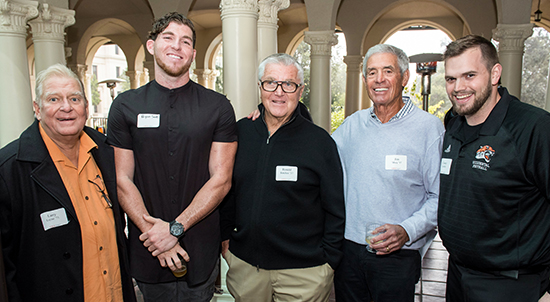
Larry started a campaign to raise $50,000 to install Friday night lights on the field, which he succeeded in doing (with a little boost from his dad, Howard Layne ’45). But he was no stranger to mounting gargantuan tasks—like selling enough “candy bars or peanut brittle or whatever” to bring the Righteous Brothers to campus for a noon concert in the school auditorium or erecting a giant “SHS” on the side of the mountain made from broken bags of gypsum from the local lumber yard.
Howard Layne enrolled at Oxy from Hollywood High School and was a member of the football and diving teams as well as an ATO. He met his future wife, Beth Odell ’46, and they were married in 1945.
A veteran of World War II who took part in the Battle of Iwo Jima, Howard became a licensed building contractor and worked with his father before going into business for himself. He built houses, industrial buildings, airplane hangars, libraries, and a car wash.
“My father purchased the empty lot next to the house where he stored materials left over from the last job,” Larry recalled. “I played with the materials, like wood. I liked building stuff.”
Coming out of high school, Larry applied to both Stanford and Oxy, and ultimately decided he would get more playing time suiting up for the Tigers football team. (Fun fact: As a student at San Fernando Middle School, Larry’s P.E. instructor was Jim Mora ’57—and for his students who did well enough in his class, Mora would rent a bus to take them to watch him coach football at Oxy.)
While Larry came to Oxy for football, rugby soon became his passion. “When I finished all my economics major requirements, I then sort of took another major—rugby,” he said. “I had so much fun playing rugby.”
Rugby made its debut at Occidental in the winter of 1965, and the Tigers opened their maiden season in Westwood on February 6 with a 10-6 win over UCLA’s JV squad—the first of two matches with the Bruins. Oxy’s schedule that first year also included San Fernando Valley State, San Diego State, Santa Barbara Rugby Club, Pomona, and Loyola.
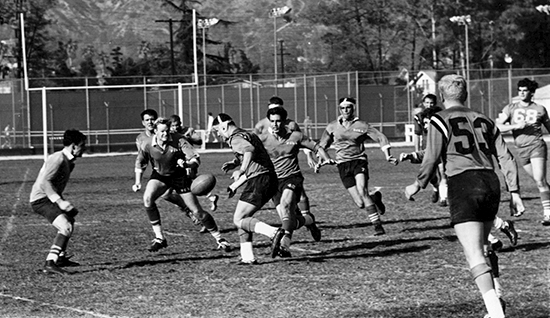
Drawing upon Mora’s roster of gridiron players, former track and football letterman Mike Quint ’58 assembled the first Oxy rugby team. Quint wasn’t quite the level of athlete as some of his Oxy football teammates—Jack Kemp ’57, Mora, and Ron Botchan ’57 among them—but in rugby, he found his niche.
Quint’s time as a student at Oxy was “the glory days of his life,” writes son Peter Quint ’87. In the 1960s, he notes, “There were no amateur track clubs like they have now, so I think forming the Oxy rugby team became his extracurricular activity.
“More than anyone I have ever known, my dad invested in time, energy, and very frequent contact with the men with whom he participated in athletics during his college years,” Peter adds. “He enjoyed the football-like intensity of rugby, and the intramural club-like atmosphere with less equipment to invest in appealed to him as a worthy activity.”
“Mike Quint was a great coach who was tolerant of our lack of knowledge,” recalls Joel Sheldon ’66. “He made the environment welcoming and fun while teaching us the game and pushing us to be the best we could be.
“When we started, we were given old football jerseys that were not even used for practice, and we had no idea about the rules— very different than football,” Sheldon adds. “I remember going down to the only sporting goods store in L.A. we could find that sold rugby equipment with my roommate, Rich Verry ’67, to buy the one and only ball we started with. Practices were held in an Eagle Rock park over the hill from Oxy.”
Quint’s inaugural squad set the template for Oxy rugby for decades to follow: In their first season, the Tigers went undefeated, winning all seven of their matches. “We were a pretty ragtag group but we played really well together,” says Pete Tingom ’68.
In the years to follow, the Tigers’ skills progressed measurably, even when the won-loss record didn’t fully reflect it. Following an 8-7 campaign in 1968—Larry’s freshman year at Oxy—Quint declared, “Oxy is now recognized as a first-class team; we have prestige and can be proud of our team. In four years we have progressed from an aggressive game of keep away to one of the best in the land—in my opinion, one of the five best college teams in the country.”
As a student-athlete at Occidental, Larry played varsity football under coaches Doug Gerhart ’58 and Bob Black ’64 and rugby for Quint and his successor as coach, Mike Luttrell ’67 (“the hooker on our team and a real tough guy,” one teammate recalls).
“Rugby—and certainly Oxy rugby—is a very unique brotherhood, almost mystic, amongst all the players at Oxy and even worldwide,” Dave Farmer ’67 says. “It’s not the same as football, because the entire 15 guys are on the field the whole time. They depend on and count on each other throughout the 90-minute game.”
For Dave Milam ’66, rugby began with a blur of exhaustion and discovery. “I remember our very first game. A number of us had never seen a game and certainly not been in one,” he recalls. ‘Having no sense of pace, or being fit for rugby yet, I wasn’t the only one laying prone exhausted after the game.”
What stayed with him was not just the physical toll but the distinct rhythm of the sport—the continuous flow between offense and defense, the absence of huddles, and the camaraderie that extended beyond competition. “The game was refreshing,” says Milam, who went on to play two more years in graduate school on the East Coast.
USC, after winning the football national championship in 1967, lost its rugby match to Oxy. (After this match, Trojans football coach John McKay reportedly forbade his players from playing rugby because they might get hurt. “The truth was that USC could not stand the thought of Oxy beating them,” Farmer says. Adding to the lore, Ray “Grog” Wicken ’69 flattened Trojan Tim Rossovich, a first-round pick in the 1968 NFL/AFL draft, “much to Rossovich’s chagrin and Grog’s and his teammates’ delight,” Farmer adds.)
After five seasons of coaching the Tigers, for which he took a salary of $1 a year, Quint stepped aside as head coach, and Luttrell took over with the 1970 squad. After Larry graduated from Oxy the following year, he remained involved with the Oxy ruggers as head coach over the next two years. Even as he pursued his MBA at UCLA (a two-year program that he stretched into five), his love for rugby took greater root as a member of the Bruins’ 1975 Monterey national championship squad. In 1979, he helped found and coach the women’s rugby team for the Bruins.
His gift for organizing proved to be an asset for his chosen profession: construction. Unlike his father and grandfather, Larry had a different vision for his business—building public storage spaces on pieces of land unsuitable for anything other than storage.
Larry viewed storage as “a cash cow,” he said in 2023, and “I wanted to build income-producing property. [My dad] never admitted it, but 95 percent of his net worth were these industrial buildings that he built when he couldn’t find work to keep his crew working on real construction.”
When he was getting the business off the ground, Larry turned to a number of his Oxy buddies to help. A skeptical Howard Layne asked his longtime friend, developer and Oxy trustee Jack Samuelson ’46, to dispatch an associate to help out with the operation.
“A few days later this grumpy-looking old ex-Marine-like guy showed up,” Larry recalled. He introduced Samuelson’s associate to his crew—a mix of rugby and football players as well as a few women off the track, softball, and basketball squads. “And he said, ‘Oh my Lord. Where’d you get these people?’ They’re all willing to help out and learn.”
In 1977, Nova Storage opened a recreational vehicle storage yard in Mission Hills on the site of its first self-storage facility, which opened in 1980. Over time, Larry dotted the perimeter of California’s freeways with storage locations in Lancaster, Downey, South Gate, Lynwood, Gardena, Palmdale, and Adelanto—and he owned every property.
During the late ’70s and early ’80s, Larry was busy building his businesses and still deeply involved in rugby, playing hooker for the Santa Monica Rugby Club and occasionally for California-level representative touring sides like the Grizzlies and the Cougars. “The big prize—the U.S. Eagles team—always eluded him,” Engle says. “While he had the skill and the will, he didn’t quite have the size for international rugby.”
He continued to find time for the Oxy rugby program as well. He suited up many times for the Oxy Olde Boys rugby team following its founding in 1981 and lent his financial support to the team many times over. “Larry was a great guy and motivator,” says Michael Farmer ’70, who played rugby for seven years at Oxy. “He was always there to get everyone up for the match and during the game.” (Not to be outdone, Michael’s father, Bill Farmer ’50, played for the Oxy Olde Boys for 25 years—until he was 69.)
As a non-SCIAC sport, rugby was never a priority of the athletics program. In the 1980s, toward the end of Richard C. Gilman’s presidency, the team formally took residence in the College’s burgeoning club sports program, where it remains today.
When University of Sussex exchange student Michael Godfree arrived at Occidental in the 1975-76 academic year, he was steeped in a rugby culture that felt foreign to his American teammates. “I started talking to the rugby guys and they were looking at me like I stepped off the moon,” he says.
Godfree went home to Sussex to complete his degree, came back to Oxy newly married (to art and art history professor Linda Lyke), and would eventually serve as head coach of the men’s rugby team for more than 25 years, stepping aside in 2006.
During his tenure, Occidental produced a notable group of players who went on to represent the United States in international competition. Dave Hodges ’90 is one of an elite few players to appear in four Rugby World Cups, twice captaining the Eagles—the U.S. men’s national rugby union team. William Jefferson ’79 earned notice not only with the Eagles but also in France, where he became a fixture with the French Barbarians. On the women’s side, Jos Bergman ’89 captained the USA Women’s National team at the 1998 World Cup in Amsterdam. Additional Occidental players contributed to the USA 7s program, including Craig Hartley ’91, George Conahey ’89, and Jon Finstuen ’85.
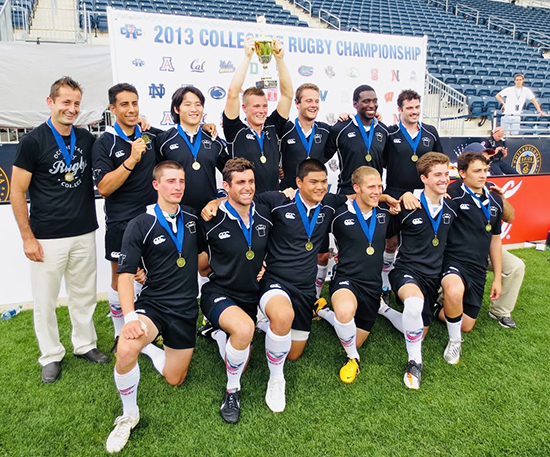
In more recent years, key contributors to the Oxy rugby experience have included Patrick Guthrie ’86, who helped coach the women’s rugby team in its early years and worked with the men’s and Olde Boys teams for roughly two decades; Jeremy Castro ’99, who coached the men’s squad to a Final Four berth in 2011; Resident Associate Professor Malek Moazzam-Doulat ’92, who has served as a coach and adviser to the program for more than two decades; and Michael Yauch ’79, who was the heart and soul of Oxy Olde Boys for 30 years prior to his death in 2018.
The Dodgers Stadium opening day social continued until about a decade ago, when “a big block of tickets became harder to get and Larry’s health was starting to deteriorate and it wasn’t feasible for him to get into ‘Dodger Heaven,’” Sheelagh recalls.
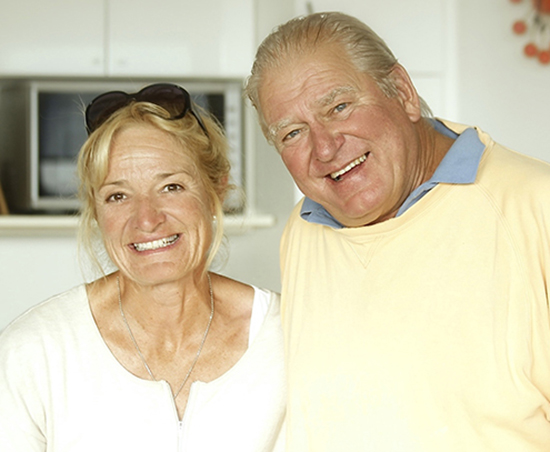
When Larry died in December 2024, “My first feeling was that things will never be the same,” Engle said at his memorial service. “It’s true … but I at least have a rugby side full of wonderful memories that will stay with me as long as I am around, and I am very thankful to kind, funny, generous Larry for all of them.”
What does Sheelagh miss about him the most? “Just the way he loved people and he always thought about others. If he saw something in a shop that he thought somebody would like, he would buy it for them. He was a very thoughtful guy.”
Happily, the memories of his benevolence endure. Sister Linda Layne recalls: “Larry took my two sons to Dodger Stadium every time we visited and my little one wrote a paper for his religion class about what a spiritual experience it was to be there. Isn’t that funny?”
A full oral history of Oxy rugby will follow in a later issue. To share your rugby memories, email the magazine at oxymag@oxy.edu.
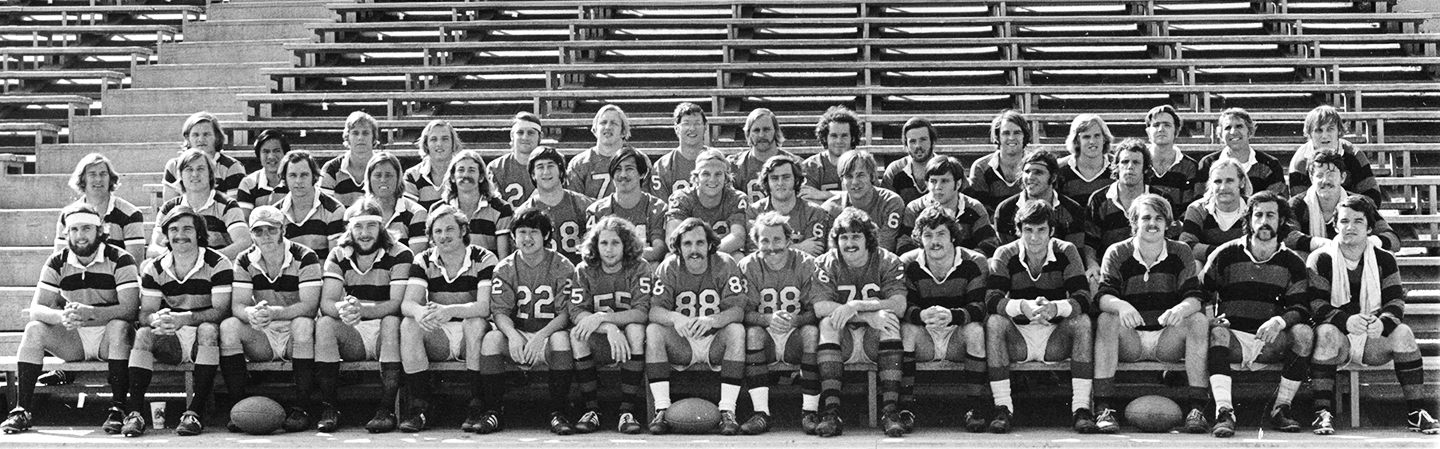
Top photo: Members of the 1971 Oxy rugby team.