As a diplomat, dealmaker, and master connector, Derek Shearer brought global leaders, policymakers, and a U.S. president to the classroom over his 45 years at Oxy
As a bright-eyed Occidental sophomore in 2002, I enrolled in Professor Derek Shearer’s Politics 231 course covering the foreign policy of the Clinton presidency because I heard Shearer brought interesting guest speakers to class. On the first day of class, Shearer handed out the syllabus and told us the first speaker would be Bill Clinton himself—little over a year removed from leaving the White House.
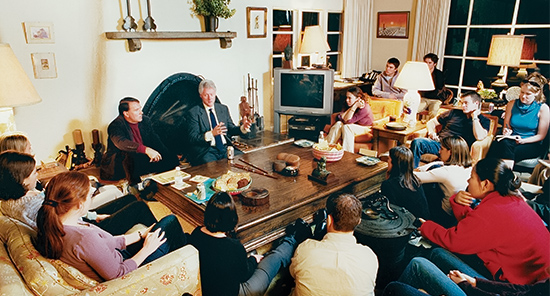
One day later, sitting in the living room of Shearer’s mother’s home in Brentwood, my 24 classmates and I listened as Clinton, casually sipping a Diet Coke, fielded questions from us for an hour and a half, spanning everything from Federal Reserve Chair Alan Greenspan to the Mexican financial crisis.
During his 45 years at Occidental, Shearer has brought countless luminaries to campus, including former Secretary of State Warren Christopher; Admiral William Fallon, former head of U.S. Pacific and Central Commands; and Derek Chollet, who served as U.S. assistant secretary of defense for international security affairs under President Barack Obama ’83. He has a Rolodex for the ages and is not afraid to put it to good use.
In the case of Clinton, they have known each other since they met at a pub in Oxford when Clinton was a Rhodes Scholar in 1969. Shearer served as a senior adviser during Clinton’s 1992 campaign, and after he was elected, he appointed Shearer ambassador to Finland.
Shearer helped coordinate the administration’s strategy for the Nordic-Baltic region and hosted Clinton’s 1997 summit with then-Russian President Boris Yeltsin. Shearer also played a role in establishing the White House’s National Economic Council.
Shearer’s sometimes unorthodox approach to diplomacy “went beyond serving California wines at official dinners, giving See’s Candy as dinner gifts, and serving Bay Area microbrew tastings,” he wrote in a 2021 opinion piece for the Washington Monthly. “On Saturdays, I was the point guard on the embassy team that competed in an industrial league where we played against businessmen from leading companies.”
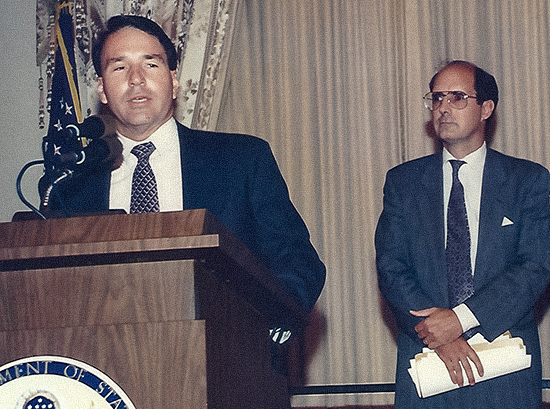
While serving in Finland, Shearer was awarded the unofficial title of “Ambassadude,” a nickname given to him by Sakke Järvenpää, lead singer of the Leningrad Cowboys, the Finnish rock band who performed at Shearer’s 50th birthday in Helsinki. The name stuck long after he returned to Eagle Rock, where he continued to use his diplomatic skills in making introductions for students or bringing together donors in 2014 to build the McKinnon Center for Global Affairs (named for Shearer’s former student, investor Ian McKinnon ’89, and his wife, Sonnet).
“Derek is this incredible bridge who knows more people, remembers more history, and connects more dots than almost anybody I know,” says Eric Garcetti, the former mayor of Los Angeles and U.S. ambassador to India, who started his professional career as an adjunct professor of diplomacy and world affairs at Occidental. “It’s been a gift for Oxy to have somebody like that in such a global city, from such a global perspective, to connect this community with the world.”
Shearer—who will retire this spring as Stuart Chevalier Professor of Diplomacy and World Affairs and director of the McKinnon Center for Global Affairs—has never been one for lectures, textbooks, or exams. Instead, he emphasizes critical thinking and writing, skills that are useful for wherever his students’ careers may take them. He wants them to have the chance to directly question those with firsthand knowledge, whether they be journalists, diplomats, or presidents.
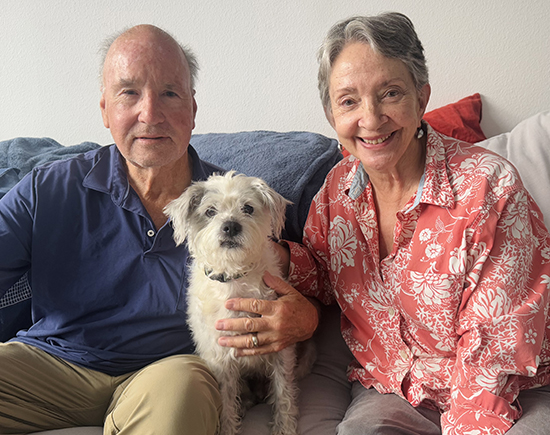
In January 2025, Shearer and his wife of more than 20 years, Sue Toigo, were evacuated from their Pacific Palisades home for two months because of the Palisades Fire. (Fortunately, their house was spared.) I recently sat down with Shearer at his home to talk about his contributions to Oxy, his views on diplomacy in the Trump era, and what’s next (besides a pick-up game of basketball).
After teaching on campus for more than four decades, what do you think is unique about the Occidental education?
The combination of the Oxy education is intellectually rigorous and reality-based. All the opportunities we give students—such as the Kahane U.N. Program, Campaign Semester, our internships in Los Angeles, and study abroad opportunities in over 30 different countries—let students test ideas against the real world.
I’ve always said to students, “If you don’t understand the world as it is, you can’t change it.”
The major skill we teach our students is critical thinking, and they learn to express themselves in both written and oral forms. At Oxy, you can’t escape writing papers. I never give multiple-choice exams because in my field, there’s no right answer. It’s more important that you approach the problem critically before proposing a solution.
Oxy is small enough that you don’t interface with teaching assistants. If you show up for class, you can talk to your professor and take them out for coffee. I mean, you invited me onto your KOXY radio show.
I certainly remember that, and it was great to have you. You’re always sending intros between students, alums, and others without expecting anything in return. You, more than anyone I know, are the master at connecting people. What is your secret?
I don’t know if it’s a secret, but it’s partly my upbringing. My parents were both journalists. [Shearer’s father, Lloyd, who died in 2001, wrote “Walter Scott’s Personality Parade” in Parade magazine from 1958 to 1991.] They liked meeting people and entertaining, and having people over. The idea was that your life is richer if you have friends and know interesting people.
When I see an opportunity, especially for students, to make an introduction, it doesn’t cost me anything but a little time. It’s a return on my social capital that makes me happy. I really enjoy the fact that people get to meet each other.
Most of diplomacy is pretty serious. Why have you focused so much on teaching students soft power like sports, music, and food?
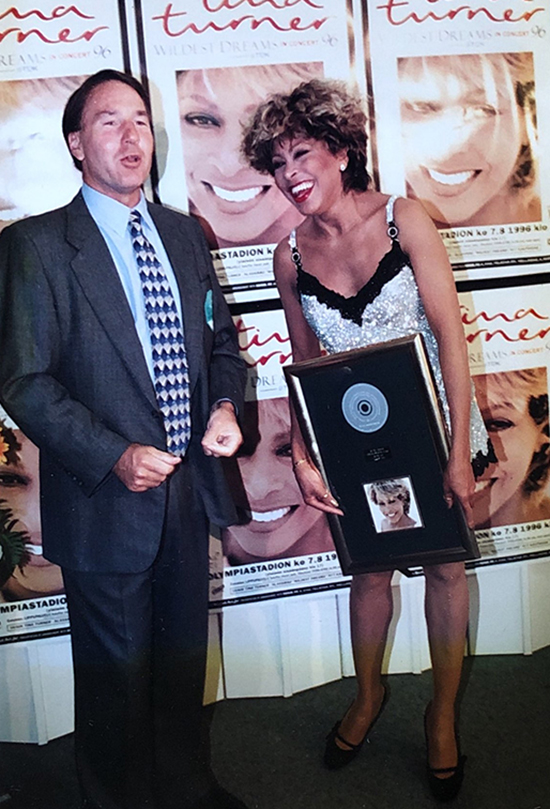
Sports, culture, music, and food are all important aspects of diplomacy. As an ambassador, I practiced all those forms of diplomacy, and I thought that, as a professor, it was a good way to reach students who aren’t all that into global affairs but are very into sports.
Sports in the 21st century have become so globalized and so political, everything from Yao Ming coming as the first Chinese sports diplomat to the politics of the Olympics, to the politics of the upcoming World Cup, where Iran will play at SoFi Stadium.
You have devoted your entire professional career to diplomacy, which is out of vogue these days. USAID is being defunded, and the Defense Department has been renamed the Department of War. What’s it like for you seeing the shift away from diplomacy?
I thought the country had reached a place where women were empowered, diversity was embraced as a strength, and America was seen as a positive force in the world. It’s discouraging, but I’m not giving up. There are younger people in the diplomatic world whom I have hope for. We’re going to have to repair the damage, and I’ve always been very practical-minded. I’m not retreating.
Are your students still excited about pursuing a career in diplomacy?
I recently had lunch with some student editors at the Occidental newspaper, one of whom is a DWA major applying to the Foreign Service. I asked if he was a bit depressed, and he said, “It’ll take a year or two to get in, and by that time, after the next election, things will change, and they’ll need me.”
That made me feel good, because sometimes I find that people my age are like, “We worked so hard for all this, and look at what’s happening.”
Occidental recently announced the creation of the Derek Shearer Endowed Presidential Professor of Practice, thanks to the generosity of Sonnet and Ian McKinnon. What does this professorship of practice mean to you?
A named professorship at Oxy is an honor—even more so because this position reflects the scope of my intellectual pursuits. As a professorship of practice, it encompasses the fields of public policy, business, and entrepreneurship—all subjects about which I have written and taught at the College—as well as international affairs. Whoever holds the post will engage the world as it is, taking a reality-based, non-ideological approach to teaching and research as I tried to do in my time at Occidental.
What were your impressions of Ian McKinnon as a student?
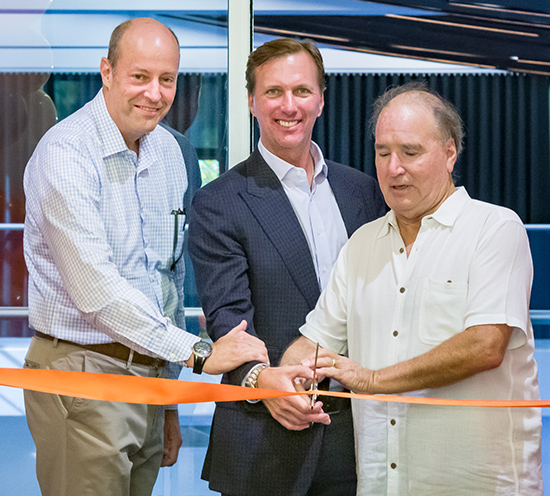
Ian is the best student I taught at Oxy. From the first day in my public policy seminar, Ian’s intellectual curiosity and analytical prowess were on display. Fellow students would sometimes complain that Ian was the perfect student—and he was, but he is more than the ideal student. Ian is one of the most decent, generous, and caring people I have met in my life. Sue and I are proud to consider him a member of our family.
When I returned to the College after government service, Occidental was going through a tough time financially. I suggested to President Mitchell that he appoint Ian to the Occidental Board of Trustees and make him head of the investment committee. Ian accepted the appointment and strengthened the endowment—a game changer for Oxy.
What are you most proud of from your decades at Oxy?
One is all the students like yourself and many others that I’ve gotten to know. Some have become friends and colleagues, and most of them have gone on to do good work. That’s like an extension of having your own children, which is very rewarding because it lives on after you.
The other is that I helped develop and institutionalize major initiatives. I established the first public policy major, and then we created an international and public affairs center. I convinced Peter Dreier to join Oxy, and he went on to establish the Urban & Environmental Policy Institute and Campaign Semester. Later, I played a key role in ensuring the U.N. program was on a sound financial footing.
And then there’s the social capital. If you walk through Johnson Hall, you’ll find framed pictures of the various practitioners, journalists, diplomats, and politicians I brought to Oxy so students could interact with people engaged in the real world.
What are your plans for retirement?
I don’t entirely know the answer because our world was turned upside down by the fire. Given the state of politics and the very slow rebuilding of the neighborhood, we don’t want to make any big decisions. I’ll do some guest speaking, and I have a couple of writing projects, including a small book on my advice on the state of the world.
The country is threatened by authoritarian rule in D.C. and the international system is broken by autocracies using force, ignoring morality and international norms. But there are good people fighting against the chaos and trying to restore hope and democracy.
Any words of advice for now?
Show up, get involved, stay balanced, and have a vision of the world you’d like to live in; then figure out a way to make it happen. Along the way, cherish family and friends, share food and books, play sports, and get a good dog.
Ben Bergman ’04 majored in politics at Occidental. He is currently a senior correspondent for Business Insider.