Oxy students and alumni find pathways into the Slamdance Film Festival, gaining industry exposure and experience following its move to Los Angeles
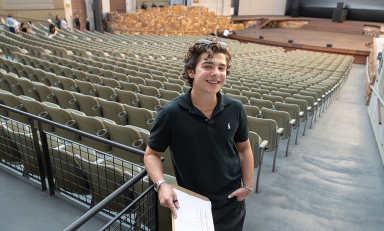
Despite living in Salt Lake City, Utah—an hour’s drive from the birthplace of the Slamdance Film Festival, the upstart alternative to the older and better-heeled Sundance—“I had never heard of Slamdance,” says Max Brown ’25, who majored in media arts and culture (MAC) at Oxy. “Sundance was on my radar, but I didn’t experience it much—festival passes were so expensive.”
Brown enrolled at Oxy in fall 2021 after deferring his admission for a year during the pandemic. During his gap year, he worked as a ski instructor in Utah and for the family business as a guide, taking tourists down the Colorado River through the Grand Canyon.
He connected with Slamdance President and co-founder Peter Baxter through his river guiding job in what might be described as one degree of separation. In the summer of 2023, Brown says, “I was taking somebody down the river who asked me what I wanted to do with my life.” (His passenger was Marlon Robbins, who at the time was dating Baxter’s daughter.) “I told him that I wanted to be a filmmaker, and he said, ‘I know somebody who could be very helpful for you.’ Then he gave me Peter’s contact information.”
Meeting over coffee at a cafe in Silver Lake that fall, “Max started asking me all kinds of questions about filmmaking, and he started speaking about the faculty here and what he was doing at Oxy,” Baxter recalls. “One thing led to another, and I eventually said to Max, ‘Why don’t you think about working at the festival as an intern?’”
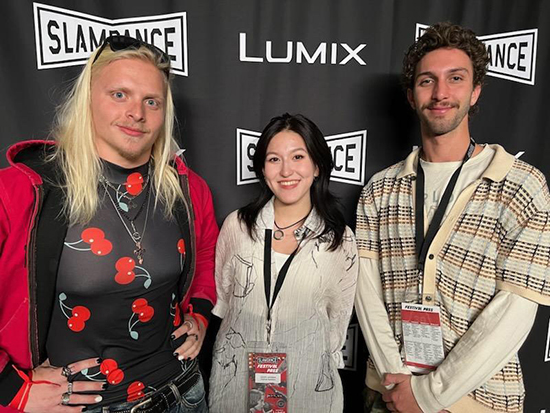
In January 2024, Brown and a couple of fellow MAC majors drove out to Utah for the festival to work as assistants. (“We informally represented Occidental that year,” he says.) Months later, Slamdance announced that the festival was moving from Park City to Los Angeles, and Occidental became one of its first community partners in L.A.
“Peter told me they had been thinking about the move for a long time,” says Brown, who worked as an executive assistant leading up to and during the 2025 festival. Last year, Slamdance enlisted 16 interns through its partnership with Oxy, in addition to Brown and another student, for a total of 18 Tigers.
“It was very cool going from working at the festival’s last year in Utah to starting the first year in L.A. with this partnership,” says Brown, whose senior comps film, The Taxidermy of Man, screened at the TCL Chinese Theatre in Hollywood on February 27 during the Golden State Film Festival. “Slamdance and Occidental really came together because of right place, right time in so many ways.”
“To support the next generation of filmmakers is part of what Slamdance does, but it can also do it through showing how a festival works,” Baxter says. “Oxy is front and center of that. It’s a beautiful thing.”
Slamdance’s L.A. headquarters on Melrose Avenue is nothing fancy. “It’s a funky space that has really high ceilings, three separate rooms, and some cool old festival posters,” says Lizzie Friedrich ’25, who started working for Slamdance as a creative assistant prior to her senior year. She was quickly promoted to production coordinator, then festival coordinator, and most recently festival producer.
Prior to the Slamdance-Oxy partnership, she says, “I had no idea how a film festival even worked. I was drawn to Slamdance initially because I was trying to keep our film club, Studio 1600, together.”
Friedrich likens her work to being the “connective tissue” between departments, even taking on some of the festival director’s responsibilities in their absence. “I’ve learned a lot about working with sponsors, but I’m more on the production side. Today, we’re going to check out the venues, pick up filmmaker bags, and deal with run-of-show and signage. There’s a lot of stuff.”
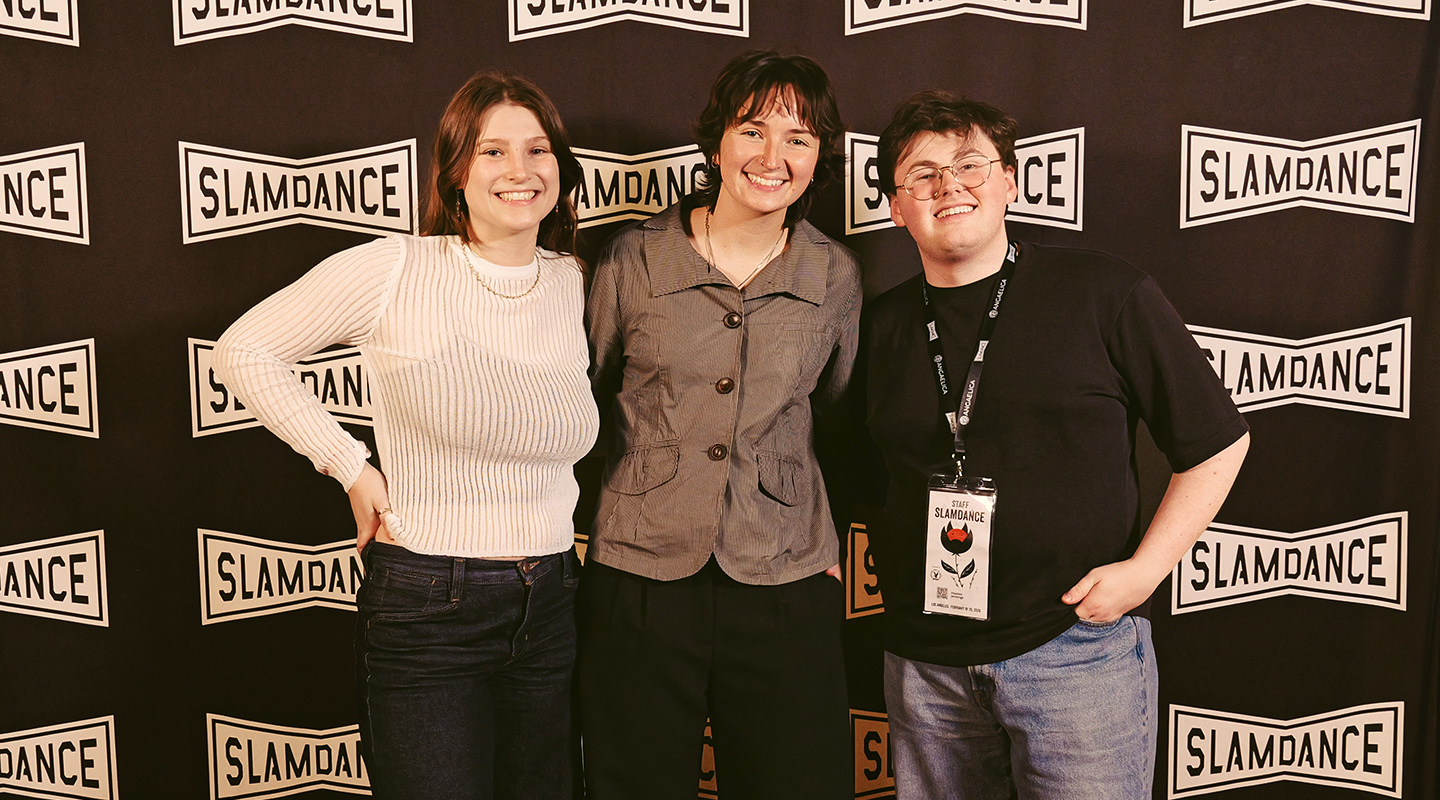
Friedrich also had a hand in hiring classmates and 2025 festival interns Lily Calvert and Hayden Jennings for the 2026 festival, which ran from February 19 to March 6.
“Max Brown and I were in the same comps group,” Calvert recalls, “and he and Lizzie encouraged me to intern at Slamdance last year. At the time, I was deep in comps mode, but I went and met all these awesome filmmakers. I wound up working in projection, so I got to watch a lot of films.”
Coming off a summer of “soul-crushing” work as a production assistant on a reality TV show, Calvert joined the Slamdance team last November as social media and digital content manager. Among their many tasks, they build individual web pages for the festival’s themed activities, such as Writers’ Day and Market Monday, while making sure that the “shopfront window,” as Baxter calls the landing page, contains all the information that patrons need and is easily accessible. Calvert also is in charge of managing the content for the virtual festival—141 films in all—which runs the week after the festival.
Among the festival’s more than 10,000 attendees in 2025 were VIPs such as Bob Weir and Richard Kind. “I was on VIP relations for one day last year, and I got to walk around with George Takei and his husband, which was really exciting,” Calvert says.
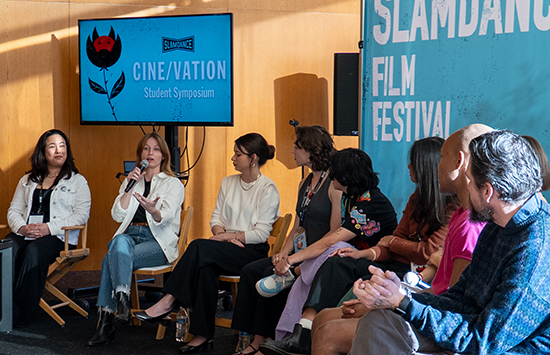
That accessibility to filmmakers and filmgoers alike adds to the festival’s low-key charm. “There are no barriers at Slamdance,” Jennings says. “You can chat with the person whose film you just watched.”
Having done social media content for Oxy’s Marketing and Communications and Admission offices, Jennings jumped at Baxter’s offer to do public relations and marketing for Slamdance—dealing with publicists and the media, as well as organizing a symposium panel for college students moderated by Diana Keeler ’09, Occidental’s director of digital media and production. “Working with Peter is like having one of your college professors as your boss,” Jennings says. “It’s rare to find someone like him in the industry.”
“Last year during the festival, I didn’t really talk to Peter much, but I very distinctly remember getting our checks, and he had handwritten us all thank-you notes,” Calvert adds. “That stuck with me.”
Nineteen Oxy students, including four returning seniors from the 2025 festival, worked at Slamdance this year. The internships are open to all majors who might be interested in careers related to the film industry. Every student in Oxy’s Theater and Performance Studies Department, for instance, has to take theater tech classes. “They all have tech experience that translates directly to what we do,” Jennings says.
Looking beyond Slamdance, “I want to be a screenwriter,” Jennings says—he wrote a TV pilot and a pitch for his senior comps—“and I want to keep exploring PR in the film world.” He’s also producing a feature film with a number of Oxy friends: “It’s a big undertaking but we all want the skills to produce our own stuff on the side and be like these Slamdance filmmakers.”
“My senior comps was a documentary, and I did a couple of docs through Oxy’s Undergraduate Research Center,” Calvert says. “To make documentaries for a living would be the dream. Until then, I’ll continue doing social media—that’s what pays the bills.”
“I’m entering the vortex again,” Anahid Yahjian ’11 says in late January, describing the imminent arrival of her second child (a baby girl, born days later) and mere weeks before her latest short film, Domestic Demon, had its world premiere at the International Film Festival Rotterdam in the Netherlands, followed by its North American debut at Slamdance on February 20.
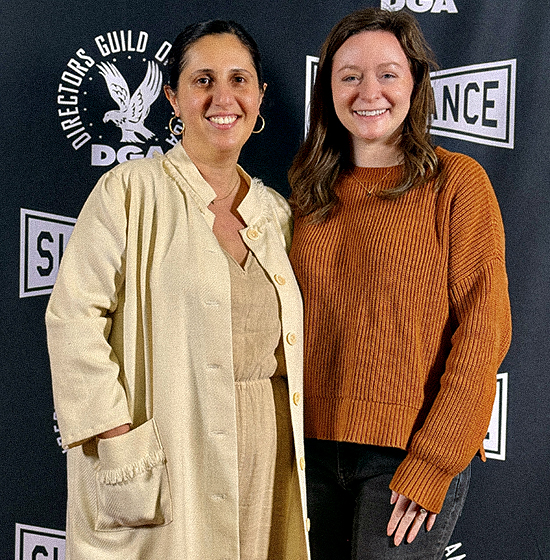
After her first child turned 1, Yahjian (who directs narrative, documentary, experimental, and branded films and content under her production company Medulla Creative) stepped away from filmmaking entirely for a year. The pause was partly practical—she wanted to be present with her son—but it was also exploratory. “I started doing more community-based social justice activities in my neighborhood,” she says. “I also participated in multiple oral storytelling events where you just get up and tell a story. I couldn’t believe how satisfying that was—and quick compared to making a film.”
By the beginning of 2024, “As we were contemplating having another kid, I said, ‘Before I do that, I want to get back into the field,’” Yahjian recalls. In her absence, the film industry had shifted dramatically. The aftershocks of the pandemic, the writers’ and actors’ strikes, and the contraction of the streaming boom had reshaped the landscape.
“I felt like a person who’d been hiding in a bunker and comes out years later to a changed world,” Yahjian says. “That took me months to process and grieve.” In response, she decided, “I had to carve a new place for myself. It felt like going back to the beginning in many ways.”
Yahjian majored in English and comparative literary studies at Oxy, with a minor in art history and visual arts and a concentration in creative writing. “To this day, those three things represent my creative interests,” she says. “I still use the same interdisciplinary liberal arts approach in everything I do.”
Domestic Demon began without a script, a crew, or even a clear plan. “It took me a second to put my brain back in film mode,” Yahjian recalls. “I had a series of images in my head that started to accrue as I wrote them down on my phone. They were all built around the space I had been existing in as a new mom—my house and my neighborhood—and the ways in which this place had become my sanctuary and my prison.”
She reached out to her friend and longtime collaborator, cinematographer Lauren Guiteras, with a simple idea: “Let’s just make something. At my house.” The two of them shot the film entirely in Yahjian’s Glendale home and surroundings, working loosely from her shot list while improvising along the way.
One day they focused on macro textures—close, abstracted images that distort the familiar—and another on shadows, silhouettes, and movement. Many images were discovered in the moment; a dead bird on the driveway became part of the film. So did soap bubbles, light patterns, and the surfaces of domestic life.
“Ever since I was a child, I’ve been a person who sees magic and wonder and strangeness all around me all the time,” Yahjian says. That sensibility, combined with clear influences—David Lynch most notably—shapes the film’s tone. The suburban setting, with its manicured calm, becomes a site of unease, echoing Yahjian’s long-standing fascination with what lies beneath the surface of American domestic life.
Months after shooting, Yahjian wrote a poetic narrative for the film, eventually distilling it down to 10 lines, which became the skeleton for the edit. The narration is in Western Armenian, her native dialect, which is considered endangered by UNESCO. “This is the language that I was mothered in,” she says, “and the one that I am mothering my kid in.”
At its core, Domestic Demon is about the long, ongoing transformation of motherhood, sometimes referred to as matrescence. It draws on Yahjian’s own experience of postpartum depression, as well as the isolating conditions of becoming a parent during the lockdown. Viewers have found connections to their own experiences of isolation, identity, and change. For Yahjian, that openness is part of the point: Four years into parenthood, “I still feel like I’m changing.”
Yahjian worked with Portland, Ore.-based editor Emily Cargill, who also was a new mother, to assemble the six-minute short in time for festival submissions. Another first-time mom, Rotterdam programmer Cristina Kolozsváry-Kiss, invited the film to premiere in the Tiger Short competition a few months later. (She calls Yahjian’s film “a visual poem about the alienation of postpartum.”)
Even as Domestic Demon began its festival life, Yahjian was already at work on her next project. Based on an experience she had while living in Armenia post-Oxy, Nelly follows two Armenian American women who intervene in a violent encounter and are forced to confront their own assumptions. The three-day shoot took place once again at her home, with a cast and crew of more than 30—a marked contrast to Domestic Demon’s minimalist production. But this time, she was eight months pregnant.
In anticipation of the birth of her second child, Yahjian says, “We’re prepared for another round of postpartum depression, but every pregnancy is different. Every child is different. It’s just another transformation.
“At this stage, it’s clear that I’ve made my best work in the midst of being a parent,” she adds. “That’s a really special thing. So I’m excited by what it may bring, even if it’s a little Lynchian.”