Latina Judicial Trailblazers Share Their Journeys With Occidental Audience
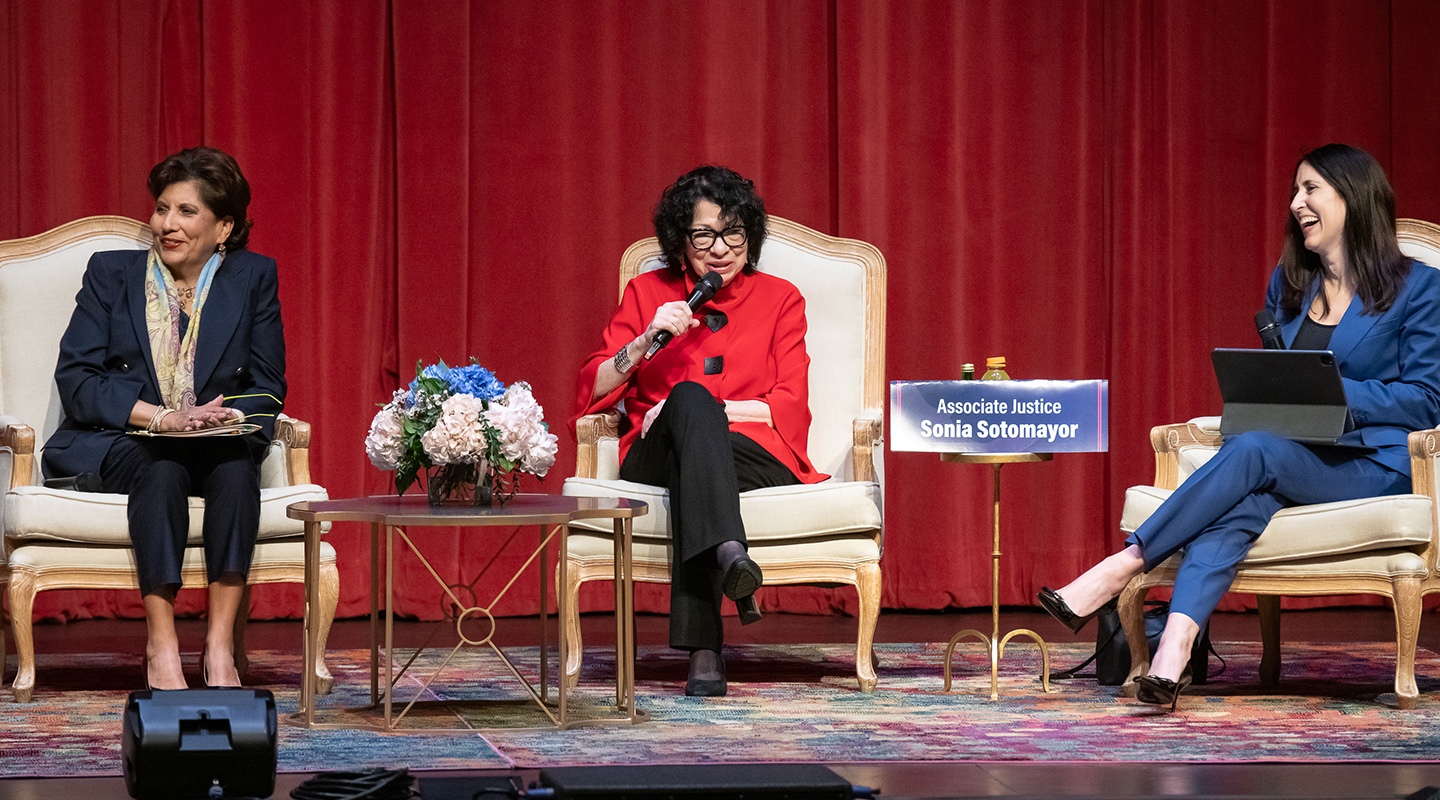
Occidental College hosted three Latina pioneers in the judiciary—U.S. Supreme Court Justice Sonia Sotomayor, who was nominated by President Barack Obama ’83 to the nation’s highest court in 2009; Patricia Guerrero, chief justice of the Supreme Court of California since 2023; and Mary Murguia, chief judge of the U.S. Ninth Circuit Court of Appeals since 2021—for a wide-ranging discussion on heritage, education, and public service on February 6 in Thorne Hall.
California Supreme Court Associate Justice Kelli M. Evans served as moderator for the event, sharing the Thorne Hall stage on her birthday with “three of my personal heroes and role models,” she said. (Likewise, Chief Justice Guerrero turned to Justice Sotomayor and said, “I’m pinching myself sitting next to you.”)
Much of the nearly 90-minute conversation focused on the justices’ shared Latino backgrounds, their paths to the bench, and the challenges and rewards of judicial service. A recurring theme was the transformative power of education. “Education was the key to all success in America,” Justice Sotomayor said. “With education, you can do anything you want in this country.”
The daughter of Mexican immigrants, Chief Justice Guerrero was born and raised in California’s Imperial Valley. Her father, who had a fifth-grade education, found steady work as a cowboy at a feed lot—“I think I would’ve been a cowgirl if it had been up to him,” she noted with a smile. From her mother, Chief Justice Guerrero said, “I learned I had self-confidence. I also learned the importance of helping other people.”
Chief Judge Murguia reflected on parents who endured hardship, discrimination, and physically demanding labor, yet emphasized education and perseverance. Her father left school after eighth grade and worked in a steel plant, while her mother lost her own mother at a young age. Despite being told where they could sit or which bathrooms they could use, the family emphasized resilience. “The sun shines for everyone,” her father often told his children, six of whom went on to earn postsecondary degrees, including law degrees.
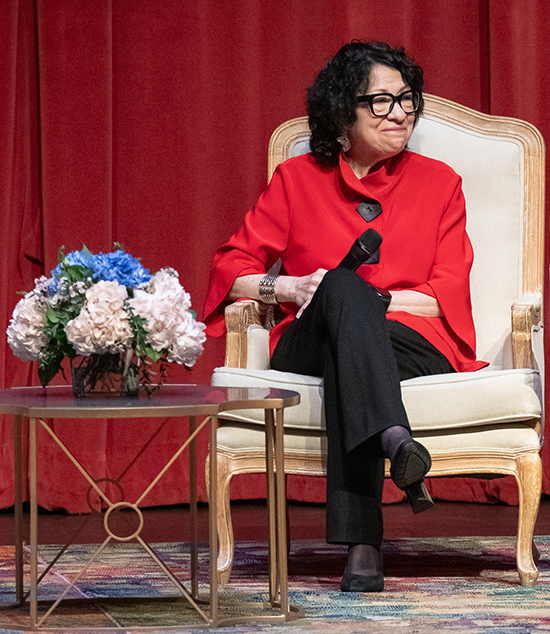
Describing herself as a “proud Nuyorican,” Justice Sotomayor recalled that her family was part of the first wave of Puerto Rican migration to New York in the 1940s. Her mother served in the Women’s Army Corps during World War II and later became a practical nurse, while her father had only a sixth-grade education. Justice Sotomayor described her family as “very proud Americans,” adding that her Puerto Rican heritage remains central to her identity.
Addressing students directly, Justice Sotomayor emphasized that the nation’s story is unfinished. “Know that you have a role,” she said, urging young people to aspire to positions of leadership and service, including the Supreme Court itself.
In discussing the challenges she has faced throughout her career, Justice Sotomayor recounted the intense scrutiny surrounding her Supreme Court nomination. “It took a friend who came up to me and said, ‘Sonia, this is not about you—get over yourself. This is about my 8-year-old Puerto Rican daughter who needs to see someone on that court that looks like her.’
“Life has a lot of potholes,” Justice Sotomayor added. “Each time you fall into one you climb out and do it again.”
In a lighter moment, Justice Evans asked each jurist what their dream job would be outside the judiciary. “I’ve wanted to be a lawyer and a judge since I was 10, but I think being baseball commissioner would be cool,” Justice Sotomayor—a die-hard Yankees fan—said to laughter.
Chief Justice Guerrero replied, “I would want to be an elementary school teacher,” specifically teaching third or fifth grade, while Chief Judge Murguia admitted, “If I could sing, I would be a Broadway music star.” (“She has a nice voice,” Justice Sotomayor told the audience.)
In closing, Justice Evans asked the justices how people can remain hopeful during “an inflection point” in the nation. The last word was left to Justice Sotomayor, who responded with a question to the audience: “What choice do you have?” With so many problems in the world, she said, each person must choose one that feels personal. “There's a problem that has your name on it that you can fix,” she said. “If we all care deeply enough, we can change things.”
The event marked just the third time in Thorne Hall’s 88-year history that Occidental College has hosted a Supreme Court justice. In February 1949, Associate Justice William O. Douglas delivered three talks on campus as part of the inaugural Remsen D. Bird Lectureships. In January 1971, retired Chief Justice Earl Warren spoke at Opening Convocation in Thorne Hall.
Top image, L-R: Chief Judge Murguia, Justice Sotomayor, and Chief Justice Guerrero discussed their shared Latino backgrounds, their paths to the bench, and the challenges and rewards of judicial service.
Tags