
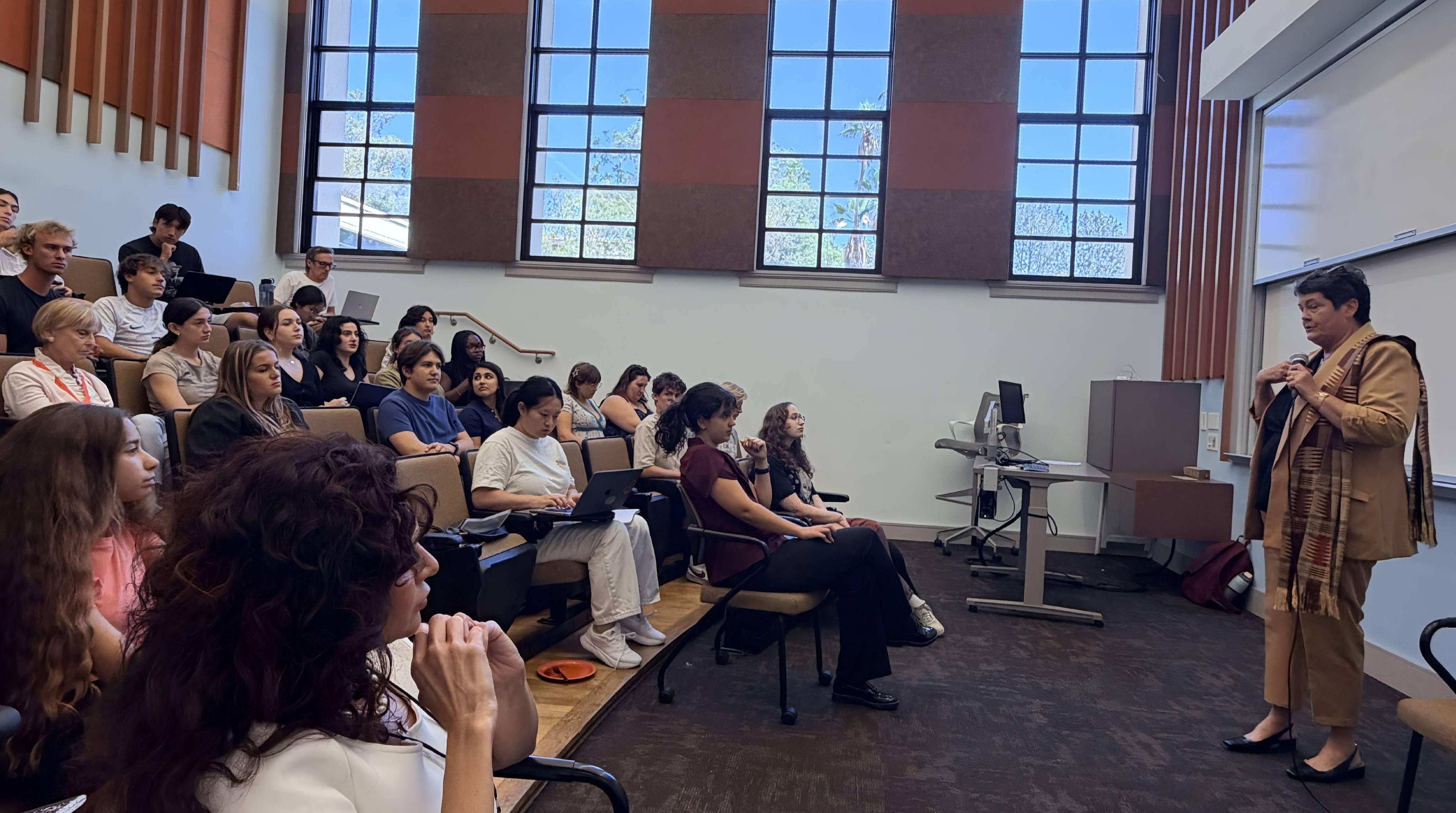
On September 3, 2026, the John Parke Young Initiative on the Global Political Economy hosted Ambassador Virginia E. Palmer in Fowler 302 for an introduction and open Q&A. Palmer joins Occidental as the Stuart Chevalier Professor of the Practice in Diplomacy & World Affairs and Ambassador in Residence, following thirty-nine years in the Foreign Service that included ambassadorships to Ghana and Malawi and postings in the PRC, Hong Kong, Kenya, Vietnam, Zimbabwe, and Canada.
Palmer shared her experience working in the Foreign Service from Beijing shortly after Tiananmen to Hong Kong after the handover, where she said she felt influential beyond her years "because I wasn't just Virginia talking to those people. I was the United States of America." The power came with a warning. "You have to do that with some humility," she said, "because America is big, and we do kind of come waltzing in, take the microphone, and assume people want to hear from us. That's sometimes welcomed and sometimes not."
Humility, for Palmer, is also a method. As Deputy Assistant Secretary for Counterterrorism, she worked to convince other governments to join the fight before an attack reached their own capitals, which meant finding the grievance underneath. "Who's the warlord that controls the well? That affects how they feel about girls’ education, for example," she said. She implored Oxy students to dig deeper into the historical tensions between governments and civilians since "we can't just read the news and react to that."
Asked how she reconciles human rights advocacy with representing a great power, Palmer then argued that mutual interest outlasts pressure: A government that complies out of fear, instead of interest, complies once. "[Foreign governments will] do it because they fear you the first time. But when you need them, like you need help on the Strait of Hormuz, for example, they're going to tell you to get lost." Citing Fight Club, she offered that "the first rule of political realism is we don't talk about political realism." There is no need to announce America First, she said, when you can act in America's interest and persuade others that theirs runs alongside it.
She refused to treat interest and principle as opposites. "A rising tide lifts all boats." Democracies are more stable and more prosperous than authoritarian systems, she argued, so fostering them produces better partners. In Malawi she redirected $90 million in HIV funding into building high schools, on the argument that keeping girls in school interrupts the transmission cycle of the HIV virus, and secured a presidential waiver of secondary school fees to keep students, particularly girls, in school. That, she said, is the power of the United States.
Humility governs how she makes those arguments abroad. "You mustn't impose; it won't work," she said of the charge that American advocacy is neo-colonial. In Ghana, facing what the Special Envoy for LGBT Rights called the worst anti-LGBT bill in the world, she cited a coalition of large corporations to make the case in the country's own economic terms rather than telling Ghanaians what to think.
The harder audience is at home. Senators used to ask her how to explain to constituents in South Dakota why a man contracting bubonic plague in Sudan mattered to them. Palmer's answer was that peace and stability abroad are what allow "an engine production in Thailand to create jobs in auto factories in Tennessee." She argued that diplomats have a huge task ahead to restore lost trust with partners abroad.
Which brought her to Occidental. "I'm excited to be at a university like Oxy," Palmer said, "because the work you're going to do is so important to stabilizing that."
The Young Initiative, alongside the entire Occidental community, is excited to have Ambassador Palmer and her on-the-ground professional experience here at Oxy.