
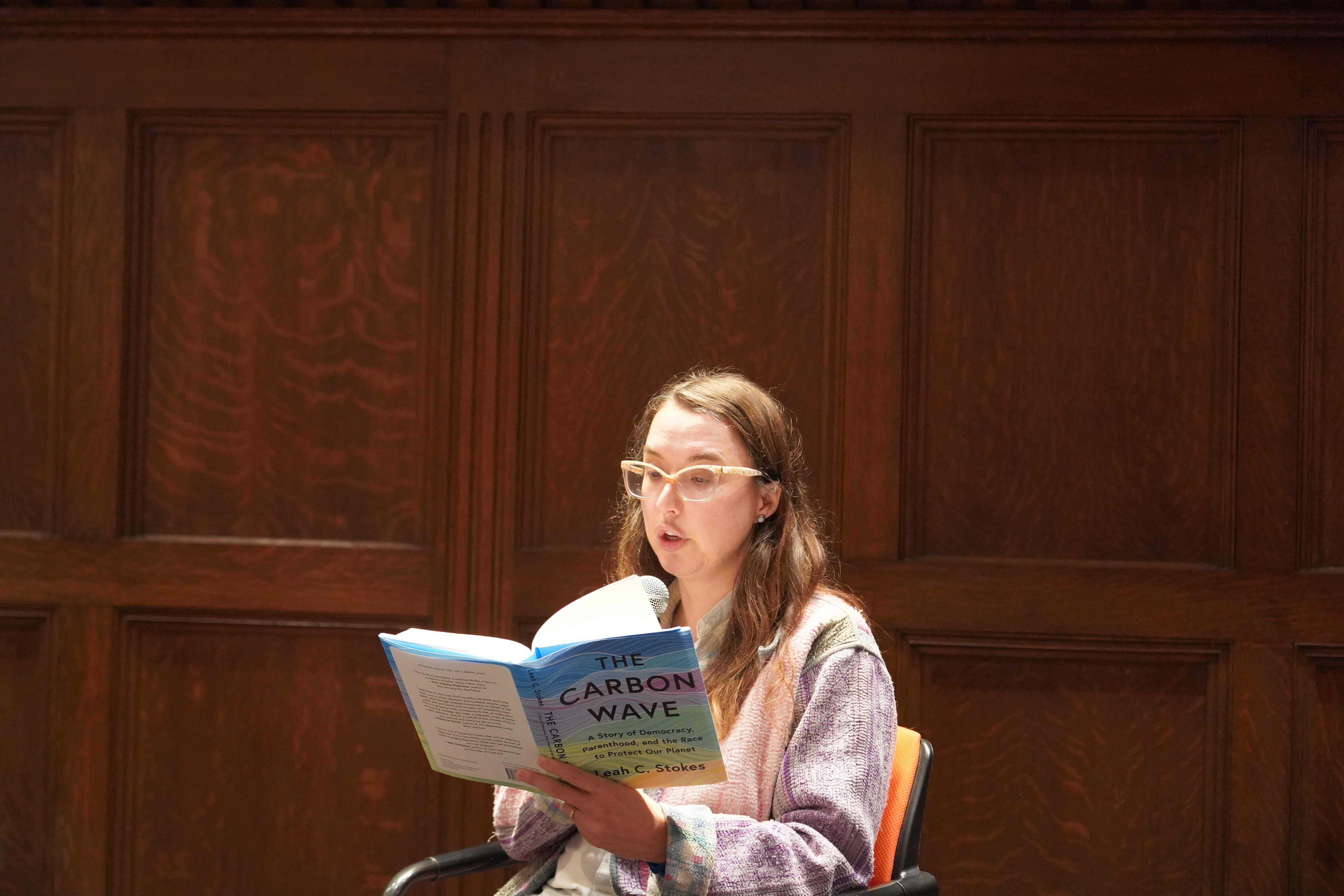
On November 4, 2026, the John Parke Young Initiative hosted climate policy scholar Dr. Leah Stokes to discuss her new book The Carbon Wave: A Story of Democracy, Parenthood, and the Race to Protect Our Planet. Stokes is a professor at UC Santa Barbara, and her book follows the passage of the Inflation Reduction Act (IRA) to ask what it can teach us about making change when policy and politics seem stuck. The event, held in Choi Auditorium, included Stokes reading the first chapter of her book and a Q&A led by Professor Micah Farver of the Politics department.
How does change happen when politics feels stuck? This is the question Dr. Leah Stokes sets out to answer in her new book, which follows the passage of the IRA, the largest climate and clean energy legislation in United States history. Stokes wrote the book for everyday people who ask what they can do about the climate crisis. Activism, she said, is often an act of improv, as with the sit-in at Nancy Pelosi’s office demanding a Green New Deal. She also described an eternal flame at UC Santa Barbara, a memorial to figures assassinated in the 1960s, that was venting methane into the atmosphere. A student-led campaign eventually replaced it with an LED lightbulb. Both examples, she argued, show that anyone is capable of climate activism.
So how does change actually occur? Stokes answered with one word: power. The IRA brought together competing priorities, including tensions around environmental justice, and she was candid in sharing that coalition building is often difficult. Through her policy work, she realized that in politics, you will sometimes disagree with friends. What is important, she noted, is to remember to focus on your interests, be pragmatic and empathetic, and build collaborations over time. When a student asked what to concede in a coalition, Stokes said it depends on how much power you have. For instance, gas companies held more power over the heat pump debate, so gas furnaces got the subsidies. In contrast, her experience campaigning for air conditioning in schools and partnering with the teachers' union gave her leverage. Now her campaign no longer relied solely on her own power; it was elevated by the teachers' union.
The conversation then turned to data centers. She was asked why they are building gas plants when renewables are cheaper. Stokes explained that a facility needing round-the-clock power must either wait for a grid interconnection or build “behind the meter,” often with gas. With an “insatiable need” for energy and effectively infinite money, she said, data centers are distorting energy markets and polluting air and water. She argued for the focus to stay on structural fossil fuel buildout rather than on individual behavior.
With midterm elections having just passed, the next question was timely. She was asked whether candidates are afraid to talk about climate, to which Stokes responded no. She pointed to the El Niño, the Newport Beach flooding, and even the Los Angeles fires, and said her research suggests candidates who talk about climate are more likely to win. She stated that we need candidates to talk about climate change, recommending that framing focus on cheap, affordable energy, plus clean air and clean water, which she said no one, Democrat or Republican, wants to be without. The final question, about whether buying an electric car matters, brought the talk back to its title. “Fossil fuel companies,” Stokes said, “paid to promote the idea of an individual carbon footprint. Replacing a furnace, stove, or car is infrastructure change, and the ‘carbon wave’ is about joining with others to change policy rather than focusing on personal behavior.” As for what each of us can do, her closing thought was to reach beyond yourself, your department, and bring others with you.
The John Parke Young Initiative and the Occidental community were grateful to welcome Dr. Stokes. The talk was part of the Young Initiative's fall speaker series, which continued on November 12 with Phillip M. Ayoub.