
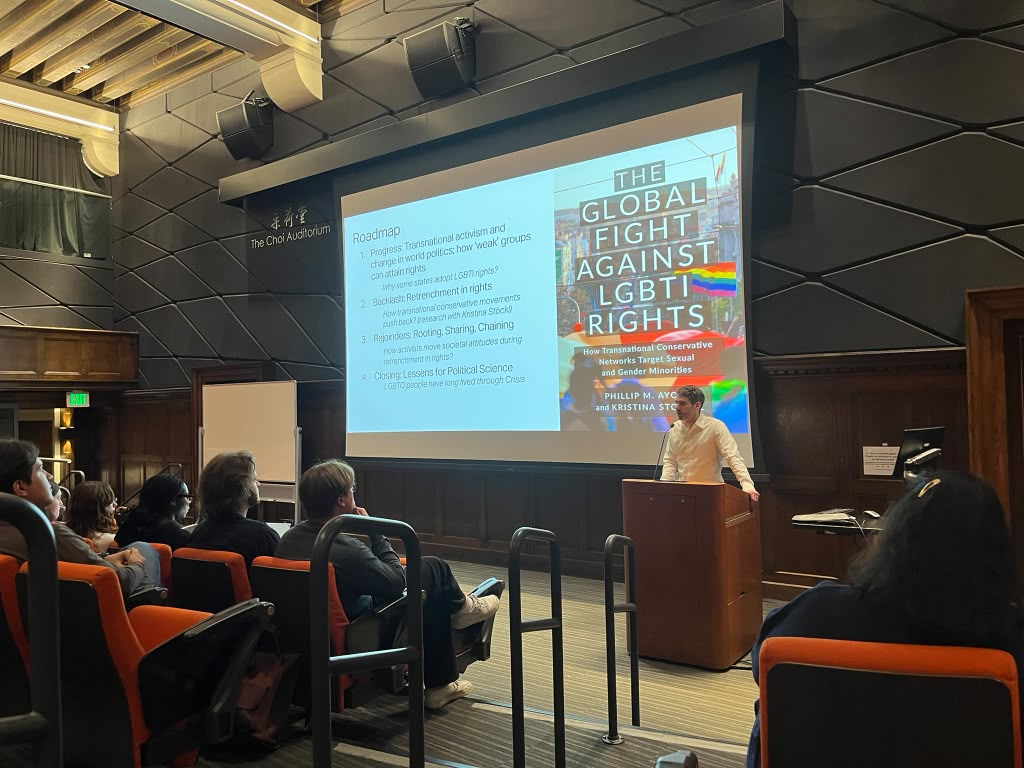
On November 11, 2026, Philip Ayoub, professor of political science at University College London, lectured on Illiberal Times, Inclusive Strategies: What LGBT Politics Teach Us About Navigating Crises in Human Rights. Ayoub explained his recent research on global LGBTQ rights, the nature of the movement to counter them, and how LGBTQ+ advocates have adapted their strategies in response.
What can the fight for LGBTQ+ rights teach us about defending human rights more generally? As political scientist Philip Ayoub illustrates, it can teach us a lot. On November 11, 2026, the John Park Young Initiative welcomed Ayoub, Professor of International Relations at University College London and former DWA Associate Professor, back to campus for a timely lecture on global LGBTQ+ rights. Over the past three decades, LGBTQ+ rights have advanced at an incredible rate across diverse regions, driven by transnational activism, pioneering governments, and evolving human-rights regimes. But just as swiftly, global conservative movements have emerged, coordinating attacks on rights, furthering retrenchment. Drawing on decades of research, Ayoub traces the evolution of the two movements: their strategies, frames, and reciprocal relationships as they interact in the international and domestic spheres.
Ayoub began by explaining the swift global progress in LGBTQ+ rights. Traditional modes of thinking believed that there were certain legal and social prerequisites for a state to codify LGBTQ+ rights, but reality differed significantly from what political scientists expected. For example, Malta codified anti-discrimination provisions on the basis of sexual orientation or gender identity in its constitution in 2014, before the U.S. and Germany legalized gay marriage. And Ireland legalized gay marriage in 2015, earlier than expected for a conservative country. How were new states able to secure LGBTQ+ rights without the qualifications traditionally thought of as necessary steps to get there? Ayoub explained that it wasn’t a coincidence that many countries introduced legal rights at the same time. Rather, countries were receiving signals to support rights through three channels: social, political, and norm broker channels. The “norm broker channel” is one mediated by domestic activists and transnational advocacy networks (TANs). Transnational groups receive inputs from domestic groups, connect with other transnational networks, and coordinate activism globally. They are more easily able to illuminate domestic issues in countries where local governments are hostile, shaping the speed and direction of diffusion. TANs create a spiral model of diffusion: a positive decision in one country might aid the movement in another. For example, former Oxy student and president Barack Obama’s change in stance on gay marriage helped legislators in New Zealand make the case for domestic rights.
But just as LGBTQ+ rights move forward, Ayoub explained, conservative groups also use TANs to claw them back. In an apt analogy, Ayoub shared pictures of “The Rainbow” in Poland, a rainbow-shaped art installation made of artificial flowers. Originally constructed in 2012, around the same time as the “rights revolution,” the arch has been burnt down and rebuilt six times, illustrating how fierce the fight for and against rights is. Ayoub explained how the advancements of LGBTQ+ rights clash with certain conceptions of personal and national identity; many moral conservative groups view them as an existential threat. Thus, resistance has transnationalized itself, and the very tools of norm diffusion used by LGBTQ+ activists are also utilized by moral conservative groups. This appears in norm promoter states like Russia positioning themselves as defenders of “traditional values” and the family, and conservative groups in America and Europe authoring foreign agent and anti-LGBTQ+ laws that then go into effect in the Global South.
To explain how LGBTQ+ and moral-conservative TANs mirror each other and interact in the international sphere, Ayoub developed the concept of a “double helix”: rival TANs are engaged in a reciprocal relationship of norm contestation, having to navigate each other's presence and thus using related instruments for mutually exclusive goals. This metaphor was partly developed in a workshop here at Occidental, and it helps scholars understand that advocates aren’t just meeting their opposition domestically; they are meeting them internationally as well. So we see conservative groups adopt the language of human rights, and attempt to mirror the universality of the rainbow by proliferating their own symbols and flags. In response, LGBTQ+ rights groups have leaned towards a national frame, using language around the nation, history, and the family. To combat this idea of foreign imposition, groups have reduced their discussion of global rights, leaning into domestic queer histories and language. As an example, Ayoub shared a study he conducted in Zimbabwe, where activists discussed cave paintings featuring queer people to root LGBT rights within Zimbabwean heritage. Rather than backing down, LGBTQ+ rights groups have innovated and adapted their strategies and language to continue to spread rights, even as conservative groups adopt their methods.
Returning to the question he posed at the top of the lecture, Ayoub explained that “these chapters illustrate that LGBT people have really taught us a lot about defending human rights, and we can learn a lot from them,” when it comes to defending human rights and democracy in an increasingly illiberal environment. To close, he put forward the example of Hungary after the March 2025 Pride ban. Political scientists were unsure what would happen after this rights reversal, but nearly 300,000 people gathered in Budapest in June, using a legal loophole to hold Pride anyway. Critically, this parade was framed as an LGBT rights parade and a defense of democracy.
The Q&A pushed the discussion further, as audience members asked thoughtful questions about Dr. Ayoub's research, other rights-advancing frames and mechanisms, and intra-movement challenges. When asked about his research on the interactions between the two networks, Ayoub pointed to the adoption of LGBT TANs strategies in domestic politics, from Talarico’s to El-Sayed’s recent Senate campaigns. Rather than throwing LGBTQ+ people under the bus to appeal to the other side, politicians are talking about religion and transgender people’s place in society in new ways. One person also asked about how transgender rights have been playing out internationally. According to Ayoub, this issue has been an “opening” for conservative movements that were not able to combat marriage equality. But abandoning trans people does not help advocates win, and instead, we “need to think in new and inclusive ways to hold the line.”
As the final speaker for the Young Initiative’s Fall 2026 Speaker Series, Professor Ayoub delivered a poignant and informative lecture, and the Occidental community was grateful to have him back on campus.