
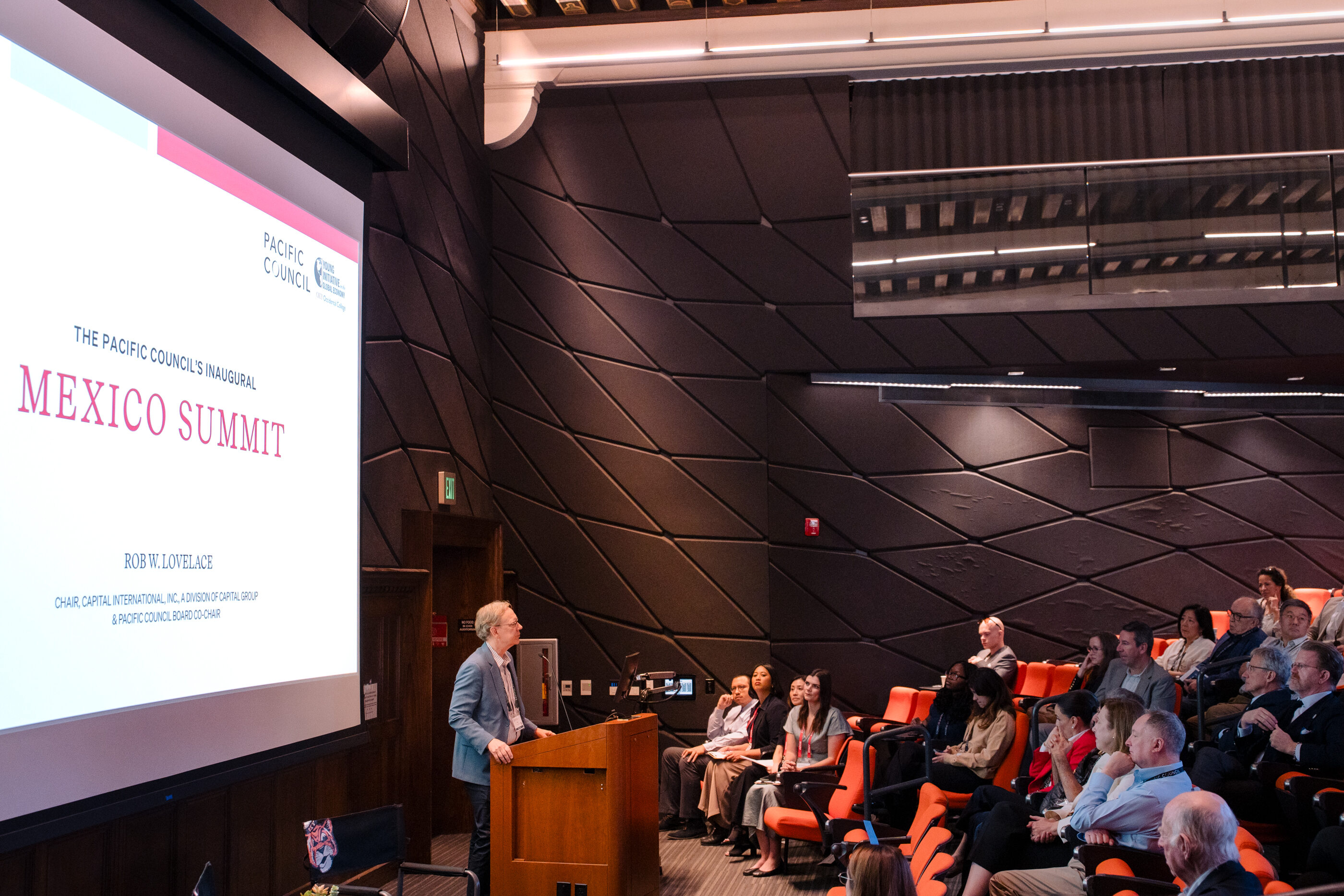
On November 7, 2026, the John Parke Young Initiative co-hosted the Pacific Council on International Policy's inaugural Mexico Summit at Occidental. Mexico's Ambassador to the United States, trade experts, Los Angeles leaders, and a Hyundai executive discussed the future of USMCA, cross-border cooperation, and North American supply chains.
What holds the United States and Mexico together when their governments disagree? On November 7, 2026, the John Parke Young Initiative on the Global Political Economy co-hosted the Pacific Council on International Policy's inaugural Mexico Summit in Choi Auditorium, four days after the U.S. midterm elections. For the Young Initiative's Student Fellows, the day began at 7:30 a.m. Fellows handed out name badges, pointed attendees from the parking lot to the Global Forum in Johnson Hall, ran microphones to audience members during Q&A, and took notes for the Pacific Council team. Between tasks, they took their seats alongside a handful of other Occidental students who had signed up to attend, in a room filled with diplomats, trade lawyers, city officials and business leaders.
Roberto Lazzeri Montaño, Mexico's Ambassador to the United States, opened the day with a keynote conversation. He described a relationship that is "very noisy" at the top but productive in its daily work, and laid out the principle he uses to manage it: "no surprises." He conveyed the idea that both governments share a diagnosis of Chinese overcapacity. He argued that North American co-production, not separation, is the remedy. "We don't have a trade relationship," he said. "We have a co-production system." Ambassador Lazzeri was also candid about what Mexico must change, noting that some imported electronics leave the country with only about 1% of their value added there. Mexico drew a record $35 billion in foreign direct investment in the first half of 2026, but it still lacks long-term certainty about its relationship with the U.S. Turning to the students in the room, he told them, "You are the owners of the future."
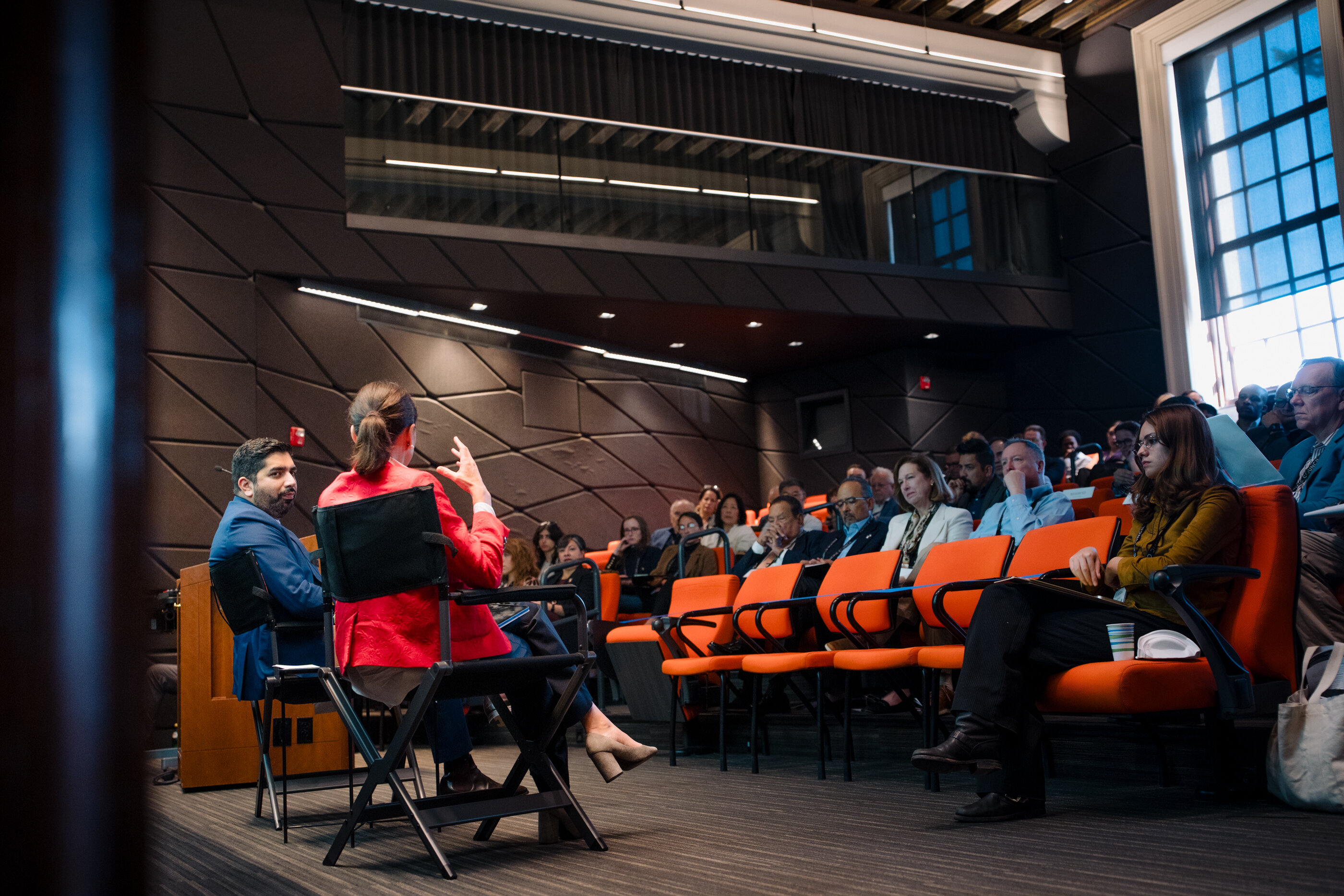
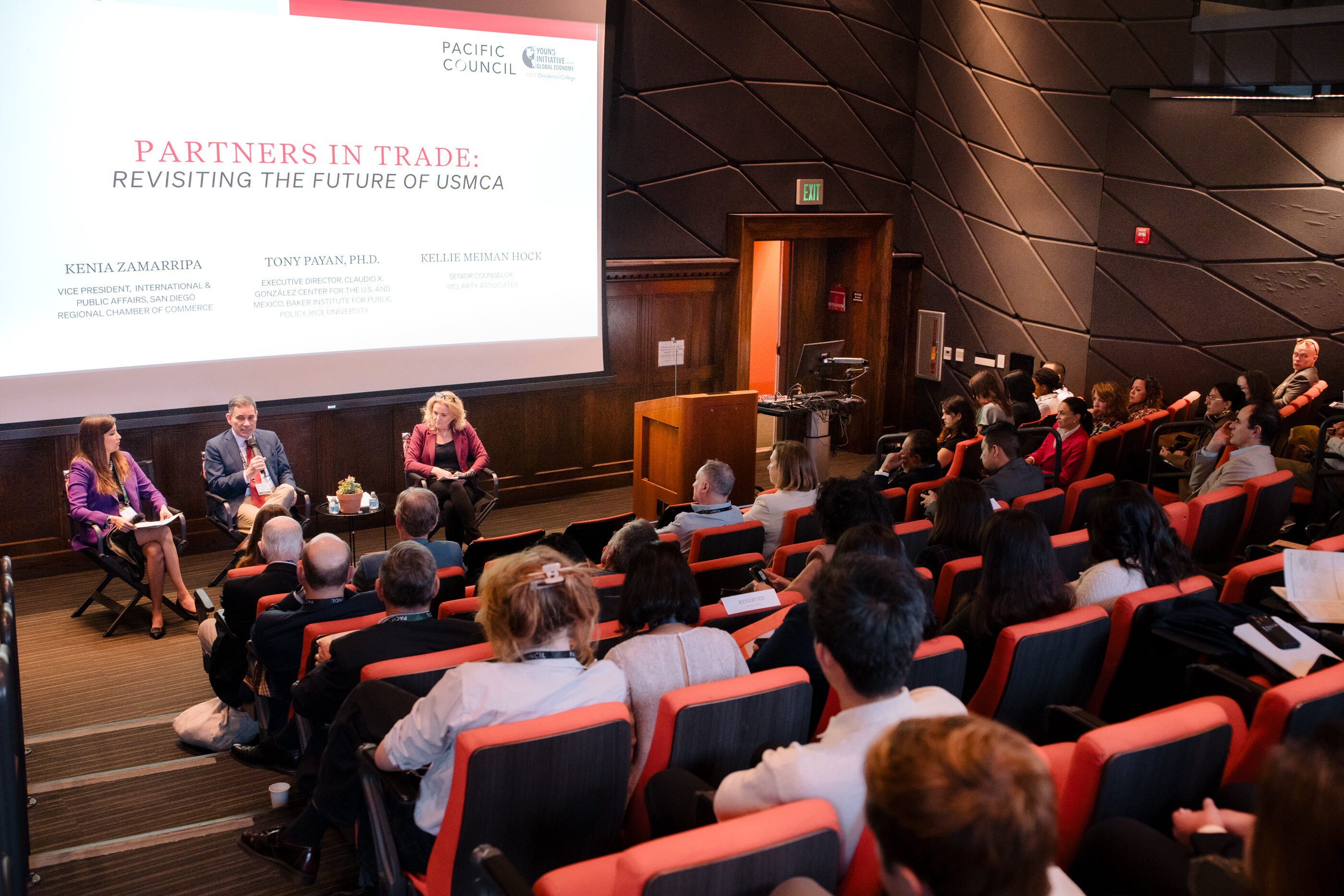
The first plenary, moderated by Kenia Zamarripa of the San Diego Regional Chamber of Commerce, took up the 2026 review of the United States–Mexico–Canada Agreement. Kellie Meiman Hock of McLarty Associates noted that North American trade totals about $1.8 trillion a year and supports roughly 13 million U.S. jobs, and traced the project back to Ronald Reagan's 1980 vision of a united North America competing with Japan and Europe. "Spoiler alert," she added, "it worked." The review itself, she said, never quite ends. "I call it the Hotel California review. You can check out anytime you like, but you can never leave. The reason we can never leave is interdependence." Tony Payan, Executive Director of the Center for the U.S. and Mexico at Rice University's Baker Institute, argued that trade's gains were real but unevenly shared, leaving displaced workers uncompensated and fueling skepticism of trade in both countries. "We're not looking at a failure of trade. We're not looking at an economic failure," he said. "We're looking at a political failure." Zamarripa offered her own image of what ending the agreement would mean: "being married for so long and then having to live together while you're divorced." One of the sharpest questions of the session came from a high school senior interning with the Los Angeles World Affairs Council, who asked how the two countries should approach AI. Payan answered with three scenarios, from Mexico falling further behind to a dedicated AI chapter in the agreement, while Meiman Hock doubted Washington could reach consensus on one. Both expected integration to continue even as the review drags on, likely into 2028.
The second plenary, moderated by Dr. Richard Downie, Senior Fellow for Latin America at the Pacific Council, looked below the federal level. Dilpreet Sidhu, Los Angeles' Deputy Mayor of International Affairs, described a city with its own foreign policy, from reassuring global partners that the ports of Los Angeles and Long Beach remain reliable to coordinating with the Mexican government during the World Cup. Mexico placed its fan zone beside El Pueblo, the city's historic birthplace, and though Mexico's team never played in Los Angeles, Sidhu said it felt like the city was its host: "you could not drive in LA without seeing a Mexico jersey every two blocks." Hector De La Torre, an Occidental alumnus who leads the Gateway Cities Council of Governments, credited personal relationships with keeping regional work steady, pointing to recent exchanges between California's courts and legislators and their counterparts in Jalisco. Dr. Maria-Elena Giner, former U.S. Commissioner of the International Boundary and Water Commission, called water "the new oil" and explained how shared data and a binational institution have allowed the two countries to manage the Colorado River together. Asked how the two countries' very different federal systems can be reconciled, she joked that a full answer "would win me a Nobel Peace Prize." When an audience member raised the Tijuana River sewage crisis, Giner noted she had been told the topic was too contentious for the panel, then answered anyway, describing a failure built up over decades and shared by both sides: "We all collectively are responsible for the issue."
The final plenary brought an industry perspective. In conversation with Marlen Marroquin of the U.S.–Mexico Chamber of Commerce, Carlos Servin, Senior Vice President at Hyundai Motor North America, described a production system now shaped as much by tariffs, content rules, rare earths and drought at the Panama Canal as by cost. "From an industry point of view, we are not against changes," he said. "But what we need is stability and consistency on the rules." Servin described the U.S. and Mexico as a single manufacturing ecosystem, though Mexico still needs rail, ports, engineers and deeper networks of suppliers. On competition from Chinese automakers, he described a reversal: Chinese manufacturers once took apart Japanese, Korean and American cars to learn from them, and now Hyundai takes apart Chinese cars to learn how they reach such low prices. Servin has ridden Mexico's Interoceanic Corridor himself, a coast-to-coast railway first built under President Porfirio Díaz before the Panama Canal existed. Hyundai has already moved thousands of vehicles across it, finds it cheaper than Panama, and is in talks to scale up. On electric vehicles, he said the company had moved too quickly toward all-battery production and is now adding hybrids to its plant in Savannah, Georgia, without changing its belief that the future is electrified.
Pacific Council board co-chair Rob Lovelace closed the summit over lunch on Cannon Plaza. He named the day's strongest theme as "we're not going back," and described an honest accounting of what had gone right and wrong in the relationship. "We can at least make new mistakes rather than making the old ones once again," he said. He ended by pointing to the students in attendance: "So excited the new generation is here that's going to help us do that."
The Young Initiative, alongside the entire Occidental community, was grateful to welcome the Pacific Council and its speakers to Oxy.