
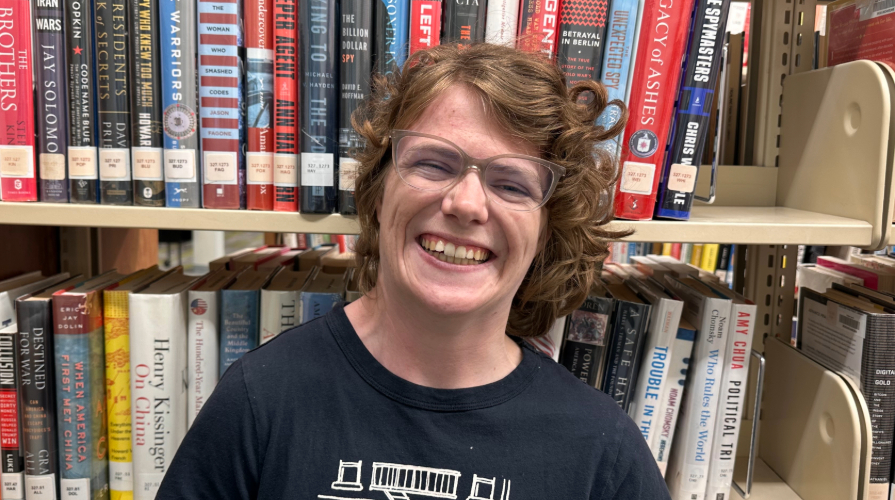
Mary Everett Hancock '23 was awarded the NSF Graduate Research Fellowship, which will fund 3 years of her PhD and allow her to dive deeper into her research which focuses on the intersection of urban economics and disability.
Why did you choose to apply for this award?
I decided to apply because I believe I have a unique perspective to bring to the field of economics, and I wanted the freedom to focus on making my research the best it can be. My research lies at the intersection of urban economics and disability. Urban economics is a relatively new subfield that is quickly growing but has yet to address the issues of how disabled people live, move, and work in cities. Conversely, much of the disability literature focuses on design of SSDI and other financial assistance programs without considering the problem of accessibility in cities and workplaces. As a disabled economist who has lived in places with populations spanning from 800 to 4,000,000, population densities spanning from 12 people to 14,000 people per square mile, and wildly different histories that continue to shape the design and culture of the region, I have had the opportunity to experience what creates opportunity for disabled people to succeed and what creates barriers to this success. This fellowship will give me the opportunity to engage with others who have insights on this matter and meet with faculty with expertise on modeling these experiences. My hope is that this research can inform disability policy from the city and regional level to the federal level.
Briefly describe the work you will be doing on your fellowship.
This fellowship will give me the time and the freedom to fully engage with my research. In light of this, I plan to reach out to organizations that focus on disability rights to gain perspective on the experiences of other disabled people in cities and their needs related to city design and workplace accessibility. I also plan to ask faculty at the University of Wisconsin - Madison, where I am currently enrolled as a dual PhD student in Economics and Real Estate, for advice on modeling these relationships and generating testable predictions. Lastly, I hope to further develop the methods in my research on rail expansion and disabled outcomes and eventually submit it for publication.
How have your experiences at Oxy prepared you to apply for this award?
I came to Oxy with goals of becoming a U.S. Senator and majoring in Politics. I enrolled in an economics-focused freshmen studies program in 2019 as a way of learning about how to craft effective economic policy. I remember quickly discovering an excitement about economics, not only as a tool but as a way of seeing the world, due in no small part to Professors Mary Lopez and Kirsten Wandschneider. I had never considered doing economics research as a career until Professor Jesse Mora asked for my help in the summer of 2021. His mentorship and confidence in the skills I was developing gave me the confidence that I could practice economics. Within two weeks of starting this work, I knew I wanted to pursue a PhD.
In the summer of 2022, I began independent research on the relationship between rail expansion and disabled employment in Los Angeles County as part of Occidental’s Summer Research Program. Under the mentorship of Professor Jorgen Harris, I learned about the art of using economic and city infrastructure data creatively to investigate new questions. In the following semesters, I took classes on cities in the Politics and Economics Departments and learned about the importance of community in shaping effective and equitable policy. I also developed a love for transportation and cities as my non-driving friends and I embarked on adventures all over Los Angeles, aided by the ever-growing Los Angeles metro system.
In summary, the close-knit community of Occidental and the enthusiasm of faculty and students is ultimately the reason I decided to pursue a PhD, the reason I developed a deep love for cities, and the reason I had the confidence to believe I could bring a unique perspective to the field.
What advice would you give future applicants about the application process?
I think it is important not only to make the case that this research is important but also to consider the perspectives you bring to related research in your field. Lean into your curiosities and excitement about the world around you and think about why you have these feelings. Take courses on topics that you’re curious about and talk to your friends and faculty about these topics. It’s these practices that lead to novel questions and approaches to research that excite people in the field.