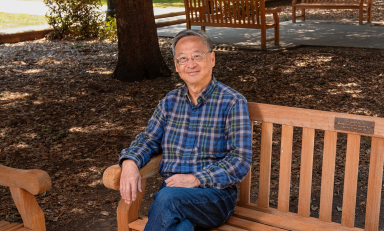
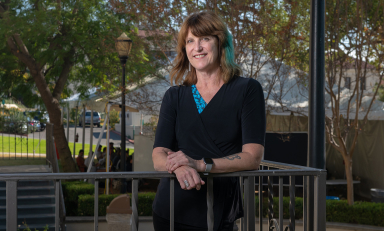
Thom Harp ’92 waited for years to direct his first movie—and after a long birthing process, he’s the proud father of two features
As a student filmmaker at Occidental, Thom Harp ’92’s storytelling choices gravitated toward affairs of the heart—even if his approach to the subject matter feels a little jaded in hindsight. His senior comps film, Be My Girl, was about a man who is in love with a blow-up doll and the marital troubles that ensued. An earlier short, The Proof Is in the Pudding, depicted a 1950s housewife who poisons her husband with the titular dessert. “I was not in a good place with relationships,” he admits with a laugh.
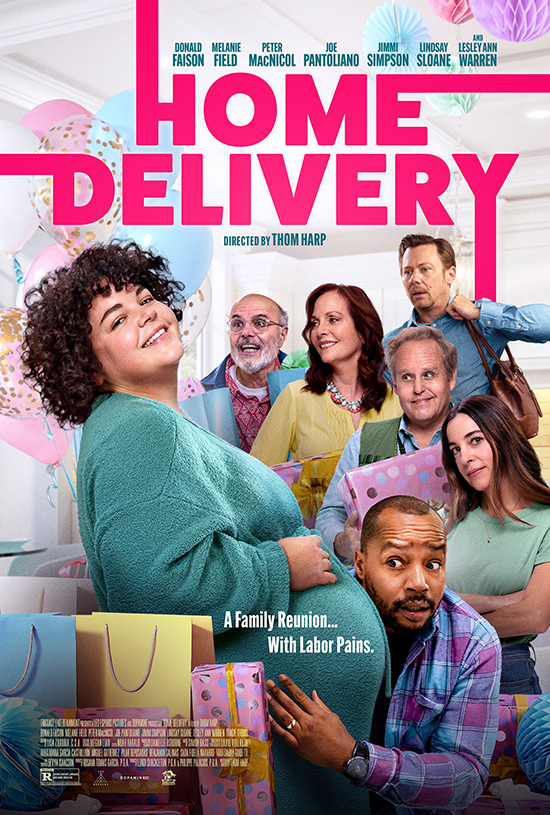
More than three decades later, Harp is still in touch with his emotions, with a pair of comedies that tackle the prospect of parenthood from wildly divergent perspectives. Home Delivery, which opened in theaters nationwide on March 27, centers on a young newlywed who invites her estranged family to witness the home birth of her first child. It’s his follow-up to The Donor Party, his 2023 feature about a single woman trying to conceive a baby through a one-night stand unbeknownst to the prospective father.
“The kinds of stories I’m attracted to are where there’s someone who gets a really bad idea, but it’s a really good bad idea,” says Harp, whose comic short films have played at festivals worldwide and garnered more than a million views on Funny or Die. Thirty years into his career, Home Delivery and The Donor Party are his first two features.
While Harp is a bit of a late bloomer by comparison with many of his contemporaries, “I said yes to all of the opportunities that gave me richness in life,” he notes. “I said yes to going to Alaska with my wife. I said yes to having kids in the middle of her med school. Each of those opportunities ends up being something that is part of who I am—and it naturally comes out in the work.”
After a brief flirtation with psychology, Harp wound up double majoring in film and theater—a period he remembers as “being drunk on creativity.” Film and media studies professors Chick Strand and Esther Yao “gave us the freedom to figure out what we wanted to make. I was focused on narrative filmmaking. I even bought a light meter and rented a dolly for my senior comps.”
After graduating, Harp worked as a camera assistant and cinematographer. He got back together with Karin Patterson ’92, whom he had briefly dated in college. Karin, who had majored in kinesiology at Oxy, told him she was applying to med school, and the couple made a pact “to go wherever she got into school,” Thom says. The couple was married in 1995, and after spending a year in Karin’s native Alaska, they moved to Seattle for med school, Portland, Ore., for her intern year, and back to Seattle for her residency.
While Karin was studying to be a dermatologist, the couple was living off Thom’s income, “which fluctuated wildly,” he says. “Some months I would do really well, and other months I would get two days of work.” He was shooting his first feature when Karin visited the set one day with the welcome news that they were having a baby.
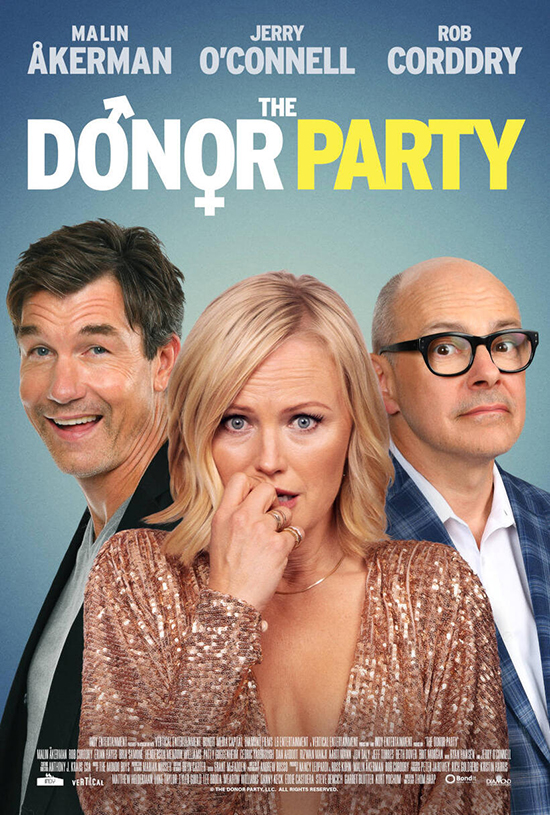
Their second child, Quinlan, was born midway through Karin’s studies, and his arrival marked a turning point in Harp’s career. “Together, we decided that I would stay at home and raise the kids, and I would shift my focus to writing,” he says. “I had this idea that eventually became The Donor Party about someone who was desperately trying to get pregnant because of the craziness that we went through.”
Fatherhood changed his approach to writing as well. “While I was changing my eldest, there was a massive diaper blowout,” he recalls, “and my baby was smiling and laughing and having the best time.” In that moment, he had a messy epiphany: “How can I take this world seriously? The only way to survive is having a sense of humor.” The first feature he wrote was a comedy, and he’s never looked back since.
Harp found a writing partner in Seattle, advertising professional Mike Standish, and they wrote a script called Booty Camp that landed them a manager. In 2005, they were invited to make a short film for the Seattle International Film Festival: “You had to write a film in a week, shoot it in a week, edit it in a week, and then present it at the festival,” he says. “Our film was a love letter to John Hughes movies called Driver’s Ed, and the audience was blown away.”
Their next short, filmed at a fortune cookie factory in Seattle and titled Fortune Hunters, starred Gedde Watanabe (16 Candles) and played at festivals worldwide.
In 2010, a feature-length treatment of Driver’s Ed was optioned by Paramount and came within a three-point turn of getting made. Harp moved his family to Los Angeles and began taking meetings. Then Paramount released a teen movie that crashed and burned at the box office, “so they decided not to do any more teen comedies,” he says.
“Everything fell apart after we moved. I lost my manager, my writing partner stepped away from the industry, and I felt like I’d put my family through a major upheaval for nothing,” he says. “Eventually, I wrote another script that helped get me back into the mix.”
One of the best pieces of advice Harp ever got came from filmmaker Lynn Shelton (Humpday), with whom he came of age in the Seattle independent film scene. “I would shoot her short films and she would edit my short films,” he recalls, “and she told me, ‘If you want to make something inexpensive, then you have to give yourself really strict parameters. You should be in one location for that whole day—you lose several hours loading up the truck again and moving to the next location. If everything happens over the course of a day, then it’ll help with the costume changes and the hair continuity.’”
In 2014, he completed the first draft of Home Delivery, leaning into his ability to create strong characters and giving each one their own voice. “I wanted to tell a story that was intimate, character-driven, and producible,” he says. The film begins as a broad comedy and sneaks deeper emotions into the narrative as it unfolds.
“At its core, it’s about family dynamics—how complicated and messy those relationships are,” says Harp, who is a child of divorce. “But it’s also about what happens when something real forces everyone to show up for each other. The emotional core of the story comes from lived experience.”
Adhering to Shelton’s maxim, Home Delivery takes place over two days. (The film is dedicated to Shelton, who died of acute myeloid leukemia in 2020 at age 54.) “I wrote it to be cheap enough for me to direct—that was a non-negotiable,” Harp says. “I knew I could do a really good job with it because I knew that it would play into a lot of the strengths that I got at Oxy through the Theater Department, like working with a group of actors telling an ensemble story. I really wanted this one for myself.”
In 2019, Home Delivery finally secured funding, with Harp attached to direct. The pandemic threw a wrench into the schedule, but filming commenced years later with an ensemble cast that includes Donald Faison, Joe Pantoliano, Lesley Ann Warren, Peter MacNicol, and a third-act appearance by Rainn Wilson as a midwife.
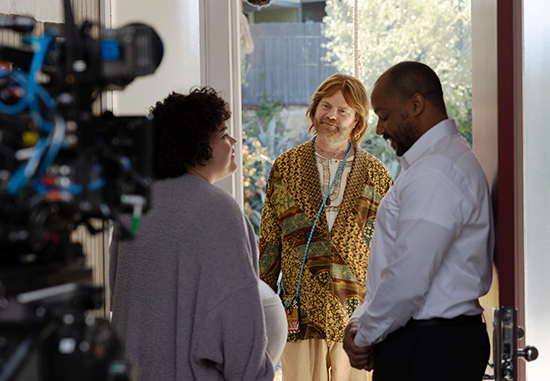
“One of the advantages of writing a small, ensemble piece is that you can give every character something meaningful to do,” Harp says. “Actors respond to that—they want moments to shine. I was also fortunate when we found Melanie Field for the lead. She was a revelation, bringing vulnerability and humor to the part.”
Harp wrote Wilson’s character with The Office stalwart in mind after directing a short for his production company, SoulPancake, titled Phil Ma: Fortune Cookie Writer, starring Randall Park. During the pandemic, the two collaborated on a 15-episode comedy podcast, Dark Air With Terry Carnation, starring Wilson as the embattled host of an AM radio paranormal call-in show.
“Rainn asked me to not only be one of the writers but also to produce the show. I ended up doing a lot of the directing as well,” he says. Performing the show over Zoom, “The writers and creatives would pitch jokes in the chat and Rainn was so fast and was able to incorporate our notes into the improv sections. We also had these scripted segments that were absolutely bonkers.”
Currently, Harp has a number of film projects in development. Crash Course—the screenplay formerly known as Driver’s Ed—is looking to go into production this summer with Harp as director (“Nothing is ever truly dead in this business”). He’s also working on a murder-mystery comedy, Killer Party, which he will direct for producer Josh Shader, and an adaptation of the New York Times bestseller Business or Pleasure for producer Margot Hand, whose Barb and Star Go to Vista Del Mar was a pandemic-era streaming hit.
While Harp may have forgone pursuing a psychology major at Oxy after an iffy grade in a statistics class, he’s never given up on trying to figure out relationships. “In Shakespeare, either everyone dies or everyone gets married—that’s the paradigm,” he says. “I have a great marriage and I believe in the possibility of great relationships, but I know that it comes with as many valleys as there are peaks. You can choose to see life as meaningless, or tragic, or hilarious. I choose hilarious because it gives me strength.”
Tags