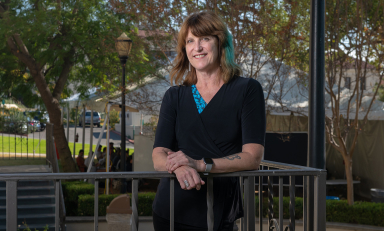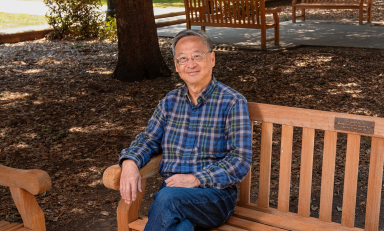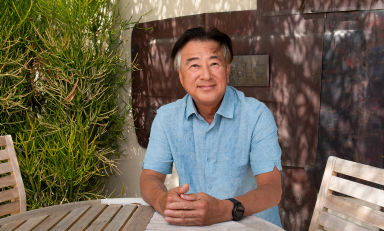
Fifteen new tenure-track faculty and a veteran kinesiology professor discuss their favorite classes, their passion for teaching, and what brought them to Oxy (hint: Location!)
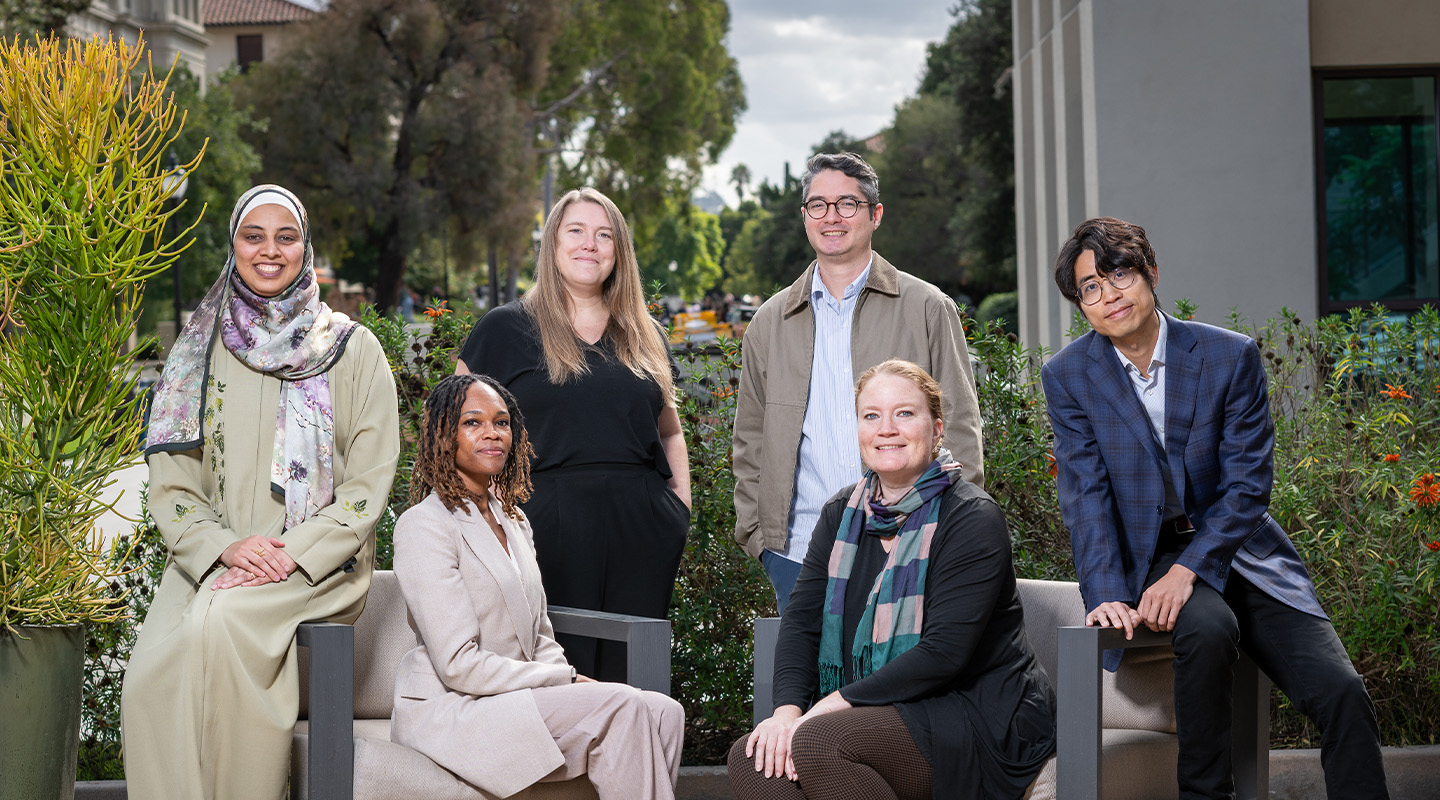
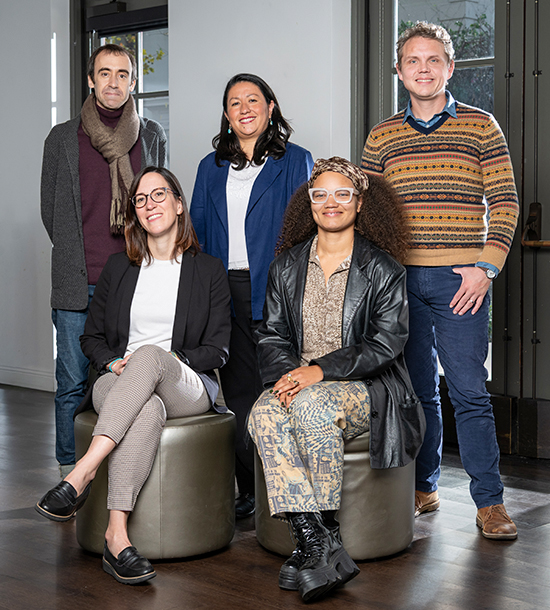
Above photo, from left: Assistant professors Alaa Abdelfattah (economics), Tiffany Wheatland-Disu (Black studies), Madeline Wander ’08 (urban and environmental policy), Joel Walsh (computer science), Margaret Gaida (history), and Kai Yui Samuel Chan (politics).
Alaa Abdelfattah, Economics
Tiffany Wheatland-Disu, Black studies
Madeline Wander ’08, UEP
Joel Walsh, Computer Science
Margaret Gaida, History
Kai Yui Samuel Chan, Politics
Alberto López Martín, Spanish & French Studies
Carla Macal, CTSJ
Tiffany Wheatland-Disu, Black studies
Madeline Wander ’08, UEP
Joel Walsh, Computer Science
Margaret Gaida, History
Kai Yui Samuel Chan, Politics
Alberto López Martín, Spanish & French Studies
Carla Macal, CTSJ
Dusty Madison, Physics
Manuela Borzone, Spanish & French Studies
Summer Sloane-Britt, Art & Art History
Meiqing Zhang, Computer Science
Frank Macabenta, Biology
Vanessa Yingling, Kinesiology
Eric Bjorklund, Sociology
Alyssa Rodriguez, Biology
Manuela Borzone, Spanish & French Studies
Summer Sloane-Britt, Art & Art History
Meiqing Zhang, Computer Science
Frank Macabenta, Biology
Vanessa Yingling, Kinesiology
Eric Bjorklund, Sociology
Alyssa Rodriguez, Biology
Alaa Abdelfattah, Economics
Alaa Abdelfattah grew up in Cairo, Egypt, and lived through the Arab Spring around the time she was heading to college. “I planned to major in economics and politics to be an agent of change for my country,” she explains. “When I got to college I was really sold on economics’ emphasis on causality and the notion that we need to identify the real causes of inequality to address them instead of the Band-Aid solutions we often apply. So, I abandoned politics, majored in economics and minored in English and American literature, and the rest is history.”
After the 2011 “revolution,” she says, “It seemed that a lot of men lost their jobs and women were carrying the torch. This had me thinking that national shocks—whether it be a political upheaval, a pandemic, or a financial crisis—could affect different groups differently and, depending on a locality’s demographic composition, different places differently. When I got to grad school, I decided to test the theory.”
Abdelfattah, who joined the Occidental faculty last fall as an assistant professor of economics, is currently teaching two classes: ECON 101 and Urban Economics (ECON 323). The latter “is fun to teach at Oxy,” she says, “because we get to learn about cities in an interactive way. One task I assign my students is to walk around a neighborhood of their choice in Los Angeles and take note of food, healthcare, and school access options to test the consumer city theory we are learning in class.”
Abdelfattah is one of 15 new tenure-track appointments at Occidental this year at the assistant professor level. (A 16th appointment, Vanessa Yingling, joins Oxy as a fully tenured professor of kinesiology.) In the pages to follow, we learn a little more about their research, their classes, and even a few “Eureka!” moments that sparked their academic pursuits.
Full Biography
Alaa Abdelfattah studies the distributional effects of public policy and national economic shocks on local labor markets. She is particularly interested in spatial inequality and the factors that contribute to wage and firm dispersion across space and over time. Her recent work studies the effect of large firms' subsidies on workers' wages and employment options. In another project, she evaluates the effect of COVID on employer's skill demand across different markets that were unequally affected by COVID due to their industrial composition. Abdelfattah has a Ph.D. in economics from UC Davis.
Tiffany Wheatland-Disu, Black Studies
When Tiffany Wheatland-Disu visited Oxy in January 2025, she was drawn to the newness of the Department of Black Studies, impressed by the “dynamism and methodological diversity” of the faculty’s research and scholarship, and excited by the prospect of contributing to the shaping of Black studies at the College.
Pursuing her master’s in international affairs at The New School sparked an interest in development economics. “Much of history is shaped by the choices we make in times of scarcity and abundance alike,” she says. “The study of economics is fundamental to understanding the complex histories of past and present societies”—nowhere better demonstrated than in the field of African history.
Inspired by her “dear friend,” Maurice Carney, co-founder and executive director of Friends of the Congo, she developed a course (BLST 212) that engages students in critical analysis of the pivotal role of Africa in fueling the global Green Energy transition.
“The Democratic Republic of the Congo possesses an estimated $24 trillion in natural resource wealth, yet the vast majority of Congolese citizens remain impoverished,” she says. “In my class Fueling the Green Energy Revolution: The New Scramble for Africa, students are encouraged to consider the centrality of the Congo’s resources to our daily lives, critically interrogate dominant narratives of sustainability, and reimagine more just models of development for all.”
Full Biography
Tiffany Wheatland-Disu is the Mellon Postdoctoral Fellow in the History and Culture of the 20th and 21st Century African Diaspora. Her research and scholarship bridge the histories of decolonization, Black radicalism, and Black political thought. In 2025, Wheatland-Disu earned her Ph.D. with distinction in History from Howard University where she was awarded several fellowships including the prestigious, Sasakawa Young Leaders Foundation Fellowship. Her dissertation, A History of the All-African People’s Revolutionary Party (A-APRP), 1968-1998: A Pivotal Moment in Black Internationalism, investigates the transnational dimensions of political thought and praxis inspired by Kwame Nkrumah’s 1958 All-African People’s Conference in Accra, Ghana. Previously, she served for more than a decade as a lecturer of Africana studies at John Jay College of Criminal Justice, CUNY in New York City. Beyond the classroom, she has worked extensively in the nonprofit sector, advocating for social justice for underserved immigrant communities of African descent.
Madeline Wander ’08, Urban & Environmental Policy
Madeline Wander enrolled at Oxy eager to study and pursue social justice, “but as a first-year, I had little direction,” she says. Professor Amy Lyford’s First Year Seminar titled Architecture, Urbanism, and the Politics of Space in Los Angeles helped give her that direction—and soon after, she learned about the Urban and Environmental Policy Department. “UEP is a gem,” Wander says. “It not only helps students develop understandings and analyses of what they see in the world but provides tangible opportunities to get involved in the work on the ground.”
Through internships and in-class engagement with community organizers, the UEP program was Wander’s conduit to getting involved in social movements, which continues to drive her work as an engaged scholar in and of Los Angeles. “Even after I graduated, my former professors continued to provide guidance and connections as I found my place in the movement for social justice.”
Returning to Oxy as an assistant professor, to the very department that was so influential on her own trajectory, “I can now contribute to UEP’s scholarship—particularly in the areas of transportation and racial inequality—and engage with undergraduates toward questioning systems of oppression, imagining what a more just world could look like, and planning how we might get there.”
Full Biography
Madeline Wander ’08’s doctoral research examined the relationship between mobility and racial-spatial isolation in suburban environments, particularly in Southern California. A scholar of transportation and racial-spatial inequality, her commitment to social justice and experience as a community organizer drives her research and teaching. An urban and environmental policy major at Oxy, she received a master’s in urban and regional planning and a Ph.D. in urban planning from UCLA.
Joel Walsh, Computer Science
“I didn’t know much about Occidental before moving to L.A.,” Joel Walsh admits. “I began to hang out with a friend’s partner and her crew, all of whom went to Oxy. They described an idyllic undergraduate experience where they had opportunities to do research and get to know their professors. It sounded great.” As luck would have it, both Walsh and his friend—the aforementioned Madeline Wander—were hired by Oxy this year.
Walsh first became interested in computer science as a high school math teacher. “In California at that time you had to have a mathematics credential to teach computer science. I became the comp sci teacher and STEAM Club adviser and we all learned how to code together. When I went back to graduate school, I knew that I wanted to really learn how a computer works, and how computing could support human flourishing.”
Of his current course load, Walsh is particularly enjoying COMP 395: Deep Learning. “When I was a grad student, I thought deep learning was magic, so now I get to teach magic,” he says. “Students can expect to develop an understanding of the mathematics behind Deep Learning, and how to use Python frameworks that are standard in industry like Pytorch, Numpy, and Scikit-Learn.”
Full Biography
Joel Walsh analyzes the intersection of educational technology, artificial intelligence, and natural language processing. He specializes in designing novel learning technologies that utilize machine learning, multimodal models, and knowledge representation. He comes to Occidental from the USC Institute for Creative Technologies, where he was an AI research intern at Finetune Learning, and previously taught high school mathematics in Los Angeles. He has a Ph.D. in STEM education and an M.S. in computational science, engineering, and mathematics from UT Austin.
Margaret Gaida, History
After completing a B.A. in physics and a master’s in philosophy of science, Margaret Gaida took some time away from academia to explore other career possibilities. She studied Arabic and moved to Tunis, Tunisia, where she learned about medieval Muslim scholar Ibn al-Haytham, whose optical works were translated into Latin and then cited by the Renaissance sculptor Lorenzo Ghiberti.
“I was fascinated by this story,” she says, “and when I spoke to a mentor about possible career trajectories, he mentioned the history of science.” She had a background in both Latin and Arabic as well as some technical mathematical skills from her physics studies—the perfect combination for working on the Arabic-Latin translation movement in the 12th and 13th centuries, and astronomy, astrology, and optics.
“Once I got my hands on the rare books in the History of Science Collections at the University of Oklahoma, and then manuscripts at the Vatican Library, I was hooked for life,” Gaida declares.
Full Biography
Margaret Gaida studies cross-cultural knowledge transmission in the medieval Mediterranean, with a particular focus on astronomy, astrology, optics, and magic. A historian of science, her work draws on manuscript studies in Latin and Arabic, the history of the printed book, and the material and visual culture of premodern scientific practice. She is currently writing her first book, tentatively titled The Lost Art of Arabic Astrology. Gaida also maintains active research interests in the history of the occult sciences more broadly, as well as in women’s history. Gaida received her Ph.D. from the University of Oklahoma and comes to Occidental from Caltech, where she taught courses in the humanities for the last five years. This spring, she will be a Museum Fellow at the Getty Research Institute.
Kai Yui Samuel Chan, Politics
Born and raised in Hong Kong, Kai Yui Samuel Chan’s undergraduate years were marked by an “extremely vibrant intellectual and contentious political atmosphere,” which greatly shaped his intellectual and personal journey. “My initial intellectual puzzle arose out of my participation in the 2014 Umbrella Movement in Hong Kong: How should activists organize democratically in the absence of hierarchical authorities and formal procedures?” This question led him into political theory at UC Berkeley, and his interests have since broadened to how people should think about political relationships, both national and transnational.
In his current class, Theorizing Membership and Migration (POLS 253), students consider fundamental theoretical questions: What is the nature of a political community? What is the meaning of citizenship? How should we think about a world that features asymmetrical patterns of mobility? “While there is no way we can talk about this course without also discussing what is currently happening in this country,” Chan says, “it also tries to get students to step back, both by examining theories and concepts, and by looking at cases of other countries.”
A recent assignment asked students to pick a non-U.S. example to illustrate a principle of citizenship allocation. “Folks chose cases from all the major continents,” he says. “I’ve learned a lot from reading the papers!”
Full Biography
Kai Yui Samuel Chan teaches classes on political theory, democratic theory, and transnational politics. His research concerns individuals and communities traversing state borders. Chan’s current book project, Entangled Peoplehood, examines self-determination in light of the challenges confronting colonized, indigenous, and exiled peoples as they navigate an existing global order of nation-states. His previous research has been published in American Journal of Political Science, Political Studies and the European Journal of Political Theory. Chan has a Ph.D. from UC Berkeley in political science with a specialization in political theory.
Alberto López Martín, Spanish & French Studies
Native Spaniard Alberto López Martín’s interest in the country’s literature and graphic narrative lies in “better understanding political and economic contexts considered moments of crisis or emergency through the cultural production that emerges alongside them,” he says. “I am particularly interested in exploring how cultural discourses such as historical memory related to Francoism or Spain’s environmentalist tradition are represented in comics and poems, and in examining the role these texts play in amplifying, enriching, or complicating such debates.”
He’s hard-pressed to choose a favorite class—“I’ve been fortunate enough to teach courses on ecocriticism, graphic narrative, and migrant narratives in Spain”—but ultimately cites the Spanish Studies senior seminar he taught at Oxy last fall. The classroom conversations “helped me better understand the culture of the College,” he says. “For me, it is very important that, through our readings and conversations, our students develop a deep understanding of cultural phenomena and ecosocial challenges in the Spanish-speaking world and their connections to global issues and to those in the United States; and, of course, that they also refine their Spanish and feel comfortable using the language.”
Full Biography
Alberto López Martín specializes in 20th- and 21st-century Spanish cultural production, with a focus on contemporary poetry, comic, and graphic novels. An economist by training, his research explores representations of ecosocial crises through the theoretical frameworks of ecocriticism and affect and emotion studies. His scholarly interests also include Spanish for specific purposes and ecopedagogy. His first book, Poéticas indignadas (Outraged Poetics), examines evolving notions of poetic commitment in the Spanish literary scene in the aftermath of the 2008 Great Recession. López has a Ph.D. in Spanish from Florida State University. He comes to Occidental from Valparaiso University, where he was an associate professor of Spanish.
Carla Macal, Critical Theory & Social Justice
Born in Guatemala but raised in Los Angeles, Carla Macal’s interest in critical theory and social justice stems from her academic background in sociology, social work, and geography. “I am very much an interdisciplinary, first-generation scholar who is curious about how systems of oppression generate social inequality.” She cites mentors at UC Irvine (Rudy Torres), the University of Oregon (Laura Pulido), and UCLA (Victor Narro) “who supported me academically and have written extensively about inequality in Los Angeles, looking at the formation of settler colonialism and structural violence.”
Macal’s specialty lies in the intersections of anti-colonial feminisms and popular education pedagogies of Paulo Freire and bell hooks. Last semester, she taught Decolonizing Education (CTSJ 227), where students engaged and learned about nontraditional methods like testimonio, body mapping, and counter-data. “Students created a human-sized body map and individual body maps about their environment, home, and geographical location,” she says. “It was great to see the participatory experience this class engaged in and how students can apply these methods in their comps or other classes.”
Full Biography
Carla Macal studies the intersections between state violence and intergenerational healing. Her book-in-progress, Healing Cartographies: GuateMaya Feminists Weaving Transformative Memory Across the Hemisphere, follows the oral and embodied testimonies of Guatemalan and Maya women survivors of the 36-year Guatemalan Civil War (assistant professor, 1960-96) and their production of counter-cultural memory. Macal also is the creator of Ixoq Arte, a natural body care product created to preserve ancestral Indigenous knowledge. She comes to Occidental from UC San Diego, where she was a UC President’s Postdoctoral Fellow in the Department of Literature.
Dusty Madison, Physics
“I’ve been fascinated by outer space for as long as I can remember,” Dusty Madison says. “More precisely, I’ve always been a little terrified of space. It’s so big and empty and I’ve always struggled to wrap my head around it. I had a love for space before I even knew what physics was—and when I finally took a class in high school, things really clicked for me.”
As a gravitational-wave astrophysicist, Madison appreciates the precise quantitative reasoning that physics entails. “Physics research requires a lot of creativity, but not just any creative idea will do,” he says. Things eventually have to hold up to experimental or observational tests.”
Madison insists that he doesn’t have a favorite class to teach. “There’s so much fascinating content to be covered in any physics class that I can find things I am passionate about and that I want to make the students passionate about.” He was happy to teach Astronomy (PHYS 102) last semester: “We cover tons of cool stuff about astronomy. It’s an excellent class for anyone interested in dipping their toes into the physics pond.”
Full Biography
Dustin “Dusty” Madison is an astrophysicist working on new and creative ways to study the gravitational Universe. He studies gravitational waves—tiny ripples in the fabric of space that can teach people about some of the most extreme systems in the universe, like black holes orbiting each other. Madison’s efforts have mostly been as a member of NANOGrav, a pulsar timing array using world-class radio telescopes to monitor the precise clock-like behavior of pulsars as they float about in a churning sea of gravitational waves. He has a master’s and Ph.D. in physics from Cornell University and did his undergraduate studies at UC Berkeley.
Manuela Borzone, Spanish & French Studies
Manuela Borzone brings a global, interdisciplinary sensibility to her teaching in Spanish and French studies, shaped by her academic path from Argentina to Los Angeles, with a few stops along the way. “I love working with students in the liberal arts,” she says, recalling how exposure to a small New England college after her B.A. revealed “the wonderful and highly creative connections between disciplines that students were making.” That experience, combined with Oxy’s location—big city, warm weather, with the ocean and mountains well within reach—sealed the deal.
A native Spanish speaker, Borzone is passionate about language in all its complexity, from structure to cultural nuance. She is equally invested in literature and the arts, noting their “power to compel us to think about the human condition.” Her scholarly focus grew out of her own migration experience, leading her toward comparative approaches before specializing in Southern Cone studies.
Last fall, Borzone taught The Argentinian Imagination (SPAN 374), a course she designed to introduce students to the culture of the country through its literary and cultural production from the 1810s to the present; its syllabus spans short stories, novels, music, film, and graphic narrative, as well as history, politics, and a pinch of economics. “Focusing solely on one literary tradition from multiple angles allows us to go really deep,” she says, “and I think students come away really interested in studying abroad in Argentina or, if they are returning from study abroad, to continue to broaden their interest in the country.”
Full Biography
Manuela Borzone is a literary scholar whose work focuses on the representation of the Argentine gaucho in literature, illustration, and film. She has earned several awards, including best peer-reviewed article, distinguished teacher, and scholar of the year, and her research has appeared in award-winning collections. At Oxy, she teaches a variety of courses which range from Spanish language to upper-level literature and culture. Borzone has a Ph.D. in comparative literature from the University of Massachusetts Amherst and comes to Occidental from Nebraska Wesleyan University, where she taught for three years.
Summer Sloane-Britt, Art & Art History
Summer Sloane-Britt began volunteering at museums in middle school. “My community was full of artists and creative people, often frustrated with how historians or writers positioned their work,” she recalls. “I decided that I didn’t want to be an artist; instead, I wanted to serve as a voice for artists, advocating for their viewpoints, relating their work to sociopolitical contexts, and honoring their distinctive journeys.”
Sloane-Britt’s primary area of focus examines how liberation movements and photography intersect. While doing graduate research on the Black Freedom Movement, she discovered Mexican-American photographer Maria Varela’s images of cooperative farms in the rural American South, a project commissioned by the Student Nonviolent Coordinating Committee (SNCC).
The more images she found from SNCC, the more focused Sloane-Britt’s research became. “An important part of my current book project is the attempt to intervene in considering U.S. organizing worlds as detached from one another, instead looking for the intersections.” She points to Varela, who worked with SNCC before moving to land rights organizing in New Mexico and shared images with the United Farm Workers. “The images she made were emotionally received by farmers who felt connected to one another, despite geography or having never met, through their common struggle for self-determination in the wake of American imperialism.”
Full Biography
Summer Sloane-Britt has a B.A. from Swarthmore College and a Ph.D. in art history from the Institute of Fine Arts, New York University. She researches the global history of photography, particularly the intersection of photography and liberation movements. Her dissertation explores the Student Nonviolent Coordinating Committee (SNCC) photography department, emphasizing their innovative contributions to the 1960s Black Freedom Movement. At the Institute, Summer co-curated the 2021 exhibition Cauleen Smith, H-E-L-L-O: To Do All at Once and a recent group exhibition on Chicane muralism in Los Angeles. Sloane-Britt has held positions at the Billie Holiday Theatre, the National Gallery of Art, the Grey Art Gallery, the Metropolitan Museum of Art, and the Philadelphia Museum of Art.
Meiqing Zhang, Computer Science
“The logic and problem-solving involved in computer science can be very fun, rewarding, and even aesthetically pleasing,” says Meiqing Zhang. Coming from a social science background, she found “the challenge and promise of combining computational approaches with social inquiry quite fascinating.”
Last semester, Zhang taught natural language processing (NLP), a rapidly evolving field. “We covered the contemporary state-of-art approaches to NLP as well as the evolution of techniques leading up to large language models. Students learned NLP with deep learning and the architecture underpinning LLMs, which can be applied to a variety of natural language tasks.”
Outside of work, Zhang says, “I tend to be spontaneous. Los Angeles has much to offer through its food, cultural, arts and sports scenes.” That totally computes.
Full Biography
Meiqing Zhang comes to Oxy from Wesleyan University, where she was a postdoctoral research fellow in computational social science. Zhang has a B.A. from Harbin Engineering University; a master’s from the University of Chicago; and a master’s in computer science and Ph.D. in communication from USC, specializing in political and computational communication. Her research draws on computational methods, including machine learning and natural language processing, to study media and politics. She has taught natural language processing, social data science and machine learning methods in audiovisual analysis.
Frank Macabenta, Biology
Frank Macabenta has been interested in both science and art since he was a child. He was introduced to developmental biology in grad school when he did a rotation in a fruit fly lab. “The high-resolution images of immunostained tissues we obtained using confocal microscopy felt like a union of two of my biggest passions,” he says. “Fruit flies are extraordinarily well-suited to introducing undergraduate students to both introductory and advanced concepts in biology through their ease of handling, relevance to human biology—60 percent of genes are conserved between fruit flies and humans—and the vast array of genetics, cell, and molecular biology tools we have available.”
As a student at the University of Guam, Macabenta got to know and interact with his professors “way more than if I had gone to a much larger university,” he says. Looking at Occidental under the microscope after several years at Cal State Monterey Bay, where he worked with an “incredibly diverse” student body, “It is clear that the rich learning environment at Oxy reflects the values that have shaped my own journey as a scientist and an educator.”
Full Biography
Frank Macabenta focuses on understanding the mechanisms underlying collective cell behavior leading up to organogenesis. Through a combination of confocal microscopy and the vast array of genetics, cell biology, and molecular biology tools available to the Drosophila fruit fly model system, he seeks to uncover the gene regulatory networks that control cell fitness determination, intercellular communication, and collective migration leading up to the assembly of the larval midgut muscles. Macabenta has a Ph.D. in cell and developmental biology from Rutgers University. He comes to Occidental from Cal State Monterey Bay, where he was an assistant professor of biology.
Vanessa Yingling, Kinesiology
After 25 years of kinesiology education and research, Vanessa Yingling was hired to help reimagine Occidental’s Kinesiology Department during a period of transition, an opportunity she fully embraces. “Kinesiology is a dynamic, multifaceted discipline that works well with other departments and programs,” she says. “Students benefit from an integrated multidisciplinary education in the field, whether their goals are pursuing a doctorate in physical therapy or other healthcare professions, working in the community, or owning a small business.”
Occidental’s focus on community partnerships aligns with Yingling’s vision for a kinesiology program—to translate academic knowledge into applied practice. “Equipping students with the skills to critically evaluate information and distinguish reliable sources from pseudoscience is crucial for their success in academia and beyond,” she says.
“Engaging with students as we build a research infrastructure in the department has been rewarding and fun to watch,” Yingling adds. The department held a Kinesiology on the Quad event last semester, and she introduced the Occidental Kinesiology Research Group (OxyKRG) “to provide the structure as we grow research in the department with few faculty.” Modeled after a similar group she had at Cal State East Bay, its goal is “to prepare students not just to consume science but to create it—with integrity, curiosity, and the skills needed for graduate study, professional advancement, and lifelong engagement with kinesiology.”
Full Biography
Vanessa R. Yingling is a biomechanist, educator, and researcher focused on bone strength development and health, with a particular interest in translating her research into programs or information to benefit the public. Yingling has a B.S. from UC San Diego; an M.S. from State University of New York, Buffalo; and a Ph.D. from the University of Waterloo. Her postdoctoral fellowship was at Washington University in St. Louis Medical School in the Department of Orthopaedic Surgery. She comes to Occidental from Cal State East Bay, where she was a professor of kinesiology.
Eric Bjorklund, Sociology
“Like a lot of students entering college, I had never heard of sociology,” Eric Bjorklund says. But from his very first class (SOC 101), “I was hooked. Growing up I was passionate about history—it unlocked the past and provided a powerful lens for contextualizing the present. The sociological perspective felt like the missing piece of the puzzle.
“Likewise, I became deeply engaged in politics and direct action via the punk/hardcore scene. Sociology captured what I was passionate about while providing the tools to focus my interests on formal research.”
Last semester, Bjorklund taught “two very different but equally fun courses” at Oxy. Health & Illness (SOC 320) examines the organization of health across multiple levels of society through such topics as the medicalization of life, structural health inequalities, the role of healthcare systems, and contemporary challenges in U.S. medicine.
Culture, Power, and Music (SOC 310) is built along the idea “that music is an organic social process,” he says. “Its meaning rests in its ability to point beyond itself to the social world it is embedded in.” Students examine how aspects of social life such as ritual, identity, protest, intimacy, and values are represented through music, and how humans use music to make sense of the world.
Full Biography
Eric Bjorklund specializes in health, inequality, and political sociology. His research examines how the distribution of power within society shapes material conditions and formal political processes in ways that generate and reinforce health disparities. Most recently, his focus has been on the sociopolitical determinants of county-level disparities in alcohol, suicide, and substance/opioid mortality rates. He also utilizes a mixed methods approach to analyze white reactionary conservative politics in the United States. Bjorklund has a B.A., M.A., and Ph.D. in sociology from the University of Arizona.
Alyssa Rodriguez, Biology
Alyssa Rodriguez first took an interest in biology after she did a strawberry DNA extraction experiment in middle school. “I was in awe of the DNA dripping from the end of a toothpick at the end of the experiment, knowing I was holding the molecular code to all life,” she says. It’s a moment she strives to recreate as her students perform the same experiment in her Introduction to Cellular and Molecular Biology class at Oxy.
What comes after strawberries? In Rodriguez’s upper-division Principles of Biochemistry (BIO 322) course, students look at a variety of biochemical concepts including 3D protein structure, enzyme kinetics, and metabolic processes in humans. “The laboratory component to this class includes two module experiments that last over a month each,” she explains. “It is wonderful to see students grasp concepts week to week, keep a detailed lab notebook, and write a formal lab report at the end of each module.”
Much as she experienced as an undergrad at the University of San Diego, Rodriguez looks forward to being a mentor to her students: teaching them foundational knowledge, guiding them toward their career goals, and introducing them to the international scientific community at conferences.
Full Biography
Alyssa Rodriguez examines the molecular mechanisms underlying human disease including chemotherapy resistance. She studies proteins involved with DNA repair and genome stability. Her research team utilizes molecular biology techniques, biochemical assays, and computational modeling to understand protein-DNA interactions at the amino acid and nucleotide level. Rodriguez has a Ph.D. in biochemistry and structural biology from Vanderbilt University and received her B.A. in biochemistry from the University of San Diego. She comes to Oxy from UC San Diego, where she was a National Institutes of Health-Institutional Research and Academic Career Development Award (IRACDA) Postdoctoral Research Fellow.