

FYS Registration will open on Tuesday, June 16, 2026 at 10am (Pacific Time).
Most First Year Seminar (FYS) courses meet Monday, Wednesday, and Friday from 1:20-2:15pm. In additional, Fall FYS courses have an additional "Common Hour" meeting on Fridays from 2:25-3:20pm.
When looking at class times on this page or on Course Counts, keep the following abbreviations in mind:
|
M |
Monday |
|
T |
Tuesday |
|
W |
Wednesday |
|
R |
Thursday |
|
F |
Friday |
Meet Your FYS Professors
A number of our FYS professors have recorded short videos introducing their courses—watch them on our FYS YouTube Playlist to get a feel for what sparks your interest. (Note: not all courses have videos, so be sure to explore the full list below.)
Immersive FYS Course for Fall 2026
Immersive: Life on the Edge
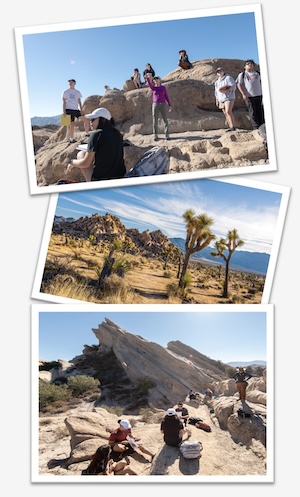
Open only to first-year students, Life on the Edge is a special program that consists of two connected courses that will give students the opportunity to explore environmental and geological issues with a special focus on southern California. Students will get to go on a two-day field trip to Anza-Borrego Desert State Park to get hands-on experience exploring the natural environment.
Student who participate in this 8-unit program will take both a First Year Seminar and one of Oxy's most in-demand science courses:
- FYS 1: Life on the Edge: How Geology Shapes Our Lives in Los Angeles and Environs (4 units)
- GEO 105: Earth Our Environment (4 units)
By participating in this program, you'll fulfill both your Fall FYS and also the Core Lab Science requirements.
FYS 1: Life on the Edge: How Geology Shapes Our Lives in Los Angeles and Environs
Prof. Ann Blythe and Prof. Nikki Seymour
Geologic and environmental issues shape everyday life in Southern California—right under your feet! This course invites you to connect science to society, classroom learning to real landscapes, and big ideas to your own life in California. Through integration with GEO 105, this FYS will build on key geologic concepts through lively discussions, thought-provoking readings, and three engaging writing assignments designed to sharpen your critical thinking. You will tackle big, timely questions: How prepared are we for earthquakes, especially the “Big One”? How has water scarcity shaped California’s growth and identity? Where does our energy come from—and what would it take to build a more sustainable future? We will experience in-class concepts first-hand with a two-day field trip to Anza-Borrego Desert State Park, an outstanding example of the region’s dramatic geology and desert environment.
Visit the course web page for more information!
Standard FYS Courses for Fall 2026
All of the seminars listed below earn 4 units.
FYS 2: Social Difference and the Politics of Technology
Prof. Brian Bartell
"Technology" is often thought of as being neutral and at its best providing solutions to problems without human bias. Despite this, contemporary developments in predictive policing and algorithmic racism, to give only two prominent examples, suggest that this is not the case. In Social Difference and the Politics of Technology we will discuss contemporary issues like AI, automation, and environmental technologies, and a longer history of technology dating to plantation slavery and European colonialism. The course will ask students to think about the ways that technological development has never been neutral and has always been connected to histories of race, gender, sexuality, and hierarchical conceptions of what it means to be human, as well as economics and labor, and ecological issues. In doing so we will look at a wide array of texts and media to examine these histories, to imagine worlds otherwise to them, and as a foundation for developing writing skills in order to ethically engage with technological change on an increasingly unequal and unstable planet.
FYS 3: Exploring Experimental Poetry
Prof. James Ford
While poetry often gets framed as a path for individual expression, poetry has proven especially effective for questioning the terms of cultural belonging, political agency, and collective memory. This seminar will examine poets from several different cultural traditions. Poetic form is constantly changing along with our rapidly changing world, in order to address the gaps and contradictions that narrative cannot always fill. For that reason, this course is interested in the centrality of experiment to poetic creation.
Close readings of poetry from Phillis Wheatley, Derek Walcott, Solmaz Shariff, Marlene Nourbese Philip, Philip Metres, and Kevin Young will provide test cases for improving our skills in writing thesis-driven and argumentative essays.
FYS 4: All That Glitters: Life, Literature, and Film in Los Angeles
Prof. Jackie Elam
Norman Mailer described Los Angeles as a “constellation of plastic.” John Fante called it a “sad flower in the sand.” Is Los Angeles really just “72 suburbs in search of a city,” as Dorothy Parker claimed, or is there something else brewing beneath the beautiful, sunny skies? We’ll explore (primarily through films and literary texts) 20 th and 21 st century Los Angeles as both a real and imagined location. Through the completion of three papers, a self-directed field trip and other activities, you’ll craft your own conceptual “map” of the place. Please note that some of the literary and film texts for this course may be disturbing. Contact the instructor if you have any questions.
FYS 5: Cultural Anthropology & Other/Realities
Prof. Alex Bolyanatz
This course is essentially an introductory course in cultural anthropology. Cultural anthropology emerged within the past two centuries as a means of coming to grips with the diversity of ways of being human. While cultural anthropology’s history has been tainted by collusion with racist and imperialist programs, it remains the single loudest academic voice on behalf of indigenous peoples around the world. In this course, we will look at a part of the world—New Ireland, Papua New Guinea—that is different, in many respects, from the WEIRD (Western, Educated, Industrialized, Rich, Democratic) societies from which most, if not all, of the students in this class come. We will discover that non-WEIRD societies have a logic to their ways of being and relating, and that sometimes, WEIRD ways of doing things are, well, weird. This is a 4-unit course. On average, you should expect to spend at least twelve (12) hours a week (including in-class time) on this course.
FYS 6: Why This; and What Else?: Social Criticism and the Literary Imagination
Prof. Devin Fromm
A foundational principle of the modern world is that, in large part, we make it for ourselves. This happens in a variety of ways that we usually consider within the confines of philosophy, politics, and law. But storytelling appears as an equally powerful force, with its unique ability to give complex insight on a given social moment, along with its persuasive ability to unsettle accepted norms and imagine radical alternatives. In this case, our seminar will look at a variety of ways in which narrative has emerged as a specific vehicle for social criticism, as it develops specialized techniques to challenge social arrangements and effectively imagine alternatives. This seminar will look closely at a variety of such efforts at criticism and reimagining, considering literary approaches to rationality, conflict, empathy, and perspective, and working through such diverse movements as romanticism, realism, modernism, and postmodernism.
FYS 7: Literature and Philosophy: The Dionysian in Modern Thought
Prof. Damian Stocking and Prof. Sydney Mitsunaga-Whitten
More than simply a "god of wine," Dionysus was for the Ancient Greeks a god of ecstatic self-abandon, of gushing fertility, of violent dismemberment and unexpected rebirth. In myth he was attended by raving Maenads and mischievous Satyrs; amongst humans he was worshiped with festive dances, communal shouts, ritual obscenities, and (perhaps most importantly) with poetry-with the literary genres of ode, comedy and tragedy that were invented specifically to honor him. What could be farther, we might ask, from the cool, reasonable practice of philosophy than this wild, uncanny, irrational god? And yet, as we shall see in this class, this reckless god of madness and poetry stands at the foundation of some of the most important ideas in modern philosophy-Hegel's phenomenology of spirit, Nietzsche's will to power, Heidegger's philosophy of Existenz, Bataille's notion of excess, and Derrida's "non-concept" of differance. Beginning with an exploration of Dionysian poetics in Ancient Greece, this course will attempt to show what thinkers like these found so inspiring in this ancient god, and what the writers and thinkers of our own time might yet find in him still.
FYS 8: German Film: Modernity and its Monsters
Prof. Alex Gardner
This course offers a survey of German film from the origins of cinema to the present day. We will focus on questions pertaining to how one can interpret or “read” a film, as well as the relation of German film to contemporaneous developments in art, literature and politics. How is the authoritarianism of the early 20th century depicted and/or confronted in film? What do horror films tell us about the anxieties and prejudices of the societies that produced and consumed them? Throughout the course, we will investigate the ways in which the dilemmas and aspirations of the modern world became legible in film, and ask to what extent film is a medium uniquely suited for depicting and attempting to understand modernity’s paradoxes.
FYS 9: Transnational Feminist Film
Prof. Viviana MacManus
This course uses a feminist lens to analyze transnational documentary and feature films. We will examine the politics of gender in films produced in the West and the Global South and we will assess the flows between "first world" and "third world" cinematic traditions. Students will gain the necessary skills to analyze representations of gender, race, class, nationality, and sexuality in transnational film. The course considers how film can be a powerful tool that operates in the perpetuation of "third" and "first world" hierarchies and the economic, racial, and gendered inequalities that stem from histories of colonization. We will also consider how film can offer a critique of these dominant ideologies and inequalities that reflects postcolonial relations between "first" and "third" worlds. We will turn to feminist film theory, documentary film theory, cultural studies and postcolonial feminist theory in order to facilitate our analysis and class discussions of these films.
FYS 10: White Privilege, White Grievance, Why We Don’t Talk About Class
Prof. Anita Zachary
Recent events such as the deployment of ICE in major cities and the deaths of two Americans protesting the federal government's actions, the flurry of executive orders, limiting rights, and the move to eliminate birthright citizenship highlight the ongoing conflict between race and class. Additionally, the ever-increasing efforts by local school districts to prohibit teaching America's history of systemic oppression and the growing political divide today can be understood by critical inquiry into the study of white identities. This seminar, through the lens of whiteness studies, will examine and analyze a series of texts, including essays, articles, digital media, and more, to consider how writers, artists, and public intellectuals ask difficult questions and present ideas to engage in critical conversation regarding these topics. The real work of this course is strengthening students' ability to analyze, evaluate, and produce arguments. Students will engage in essay writing, with an emphasis on constructing logical arguments and developing persuasive analysis, utilizing primary and secondary evidence to support ideas, in preparation for writing an academic research paper. Works from scholars such as David Roediger, Ashley Jardina, George Lipsitz, Peggy McIntosh, and numerous others will be examined.
FYS 11: Isn't It Romantic? Romance Novels as the People's Genre
Prof. Q. Ostendorf
While the term "romance novel" today often brings to mind tawdry love stories featuring heaving bosoms and uncontrollable passions, the genre of romance is much more complex than these stereotypes would make it seem. The modern romance novel not only celebrates love, but also questions gender, sexuality, family and friend relationships, and professional success. In this course we will explore the modern romance novel, asking what constitutes a romance novel and what the continuously popular genre can teach us about readers' desires and discontents.
FYS 12: Rescued Books Club: Novels from the New York Review of Books Classics Series
Prof. Ara Corbett
The New York Review of Books Classics series is dedicated to reviving literary works that have fallen out of print and into relative obscurity. This course is for students interested in exploring this series, with a focus on three of the great, lesser-known short novels of the 20th century: Jean Stafford’s The Mountain Lion (US, 1947), Natsume Soseki’s The Gate (Japan, 1910), and Barbara Pym’s The Sweet Dove Died (UK, 1978). In studying these distinctive works, students will develop their close reading skills, engage with literary scholarship, and write their own original, thesis-driven essays while strengthening and sharpening both their analytical prowess and prose style.
FYS 13: "The White Man’s Burden": Foreign Aid, Development and Neo-Imperialism
Prof. ShahBano Ijaz
This course will provide an overview of foreign aid as a key global fiscal flow and its role in the development of the global south. Beginning from the origins of foreign aid and its strategic use by donors during the Cold War, it will reflect on how foreign aid has been used for multiple objectives, from propping up autocratic regimes to furthering donors' goals of promoting democracy. The course will highlight some of the macroeconomic changes that are driven by aid's transnational nature, including the emergence of a large NGO economy in the global south. Students will also be familiarized with the domestic consequences of foreign aid: what does aid mean for different groups in recipient countries (politicians might engage in corruption; voters might engage in accountability) and what agency they have in ensuring the efficient use of aid money. Finally, it will inspire students to think of what the best uses of aid might be in a post-pandemic world where it continues to remain relevant (and, as evidenced by vaccination flows, useful in some ways). Throughout the course, students will be encouraged to question the ethics of foreign aid and the positionality of the ?white men? in determining who gets aid and how.
FYS 14: Debates in Sexuality
Prof. Caroline Heldman
This course introduces three theoretical perspectives on sexuality: biological, psychological, and social construction. With these perspectives in mind, we address pressing topics involving sex-prostitution/sex work, abortion, pornography, and sexual violence.
FYS 15: The Body in Words
Prof. Marta Llorente Bravo
How do we describe pain to healthcare professionals? What does it really mean to say that someone is "fighting" cancer? What discourses contribute to establishing normative bodily ideals and how do they influence our bodily experiences? These are some of the questions addressed in this course as we explore the relationship between the body and how we talk about the body. Exploring texts produced by or about people who experience (dis)abilities, ailments, cognitive decline, or chronic pain we will delve into debates of normalcy, ableism, and healthcare communication, we will focus on how we adhere values to the materiality of the body through its linguistics codifications.
FYS 16: Revolution
Prof. Marla Stone
This seminar traces the theory and practice of revolution in modern history. We start with the Scientific Revolution and the Enlightenment as the paradigm shifts which brought a revolution in thought and subjectivity in Europe. From there we focus on the French Revolution and political revolution, following its legacy and impact through the revolutions of the 19th century, the rise of Socialism and Communism, the Russian Revolution, decolonization, and the global revolts of 1968. The course looks closely at how these revolutions in thought and politics changed the way people understood their relationship to state and society. We will ask a number of questions, including: What causes revolutions? Who makes a revolution? What is the meaning of success or failure in a revolutionary situation?
Among other questions, this course poses: How do revolutions speak to each other, both across time in the same national setting, or across national contexts? What does the act of revolt or rebellion tell us about power in a given historical moment? Finally, how does studying historical moments of transition or rupture help us understand contemporary culture and politics?
FYS 17: Latinidad and Pop Culture: Media, Power, and Representation
Prof. Cristina Awadalla
This course explores Latinx popular culture as both a site of creative expression and a battleground for power and representation. Through music, television, film, art, fashion, and digital platforms, we’ll examine how Latinx communities in the U.S. have navigated, resisted, and redefined dominant narratives about race, gender, class, and nation. Drawing on frameworks from Chicana feminism, queer theory, Afro-Latinx critique, and cultural studies, we’ll interrogate questions of visibility, voice, and authenticity.
FYS 18: City Scenes: Urban Cultural Studies
Prof. Raul Villa
This seminar will study the relationship between urban experience and creative expression in cities like London, Paris, New York, Berlin and Los Angeles during the 19th and 20th century. To do this, we’ll consider how major metropolitan environments have been the thematic subject of artistic reflection, or the generative site of artistic production. The primary intellectual activity in class discussion and in written assignments will be the interpretation of selected works of art in the genres of literature, photography, painting, film and music. If appropriate opportunities present themselves, we may also engage in some creative and documentary exploration of Los Angeles.
FYS 19: Chaos: Just How Predictable is Our Universe?
Prof. Janet Scheel
In this seminar, we will learn how the mathematics of chaos helps us to better understand science, economics, psychology, and our environment.
FYS 20: Understanding Society through Soccer
Prof. John Lang
Beginning in England over 150 years ago, association football, commonly known as soccer in the United States, has evolved from a working-class tradition to a multi-billion dollar global industry. Argentina's World Cup final victory over France in 2022 had a global audience of roughly 1.5 billion people, making it a far larger event than the 2022 NFL Super Bowl's audience of roughly 115 million. Passion for the game connects fans in the legendary arenas of Wembley Stadium (England), Estadio Azteca (Mexico), and Maracana Stadium (Brazil) among others, to the suburban fields of the United States, and makeshift pitches across the globe. Given its ubiquity, with possibilities to watch the game on television 24/7, not to mention on the small screen of everyone's smartphone, one wonders, how can soccer be used as a prism for learning about society?
FYS 21: Refuse, Reduce, Repair, Repurpose, Recycle: How do we do more with less to reclaim our planet?
Prof. Bevin Ashenmiler
Do you love a good thrift store, or pick up free stuff from the side of the road? This class will introduce students to the theoretical and practical challenges related to reuse systems and the circular economy. Using Occidental College as our starting point we will start by collaborating with Touchdown Thrift, the Office of Sustainability, and other campus groups, then expanding outward to learn from the broader Los Angeles community. Students will consider how solid waste recycling, from textiles and plastics to electronics, are changing, which emerging technologies hold promise, and how are current policies holding us back? This class will include several off campus field trips.
FYS 22: Artificial Intimacy: AI Companionship on Screen and in Everyday Life
Prof. Allison de Fren
Friendship, love, sex, therapy, mentorship, collaboration: these are just some of the relationships once reserved for other humans that are increasingly being demanded of AI systems. The question of what happens when we replace human relationships with machines isn’t new—the Romantic writer E.T.A. Hoffmann was worrying about it in 1816—but it has never felt more timely. In this course, we will explore AI companionship as both a science fiction fantasy—in films such as Her, Ex Machina, and After Yang—and as a growing feature of everyday life, from chatbots and virtual assistants to humanoid robots. In addition to film, we will engage short stories, critical essays, and experimental interactions with different generative AI systems while discussing a broad range of issues, from the social and psychological to the political and environmental.
This is also a course about you, right now, as a first-year student at a particular moment in the history of thinking and writing. GenAI is reshaping how people read, analyze, and produce work in the classroom. We will address this head on as you complete a series of short papers over the course of the semester, while cultivating habits of mind for navigating a world in which the line between human and artificial keeps shifting.
FYS Grade Mode
All FYS courses are graded on an Satisfactory/Unsatisfactory (or S/U) basis. Grades of S/U do not factor into a student’s term or overall GPA and students will receive a grade of S if their work is considered to be of passing quality as defined by the course syllabus. This is intended to encourage students to focus on gaining knowledge and skills required to meet college-level critical thinking and writing expectations. The grade mode emphasizes the growth represented by students’ work throughout the course.